


Business Metrics
Defining and Describing Business Metrics
_Business metrics are quantifiable measures used by startups and scaling teams to track performance across financial, operational, customer, and marketing dimensions, enabling founders to make data-driven decisions on growth, efficiency, and pivots.[1]
In innovation consulting, the term applies when advising founders on selecting metrics that align with strategic objectives—like optimizing customer acquisition cost (CAC) during product-market fit searches or monitoring churn to validate retention hypotheses—rather than generic reporting. It doesn't cover ad-hoc measurements without clear formulas or governance, nor vanity metrics that fail to drive action. Consultants prioritize these because they reveal market dynamics, inform founder decisions on resource allocation, and signal when to iterate on technology adoption or organizational changes.[1][2]
Disambiguation
Primary sense — the innovation-consulting sense
Quantifiable measures tracking specific business performance aspects, from revenue to customer retention, to guide data-driven strategy in startups and growth-stage companies.[1]
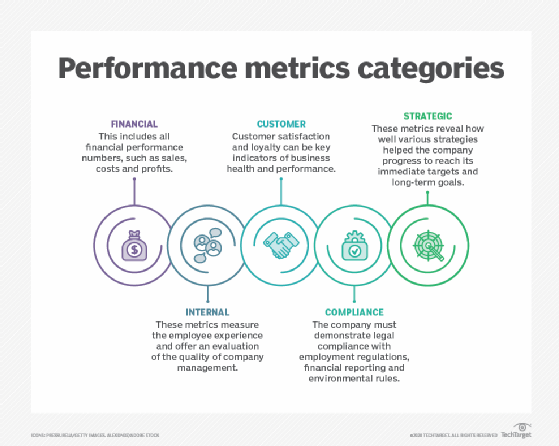
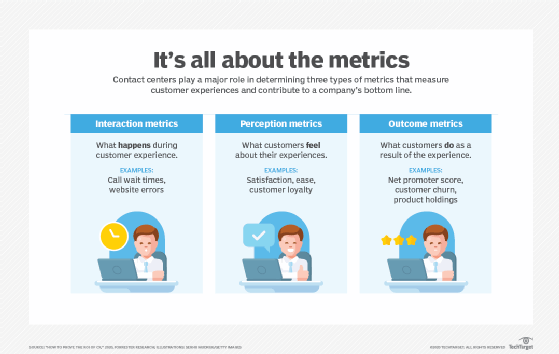
- Encompasses financial (e.g., ROI, profit margins), marketing (e.g., CAC, CLV), operational (e.g., cycle time), and customer metrics (e.g., NPS, churn rate), selected to align with objectives like scaling or efficiency.[1]
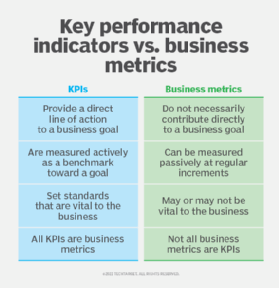
- Differs from KPIs, which are "critical" metrics tied directly to strategic goals; all KPIs are metrics, but not vice versa.[1][5]
- In practice, requires "metric definitions" specifying formulas, data sources, and governance for consistent use across teams.[2]
- Not mere raw data points (e.g., total visits) without context or benchmarks; boundary cases like unbenchmarked counts are "measures," not actionable metrics.[5]
Other senses
1. Metric Definition (governance-focused)
The formal specification of a metric's calculation, data sources, frequency, and interpretation rules to ensure organizational consistency.[2]
- Includes elements like formula, ownership, and alignment to strategy; essential for enterprise performance systems.[2]
- Used in consulting to audit metric reliability before tying to founder dashboards or VC reporting.[2]
- Relevant to innovation when preventing "garbage in, garbage out" in high-stakes decisions like funding rounds.
2. Compensation-linked Metrics
Core financial and operational metrics (e.g., revenue, CAC, ROI) explicitly tied to pay strategy and workforce costs in business planning.[3]
- Links comp decisions to outcomes like gross margin or time-to-productivity, framing tradeoffs for execs.[3]
- In startups, helps founders model "labor cost % of revenue" during hiring surges.[3]
- Ties to innovation via aligning incentives with growth bets, like revenue-linked bonuses.
- Also used in generic HR or stats to mean any "success metric" or raw "measure"; not relevant to innovation contexts unless strategically aligned.[4][5]
Adjacent Vocabulary
- Synonyms:
- KPIs: Critical subset of metrics tied to goals; more action-oriented than broad metrics.[1]
- Performance indicators: Overlaps heavily, but often implies operational focus.[6]
- Measures: Rawer data points without full definition or benchmarks.[5]
- Antonyms:
- Vanity metrics: Superficial numbers (e.g., raw signups) that don't correlate to business health.
- Qualitative insights: Non-numerical observations like user feedback.
- Adjacent terms: Customer Acquisition Cost, Churn Rate, Net Promoter Score, Product Market Fit, Growth Hacking, OKRs.
Usage in Practice
- "Financial metrics provide insights into a company’s overall financial health and profitability," used by founders to benchmark against peers during seed rounds.[1]
- "Customer acquisition cost (CAC): The average cost of acquiring a new customer, including marketing and sales expenses," a staple in Y Combinator advice for validating unit economics.[1]
- "Sales comp, onboarding investments, and role structure drive CAC variability," as noted in compensation strategy for scaling sales teams.[3]
- "Metrics measure business processes. They're standardized and clearly named, so you can compare them across teams and time periods," from product management playbooks for cross-functional alignment.[5]
- "Add a KPI to every comp recommendation. Even one sentence that ties comp to retention rate or cost per hire can reframe the entire conversation," practical VC-style guidance for founders.[3]
- "Churn Rate: The rate at which customers stop using a product or service over a given period," key for SaaS founders iterating on retention loops.[1]
Common Misuses
- Treating all data points as metrics: Raw website traffic without conversion context is a "measure," not a metric; use "leading indicator" instead.[1][5]
- Equating metrics with KPIs: Tracking dozens of metrics without goal alignment creates overload; prioritize "KPIs" for strategic focus.[1]
- Ignoring governance: Undefined calculations lead to inconsistent reporting; specify a full "metric definition" first.[2]
- Vanity applications: Total users without cohort analysis misleads growth stories; switch to "cohort retention" or "LTV ratio."[1]
Images
Sources
[1]: Metrics in Business: Key Insights & Strategies for Success - Tempo.io
[2]: What is Metric Definition? - Hyperbots
[3]: Business metrics that matter — and how they relate to compensation
[4]: 7 Types of Metrics To Measure Business Success | Indeed.com
[5]: KPI vs Metric vs Measure: What They Mean and How They Work | Klipfolio
[6]: What are metrics. A guide for product managers - GoPractice
[7]: KPIs vs Metrics: Key Differences & Examples (2025) - Datapad
[8]: Business Metrics - Definition, Classification, and Examples