


Product Market Fit
Defining and Describing Product-Market Fit
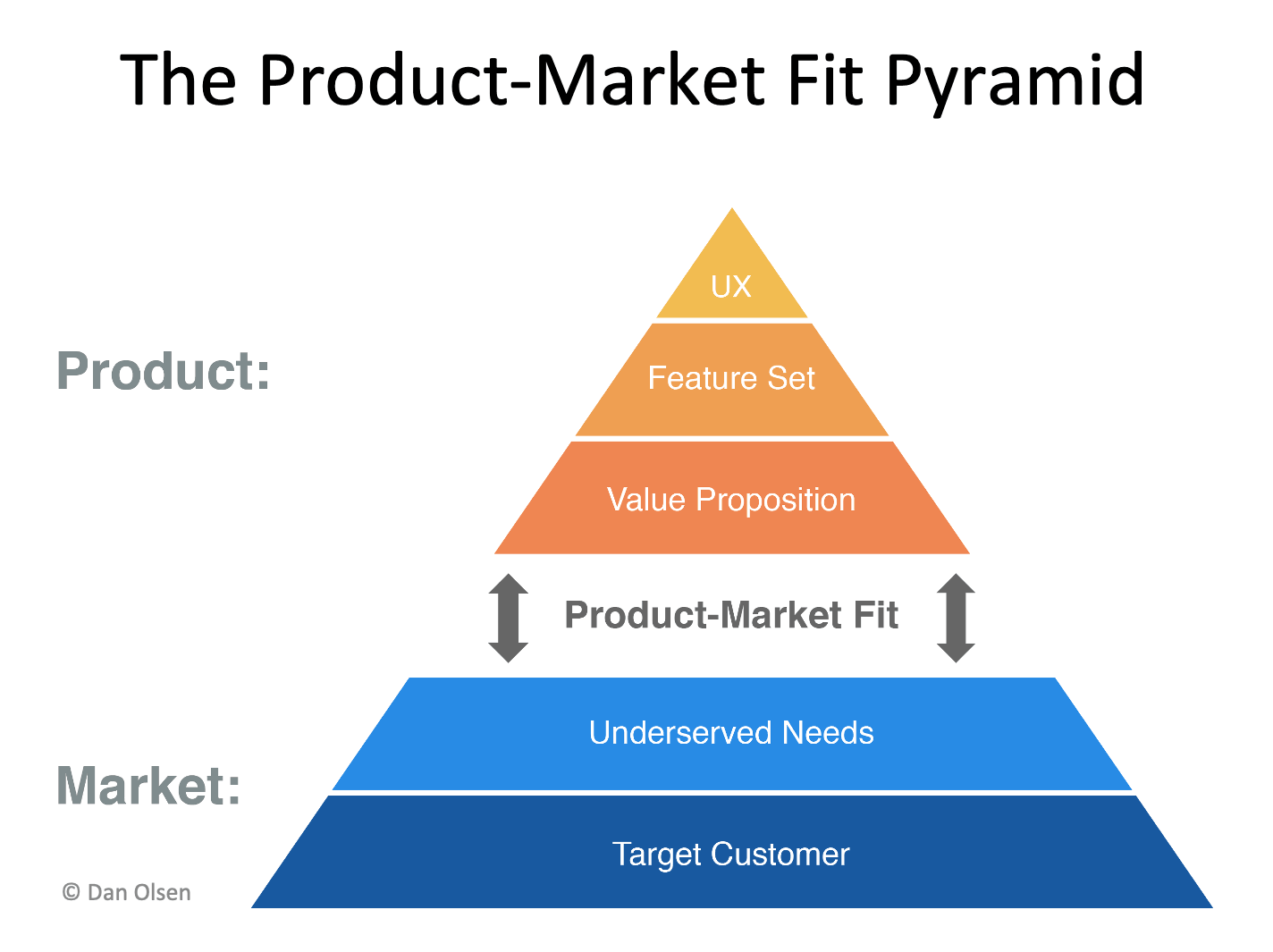
Product-market fit is achieved when customer demand so clearly outpaces your ability to supply that the market itself becomes your growth engine.
Product-market fit (PMF) is "the stage where a product successfully satisfies a strong market demand."
[hki8w3]
It occurs when target customers not only buy and use the product, but also promote it organically, driving sustainable growth and profitability.
[hki8w3]
The concept represents a fundamental inflection point for startups and established businesses alike: the transition from uncertain product problem hypothesis to Validated Learning market reality. PMF signals that a business has found genuine product-market alignment—that the gap between what customers need and what the product delivers has closed meaningfully enough to sustain organic adoption, retention, and word-of-mouth growth.
The condition is not a permanent state but rather a dynamic equilibrium that requires continuous attention. As one analyst notes, "the market's pull is often stronger than the product's elegance. In a market with real urgency and enough buyers, customers will tolerate rough edges. In a weak market, even a great product can struggle to escape gravity."
[s4lsim]
Uses in Context
- Startup validation metrics: Investors and founders use PMF as the primary evidence that a startup has solved a real problem and has proof of sustainable demand—"the strongest indicator of a startup's potential to grow and scale." [8i8aqd]
- Growth strategy pivot point: Organizations recognize PMF as the moment to shift from product experimentation to scaling delivery and marketing efficiency, moving from "push" to "pull" dynamics. [s4lsim]
- Risk assessment: PMF serves as a de-risking milestone; the absence of product-market fit accounts for approximately 42% of startup failures, [u49zjn] making it a critical diagnostic for resource allocation.
- Market positioning language: Teams invoke PMF to describe a product that has become "an essential solution for your target audience. It's a need, not just a 'nice to have.'" [8i8aqd]
- Customer relationship quality: PMF frameworks emphasize "strengthening your customer-product relationship" through deep user research into psychology and behavior, distinguishing successful products from mediocre ones. [a7fymn]
- Investor communication: Founders highlight PMF to signal product-market alignment and earning potential, communicating that "customers are willing to pay and often willing to pay more than expected." [urn6bs]
History of Use
Origins
Venture capitalist Marc Andreessen coined the term "product-market fit."
[hki8w3]
[urn6bs]
[8i8aqd]
Andreessen's formulation defines PMF as "finding a good market with a product capable of satisfying that market."
[hki8w3]
The term emerged within venture capital and startup discourse as a conceptual tool to distinguish between products with genuine market traction and those that remained solutions in search of a problem. Andreessen's framing emphasized the primacy of market demand over product elegance—a counterintuitive insight that reoriented how founders and investors thought about the relationship between product development and market validation.
Evolution
- Early 2010s — Operationalization through lean frameworks: The Lean Product Playbook and similar methodologies translated PMF from concept into a testable, iterative framework with concrete steps: identifying target customers, defining unmet needs, crafting value propositions, building MVPs, testing with real users, and iterating based on feedback. [hki8w3] This shift made PMF measurable and actionable for practitioners.
- Mid-2010s — Multi-dimensional expansion: Growth expert Brian Balfour expanded the concept beyond the single PMF milestone, breaking it into a more complex framework of four essential fits that startups must achieve to scale: "Market-Product Fit, Product Channel Fit , Channel Model Fit , and Model Market Fit ." [urn6bs] This evolution acknowledged that PMF alone was insufficient; successful scaling required alignment across multiple dimensions.
- 2020s — Diagnostic sophistication: Practition ers developed more granular assessment tools, including the Sean Ellis Test (emotional attachment) and behavioral metrics (churn rates, conversion data, retention patterns), moving beyond binary yes/no PMF determinations to "Strong PMF" and "Extreme PMF" classifications. [s4lsim] [u49zjn] This phase recognized PMF as a spectrum rather than a threshold.
Best Real-World Examples
- DuckDuckGo — DuckDuckGo Demonstrated PMF among privacy-conscious users by offering a search alternative that respected user privacy; organic adoption and word-of-mouth growth validated the product's market fit despite competition from entrenched incumbents.
Case Studies
Slack: From Internal Tool to Scaled Network
Slack's path to product-market fit illustrates the power of solving a real problem for a specific user group and then scaling beyond that initial context. Founded in 2009 by Stewart Butterfield and his team, Slack initially served as an internal communication tool for the company.
[urn6bs]
The team recognized that traditional communication methods (email, meetings, fragmented chat tools) created friction and information silos. When they opened Slack to external users, they discovered immediate and intense demand: users not only adopted the product but actively promoted it to colleagues and other organizations. By 2013, Slack had achieved clear product-market fit, evidenced by "high customer retention and low churn rates" and "organic growth, with word-of-mouth driving new users."
[urn6bs]
The company's ability to scale was unconstrained by marketing; demand was so strong that "customers were willing to pay and often willing to pay more than expected."
[urn6bs]
Slack's trajectory demonstrates that PMF becomes most evident when a solution so clearly eliminates friction in a well-defined workflow that users cannot imagine returning to the previous state.
Figma: Design Collaboration as a Category Creator
Figma achieved product-market fit by identifying and solving an urgent, underserved need in the design workflow—real-time collaborative design. Launched in 2016 as a browser-based design tool, Figma offered something radical: designers could work simultaneously on the same file without local installations or file-syncing delays. The product appealed to a specific segment (product design teams) facing acute pain with legacy tools ( Adobe Creative Suite & Cloud 's single-user constraint, version-control chaos, the friction of handoff workflows).
[a7fymn]
Within a few years, Figma demonstrated unmistakable PMF signals: high retention, word-of-mouth adoption among design teams, and expansion into adjacent workflows (prototyping, specs, handoff). By 2020–2022, Figma's market fit was so strong that it could command premium pricing and still grow organically; teams adopted it not because they were sold on it but because it became the category standard, organic pull replacing push.
[s4lsim]
Figma's case illustrates that PMF is strongest when the product doesn't just solve a problem—it redefines how practitioners think about an entire class of work.
Stripe: API-First PMF Among Developer Builders
Stripe reached product-market fit by recognizing that online payment infrastructure was unnecessarily complex for developers and startups. Founded in 2010 by Patrick Collison and John Collison , Stripe offered a radically simplified approach: an elegant API, clear documentation, and a streamlined onboarding process that contrasted sharply with legacy payment processors.
[s4lsim]
Stripe's core insight was that in "a market with real urgency and enough buyers, customers will tolerate rough edges"—but conversely, developers building Payment Systems had intense urgency and were willing to adopt a newer, less-proven solution if the developer experience was dramatically superior.
[s4lsim]
Stripe achieved PMF among startups and small businesses first, then scaled to enterprises as the product matured. The company's growth was pulled by user demand rather than pushed by sales teams; developers recommended Stripe to peers, and organic adoption became the primary acquisition channel. Stripe's PMF demonstrates that "making something the market needs"
[s4lsim]
is more powerful than perfecting the feature set—developer satisfaction and word of mouth proved more valuable than mature integrations or brand recognition.