


The Existing Market Trap
The Existing Market Trap

The Existing Market Trap is a short, punchy go-to-market playbook from the Play Bigger crew on why great products die when you let incumbents’ categories define your story and strategy.
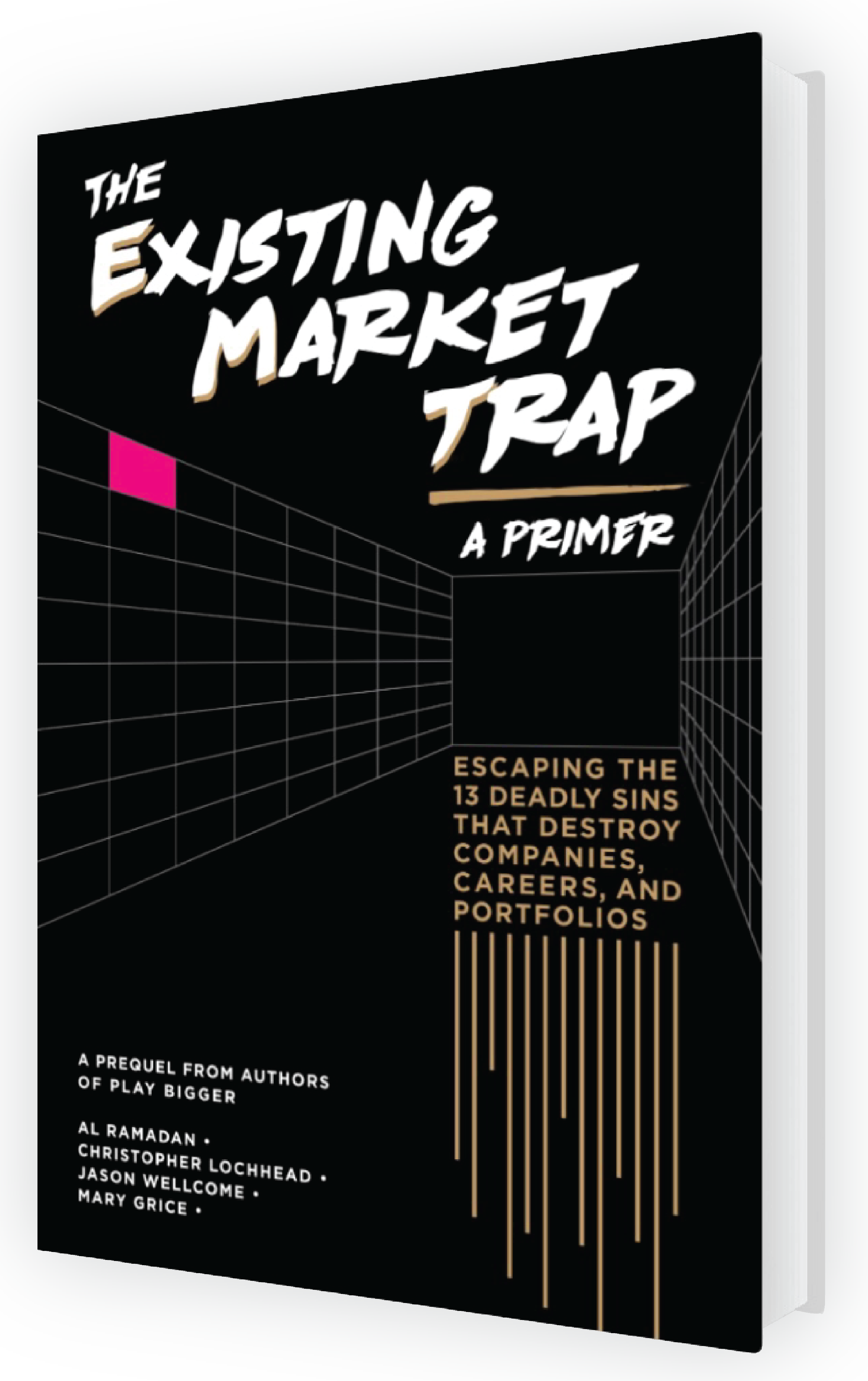
This source is a book titled “The Existing Market Trap: (a Primer) Escaping The 13 Deadly Sins That Hold New Categories Hostage”, published by Play Bigger Press.
[fdqo7k]
[0p387a]
It is written by category design firm Play Bigger (with Al Ramadan and colleagues as the core creators behind the concept) and released via Play Bigger Press in 2025.
[fdqo7k]
[nf76ov]
Innovation consultants return to it because it gives a concrete, named pattern for how startups get stuck “fighting for traction inside categories they didn’t create,” with specific GTM mistakes and fixes.
[nf76ov]
[fdqo7k]
Type and Format
- Format details:
- Where it lives:
- Google Books — canonical listing for “The Existing Market Trap: (a Primer) Escaping The 13 Deadly Sins That Hold New Categories Hostage.” [fdqo7k]
The People Behind It
- Play Bigger previously authored the book “Play Bigger: How Pirates, Dreamers, and Innovators Create and Dominate Markets,” which argues that legendary companies proactively design and dominate new categories rather than competing inside existing ones. [k050hd]
- Al Ramadan and the Play Bigger team define the Existing Market Trap as the situation where companies are “trapped in the wrong market—fighting for traction inside categories they didn’t create,” which they frame as a systemic GTM and strategy failure rather than a product problem. [nf76ov]
- Christopher Lochhead extends the same idea on his podcast, arguing that in the AI era, value comes from “creating entirely new categories that didn’t exist before” rather than chasing crowded existing markets. [k050hd]
Catalog of Notable Works
Since this is a book, this section focuses on its key arguments and related canonical artifacts that elaborate the Existing Market Trap.
- Definition of the Existing Market Trap — Play Bigger’s EMT explainer states that “most companies are trapped in the wrong market—fighting for traction inside categories they didn’t create,” and that this “Existing Market Trap (EMT)” is the deeper cause behind stalled growth, confused messaging, and fading belief. [nf76ov]
- Product vs. category distinction — In EMT-related talks, Play Bigger and Al Ramadan stress that “most startups never win - not because their product is bad, but because they’re competing in someone else’s market,” reinforcing the book’s central theme that category design is distinct from product design. [kb01vb]
Because detailed chapter lists and internal headings are not available in public previews, individual chapter titles cannot be reliably listed; the public positioning focuses instead on the 13 Deadly Sins and the EMT concept as the organizing spine.
[fdqo7k]
[0p387a]
Why It Matters to Innovators
- For founders and product leaders, it sharpens the distinction between “great product, wrong market frame” vs. true product–market misfit, which is critical when deciding whether to pivot the Positioning Theory or the Product Strategy. [nf76ov] [kb01vb]
- It strengthens the broader innovation mental model that breakthrough outcomes often require creating a new category rather than incrementally improving within an existing one, aligning with sources on Category Design and disruptive strategy. [nf76ov] [k050hd]
Best Starting Points
- Play Bigger EMT Landing Page — The clearest, short-form definition of the Existing Market Trap, why “most companies are trapped in the wrong market,” and the symptoms (slowed growth, confused messaging, fading belief). [nf76ov]
- — A highly accessible talk where Al Ramadan explains why “most startups never win… because they’re competing in someone else’s market,” ideal for founders new to category design. [kb01vb]
- The Existing Market Trap with Al Ramadan (podcast episode) — A conversational deep dive into EMT nuances and founder war stories, giving texture beyond the written primer. [ptf29i]
- Out Of The Existing Market Trap with Christopher Lochhead — Applies EMT thinking specifically to the AI gold rush, arguing that legends win by creating entirely new categories rather than chasing existing AI markets. [k050hd]
Adjacent Sources
- Play Bigger — The earlier Play Bigger book on category design from the same creators, providing the broader strategy frame EMT sits within. [k050hd]
- Category Design — The core discipline that EMT assumes: designing, naming, and owning a new category rather than inheriting an old one. [nf76ov] [k050hd]
- Zero to One — Peter Thiel’s argument for creating “zero to one” breakthroughs instead of competing in crowded markets, a complementary lens on escaping existing categories.
- Crossing the Chasm — Geoffrey Moore’s work on technology adoption and category transitions, useful for understanding how to scale once you’ve escaped the Existing Market Trap.
- Positioning — EMT is fundamentally about avoiding being positioned inside the wrong mental category, making this a natural conceptual neighbor.