


Play Bigger
Play Bigger
Play Bigger is a category-design playbook that argues companies win big not by building better products, but by creating and dominating entirely new market categories.
Play Bigger is a business strategy book by Al Ramadan, Dave Peterson, Christopher Lochhead, and Kevin Maney, first published in 2016 by HarperBusiness. It popularizes the idea of “category design”—the deliberate process of defining and owning a new market space rather than competing within existing ones. The authors blend case studies of companies like Salesforce, Uber, and Airbnb with a data-backed analysis of how “category kings” capture outsized market value. Innovation consultants come back to it because it offers a concrete toolkit and vocabulary for turning a product or company into the default in a new category, not just a better option in an old one.
Type and Format
- Type: This source is a book.
- Format details
- Publisher: HarperBusiness, an imprint of HarperCollins.
- Year of first publication: 2016.
- Length: The hardcover edition is listed at 272 pages.
- Notable editions: Available in hardcover, Kindle/e‑book, and audiobook formats.
- Where it lives:
The People Behind It
Play Bigger has four co-authors; three are category-design practitioners and one is a business/tech journalist.
- Al Ramadan
- Co-founder and partner at Play Bigger, a category design advisory firm.
- Previously a senior executive at Macromedia and Adobe, including senior vice president roles in marketing and operations.
- Works with technology companies on category design and go-to-market strategy.
- Dave Peterson
- Co-founder and partner at Play Bigger.
- Background as a chief marketing officer and brand strategist for technology companies, focusing on positioning and narratives.
- Co-developed the category design methodology used in the book and in client work.
- Christopher Lochhead
- Co-founder and partner at Play Bigger and a former three-time Silicon Valley CMO.
- Hosts the business podcast “Follow Your Different” and is known as a “category design” evangelist.
- Advises founders and executives on category creation and marketing strategy.
- Kevin Maney
- A longtime technology and business journalist who has written for outlets such as USA Today and Newsweek.
- Author/co-author of multiple business books, including The Two-Second Advantage and Unscaled.
- Brings research and narrative structure to the book’s case studies and data analysis.
Catalog of Notable Works
As a book, the “catalog” is its internal structure—the key chapters and arguments that define its category-design playbook.
- “The Category King Playbook” — Introduces the idea that in most markets, a single “category king” captures a disproportionate share of market value and sets the rules for everyone else.
- “Why Category Kings Win” — Uses market cap and IPO data to show that companies that define categories significantly outperform those that merely compete within existing ones.
- “Category Design: The Missing Discipline” — Argues that alongside product design and company design, category design is a distinct discipline innovators must deliberately practice.
- “The Magic Triangle: Product, Company, Category” — Presents the core framework that category kings align product, company, and category narrative to reinforce each other.
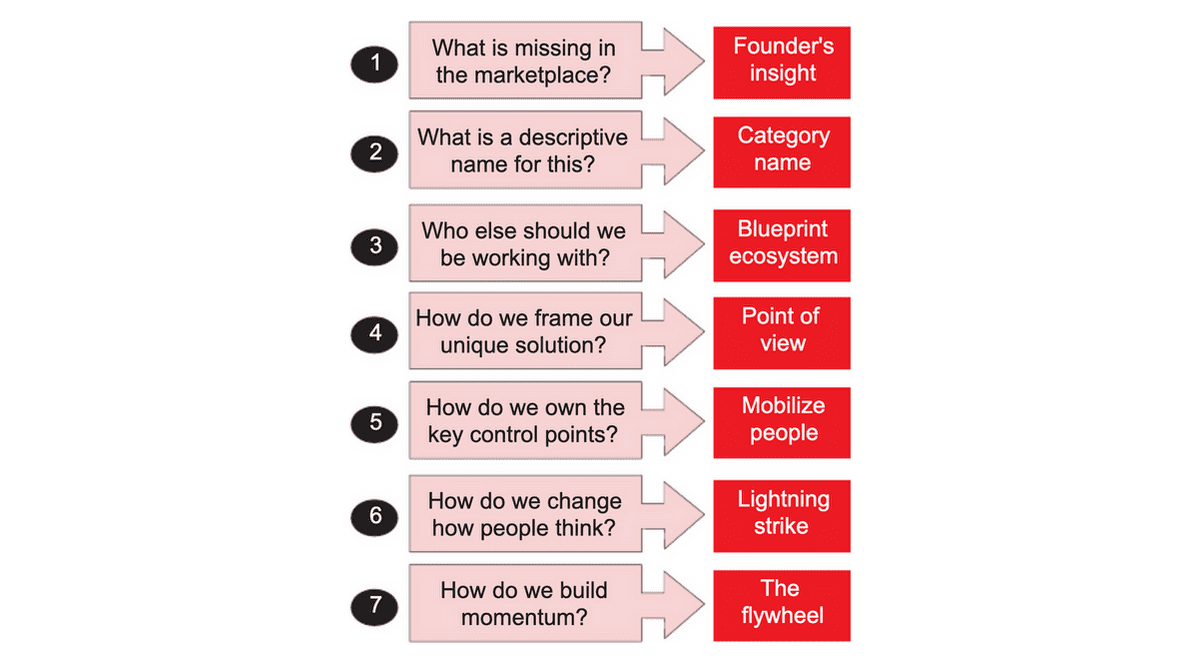
- “Lightning Strikes” — Describes orchestrated, high-impact narrative moments that reframe how the world sees a problem and cement a company as the category standard.
- “Declare a Point of View” — Explains how a compelling point of view (POV) on the problem and future is the narrative engine for category creation, shaping perception more than features.
- “Measure, Model, and Map Your Category” — Outlines how to define category boundaries, model its potential, and track its evolution over time as part of a deliberate strategy.
Why It Matters to Innovators
- Shifts focus from competing to category creation. Play Bigger reframes growth strategy from winning market share in a defined space to defining the space itself, giving innovators a language and process for becoming category kings rather than feature competitors. This is directly relevant to Category Design and Blue Ocean Strategy.
- Introduces the “category king” power-law lens. The book shows empirically that in many tech and digital markets, one company captures the majority of the market cap and profits, which explains why incremental improvements rarely lead to outsized outcomes. This lens is crucial when deciding whether to pursue a Winner Takes Most Markets.
- Provides the “Magic Triangle” as a design framework. The idea that innovators must align product design, company design, and category design gives a concrete checklist for founders beyond building an MVP: how messaging, org design, and ecosystem stance must support the category narrative. This complements Minimum Viable Product and Positioning Theory.
- Operationalizes narrative as strategy (“Point of View” + “Lightning Strikes”). By treating a bold POV and orchestrated narrative events as core to category design, the book turns storytelling from a marketing afterthought into a strategic tool for reframing the problem space. This supports work on Narrative Strategy and Thought Leadership.
- Offers a playbook for timing and sequencing category moves. The discussion of category lifecycle, measurement, and timing of “lightning strikes” helps innovators think about when to go big on awareness, when to educate the market, and when to monetize, rather than rushing all at once.
Best Starting Points
- Google Books: — The most accessible way to skim the table of contents, sample chapters, and reviews to gauge the core thesis and structure.
- Play Bigger — Book overview page — Offers the high-level summary of category design, the authors’ bios, and context on how the ideas translate into consulting practice.
- “The Magic Triangle” chapter (in the book) — A practical entry point for founders and PMs, because it ties the abstract idea of category design directly to product and company decisions.
- “Lightning Strikes” chapter (in the book) — Best to understand how to convert a point of view into market-defining moments that reframe how customers and media see your space.
Adjacent Sources
- Blue Ocean Strategy — Another foundational work on creating uncontested market space, complementary to category design.
- Crossing the Chasm — Focuses on technology adoption and go-to-market for new categories; pairs well with the category king lens.
- Zero to One — Peter Thiel’s argument for creating monopolies by doing “what no one else can do,” philosophically aligned with category creation.
- Unscaled — Another Kevin Maney book on how technology lets businesses serve niches at scale; extends some implications of category and platform thinking.
- Follow Your Different Podcast — Christopher Lochhead’s podcast, which often revisits category design and interviews founders who’ve built category-defining companies.
Sources
[1]: Real-Time Customer Profile Overview | Adobe Experience Platform
[2]:
[3]: The wealthy don't chase bigger paychecks, they build better entities.
[4]: Impact Players: How to Take the Lead, Play Bigger and Multiply ...
[5]: Guidelines for representing your business on Google
[6]: Could we be part of a larger, unknowable entity? - Facebook
[7]: Do You Have a Named Entity Strategy for Marketing Your Web Site?
[8]: Parallel meta-blocking for scaling entity resolution over big ...