


Usage-Based Pricing
AI Explains
The strategy you're calling
"Spigot Pricing"
is commonly known in business and economics as
"Loss Leader Pricing," "Freemium,"
or
Usage-Based Pricing
(depending on its specific implementation). These strategies share the core idea of pricing products or services at a low cost—or even free—to attract a large user base, with the expectation that users will increase their usage or upgrade over time, thereby driving up
Average Revenue Per User (ARPU)
.
Let’s dive deeper into this strategy and its mainstream terminology.
Mainstream Names for This Strategy
- Definition: A pricing strategy where a basic version of a product or service is offered for free, but users must pay for premium features, advanced capabilities, or higher usage limits.
- Examples:
- Spotify offers free streaming with ads but charges for ad-free premium accounts.
- Dropbox provides free storage but charges for more capacity or team collaboration features.
- Usage-Based Pricing (Pay-As-You-Go)
- Definition: A pricing model where customers pay based on how much they use the service. The initial price per unit or tier is low to encourage adoption, but costs rise as usage increases.
- Examples:
- AWS (Amazon Web Services) charges based on compute hours, storage, or bandwidth, making it affordable for small users but expensive for heavy users.
- Utility companies (e.g., electricity providers) charge a small base fee but increase costs for higher levels of consumption.
- Loss Leader Pricing
- Definition: A strategy where a product or service is sold at a loss (or at a very low price) to attract customers, with the goal of making money on complementary or incremental purchases.
- Examples:
- Video game consoles (like PlayStation or Xbox) are sold at a loss, but companies make money from game sales and subscription services.
- Printers are priced affordably, but ink cartridges drive up revenue over time.
- Land-and-Expand Strategy
- Definition: A business strategy where companies "land" customers with a low-cost or free offering, then "expand" revenue by increasing usage or selling more features over time.
- Examples:
- SaaS companies like Slack or Zoom often start with a free or low-cost plan for small teams but monetize larger teams or enterprise features.
- Salesforce offers basic CRM tools, upselling advanced analytics and integrations as organizations grow.
How "Spigot Pricing" Works
The essence of this strategy is creating a low barrier to entry that encourages widespread adoption, followed by mechanisms to increase spending as users’ needs grow. Here’s how it typically unfolds:
- Attraction Through Low Initial Costs:
- Offering a low-cost (or free) entry point ensures a large number of users adopt the service quickly. This builds market share and brand loyalty.
- Encouraging Heavy Usage:
- The product or service is intentionally designed to incentivize more usage. For example:
- A cloud storage service may offer 5 GB for free, knowing that users will likely exceed this limit and pay for more storage.
- A streaming service may offer a free trial to hook users with their content library.
- Revenue Expansion Through Upselling and Scaling:
- As customers scale their usage, they naturally pay more. Some companies also upsell premium features, higher service tiers, or additional add-ons.
- ARPU Growth Over Time:
- Heavy users become the primary contributors to revenue. While many users may stay on the free or low-cost tier, the most engaged customers drive up ARPU.
Examples of Spigot Pricing in Action
- Spotify (Freemium Model)
- Free users listen to ads but can upgrade to premium plans for unlimited, ad-free music streaming.
- Revenue grows as free users convert to paid plans and as existing users explore family or higher-tier plans.
- AWS and Cloud Computing (Usage-Based Pricing)
- Startups may begin with minimal usage, but as their businesses scale, their cloud service needs (e.g., storage, computation) increase, driving up costs.
- Mobile Apps and Games (Freemium)
- Free-to-play games like Fortnite or Candy Crush generate revenue through in-app purchases for virtual goods or additional content, especially from heavy players.
- Telecommunication Plans (Tiered Pricing)
- Internet providers offer low-cost plans with limited data but charge significantly for overages or higher-tier packages.
Why Companies Use "Spigot Pricing"
- Market Penetration:
- Low-cost or free offerings attract a large customer base, making it easier to dominate the market and outcompete rivals.
- Behavioral Economics:
- Once users are onboarded and use the product heavily, they’re more likely to upgrade or pay for additional features because of increased reliance on the service (psychological "sunk cost").
- Scalability:
- Companies can start with low-cost users but scale revenue as those users grow or consume more of the service.
- Network Effects:
- A large user base enhances the value of the service for all users, attracting even more customers (e.g., social networks like LinkedIn).
Risks and Challenges of "Spigot Pricing"
- Over-Reliance on Heavy Users:
- A significant portion of revenue may come from a small subset of users, making the company vulnerable to churn.
- Sustainability Concerns:
- Offering free or low-cost tiers can be expensive if customers don’t upgrade or scale usage quickly enough to offset costs.
- Customer Backlash:
- Incremental pricing increases (e.g., exceeding usage limits) can lead to dissatisfaction if perceived as unfair or opaque.
- Competition:
- A free or low-cost model is easy for competitors to replicate, leading to price wars.
Conclusion
"Spigot Pricing" (or its more mainstream counterparts like Freemium, Usage-Based Pricing, or Loss Leader Pricing) is a highly effective strategy in industries where user growth and scalability are key. By offering a low-cost entry point and monetizing increased usage over time, companies can maximize ARPU while fostering a loyal and engaged user base. However, success depends on careful execution, ensuring that the transition from low-cost to high-revenue usage feels seamless and fair to customers.
Defining and Describing Usage-Based Pricing
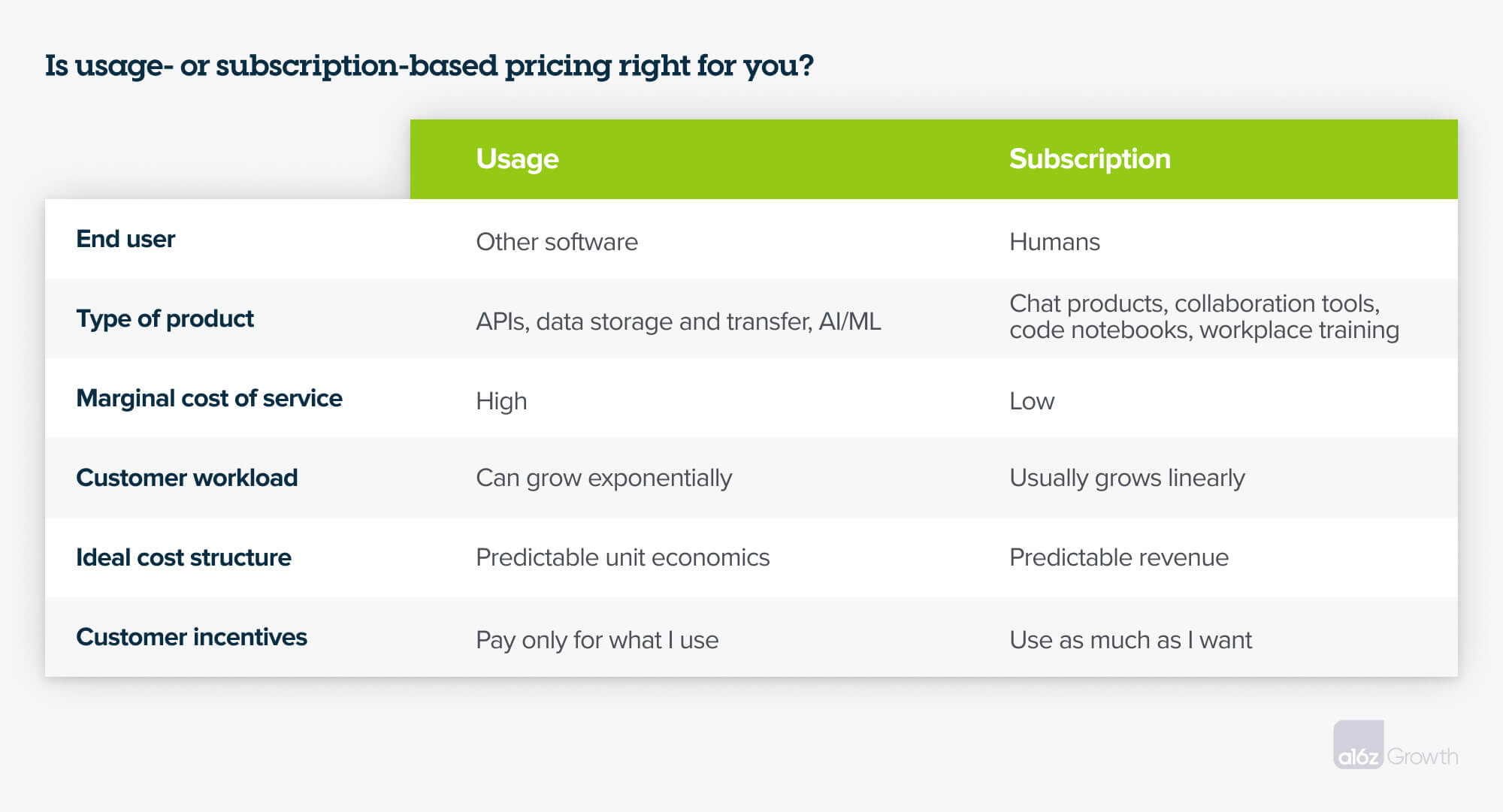
Usage-based pricing is a revenue model where customers pay based on how much they actually use a product or service, rather than a fixed recurring fee, so costs scale with consumption and value received.
[nsb2t6]
[2l205y]
[080v9w]
For innovation work, this term applies primarily to cloud, SaaS, API, AI, and other digital products where usage can be precisely metered (e.g., API calls, GB stored, messages sent, compute minutes).
[nsb2t6]
[2l205y]
[080v9w]
[isc7xw]
It does not meaningfully apply where usage is hard to measure or marginal cost is nearly zero and undifferentiated (e.g., a downloadable PDF or a simple offline tool), where simpler flat or seat-based pricing is more practical.
[nsb2t6]
[2l205y]
Innovation consultants care because shifting to usage-based pricing changes unit economics, customer acquisition, product telemetry, and go-to-market motion, and is increasingly the default for modern SaaS and AI infrastructure — 74% of software suppliers delivering via cloud or embedded deployments report using usage-based models, with over half expecting such revenue to grow further.
[080v9w]
Disambiguation
Primary sense — the innovation-consulting sense
Usage-based pricing (primary sense): a commercial model where a company charges customers in proportion to measured consumption of a defined value metric (e.g., API calls, credits, transactions, GB), instead of (or in addition to) fixed subscriptions or seats.
[nsb2t6]
[2l205y]
[080v9w]
[isc7xw]
- Common usage in SaaS, cloud, and AI: Stripe describes usage-based pricing for SaaS as customers paying “based on what they consume rather than a flat fee for access,” citing Twilio (per message), Snowflake (per credit), and AI APIs (per token) as canonical examples. [080v9w]
- Boundary cases:
Other senses
- Also used interchangeably with “consumption-based pricing” or “pay-as-you-go pricing” in SaaS and cloud contexts; in practice these are usually treated as the same concept, with minor stylistic differences in emphasis (e.g., “consumption-based” in finance/IT spend discussions, “pay-as-you-go” in customer messaging). [2l205y] [91g62k] [h6w4lo] All remain squarely within the innovation/business-model sense and are not separate senses for consulting purposes.
Etymology and Origin
- The phrase “usage-based pricing” emerges as a natural English compound rather than a trademarked coinage, but the model rose to prominence with the growth of telecoms, utilities, and later cloud infrastructure (e.g., per-minute calls, per-kWh electricity, per-GB cloud storage). [2l205y] [080v9w] [0qsurq]
- In SaaS-specific discourse, the term “consumption-based/usage-based pricing” was popularized by cloud-era and API-first companies and their investors, as founders sought to align software monetization with actual usage and value delivered. [2l205y] [080v9w] [isc7xw] [91g62k] Stripe’s and Zuora’s guides both frame it as a distinct, modern SaaS strategy as cloud delivery became dominant. [080v9w] [0qsurq]
Adjacent Vocabulary
- Synonyms
- Event-based pricing – focuses on charging per discrete event (e.g., transaction, message, workflow run), typical in payments, communications, and automation tools. [isc7xw]
- Antonyms
- Adjacent terms
- Value Based Pricing – setting price based on perceived value; usage-based pricing operationalizes this via a measurable value metric. [2l205y] [080v9w]
- Pricing Power – the ability to raise prices or grow ARPU; usage-based models can enhance this as customers grow usage. [2l205y] [isc7xw]
- Unit Economics – per-unit revenue and cost; critical when choosing and tuning a usage metric. [080v9w] [isc7xw]
- Business Model – usage-based pricing is a structural element of recurring revenue models in SaaS/AI.
- Product Led Growth – usage-based models often pair with PLG, as low-friction trials lead into usage expansion. [2l205y] [isc7xw]
- Monetization Strategy – usage-based pricing is one of the core strategies for monetizing APIs, AI features, and infrastructure. [080v9w] [isc7xw]
Usage in Practice
- Stigg defines the model as: “Usage-based pricing charges customers based on how much they use a product or service. The more they use, the more they pay. The less they use, the less they pay,” framing it as a way to “tie the bill directly to consumption.” [nsb2t6]
- A SaaS pricing guide notes: “At its core, Usage-Based Pricing (UBP)… is a model where customers are charged based on their consumption of a service rather than a flat fee,” contrasting it with fixed-rate subscriptions or per-user seats and highlighting that the “unit of value” can be API calls, data stored, or transactions. [2l205y]
- Stripe writes that usage-based SaaS pricing means customers “pay based on what they consume rather than a flat fee for access,” and gives examples: “Twilio, which charges per message sent; Snowflake, which charges per credit; and many artificial intelligence (AI)… APIs, which charge per token.” [080v9w]
- Vayu describes the appeal for SaaS founders: “Usage-based pricing charges customers for how they actually use your product, aligning cost with value… Whether it’s API calls, storage capacity, or transactions, revenue is tied directly to activity… When usage grows, revenue scales naturally.” [isc7xw]
- Zuora’s guide frames it as: “a strategy where customers are charged and billed based on how much of a service or product they use,” and emphasizes implementation concerns like metering, rating, and invoice presentation as foundational capabilities. [0qsurq]
- Salesforce explains usage-based billing to sales leaders as a model where customers are charged “based on actual consumption — credits, transactions, or data — rather than fixed licenses,” stressing flexibility and alignment of cost with delivered value. [g5i4b3]
- Metronome similarly positions usage-based billing as charging “based on actual product or service usage,” and centers the operational need to measure customer activity and convert it automatically into charges each billing cycle. [m6ief5]
Common Misuses
- Using “usage-based” for one-time implementation or setup fees.Better term: project-based or one-time professional-services pricing. These fees are linked to effort/time, not ongoing product consumption.
- Describing internal metering without a corresponding commercial model as usage-based pricing.Better term: metered billing infrastructure. Vayu explicitly distinguishes “metered billing” (technical measurement and charging) from “usage-based pricing” as the overarching commercial model built on that data. [isc7xw]