



software-development/developer-experience/devops/ansible
(2025-10-03T03:10.284Z)
Perplexity Query
(2025-10-03T03:10
.284Z)
Question:
Write a comprehensive one-page article about "Ansible".
Model: sonar-pro
Ansible is an Free and Open Source Software IT automation platform developed by Red Hat that enables organizations to automate processes such as provisioning, configuration management, application deployment, and orchestration.
[96shet]
[xxp6e5]
By streamlining repetitive IT tasks and reducing manual intervention, Ansible plays a crucial role in improving operational efficiency, minimizing errors, and supporting modern DevOps practices.
[96shet]
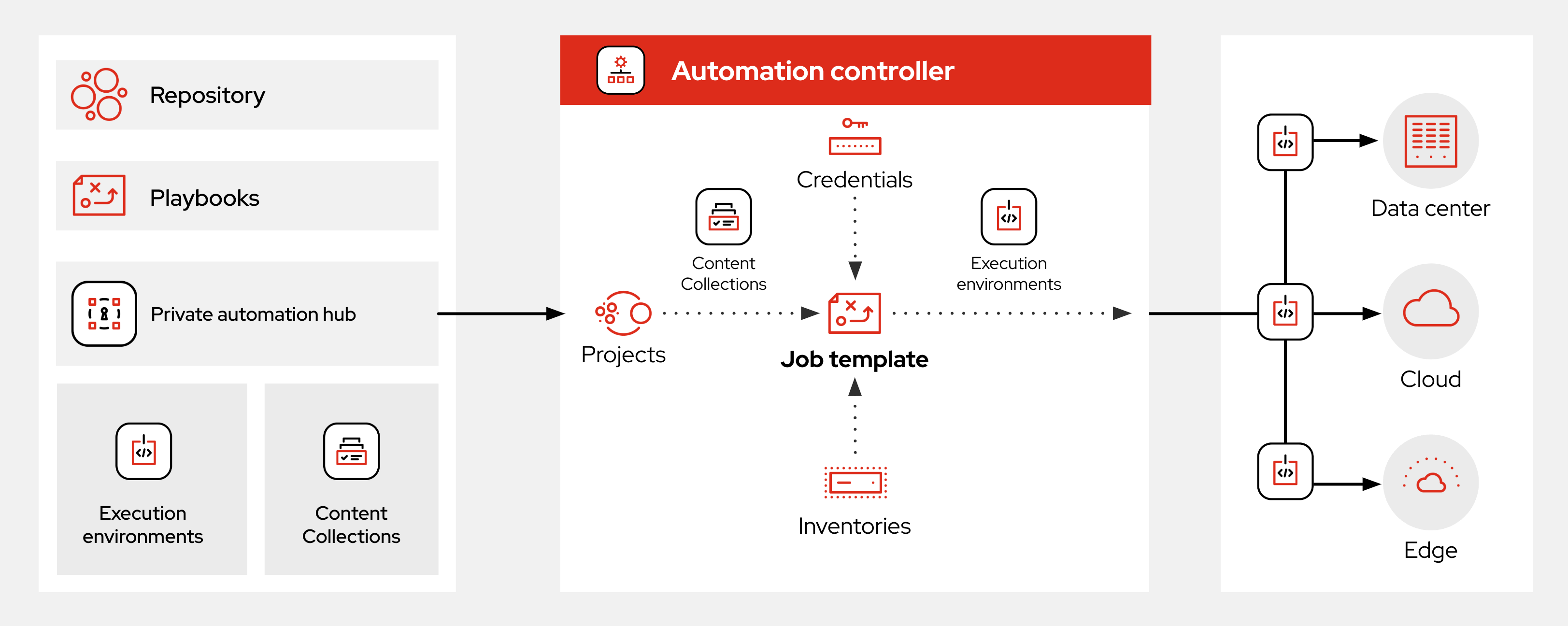
At its core, Ansible provides a simple and agentless framework for automation.
[96shet]
Users write human-readable playbooks in YAML syntax, specifying desired system states or task sequences. Ansible connects to managed nodes (such as physical servers, virtual machines, or cloud instances) through Secure Shell (SSH) or other protocols, then executes small programs called “modules” directly on those nodes without requiring additional software agents.
[96shet]
[4elmcy]
The platform’s architecture distinguishes between the control node, where automation is initiated, and managed nodes, where changes are applied.
[96shet]
A practical example is server provisioning and configuration: using Ansible playbooks, an IT administrator can automatically install prerequisites, configure network settings, and deploy applications across hundreds of servers in minutes. Ansible is also used for cloud deployments, such as spinning up virtual machines on AWS or Azure with predefined security settings, or orchestrating microservices deployments in hybrid- and multi-cloud environments.
[4elmcy]
[xxp6e5]
Another common use case involves automating network device configurations or continuous integration and deployment pipelines in software development.
[4elmcy]
Key benefits of Ansible include its agentless approach, which eliminates the need to manage additional software agents on each node; ease of use due to its straightforward YAML syntax and low learning curve; and extensibility, as Ansible supports a wide range of modules and integration with various IT and cloud platforms.
[4elmcy]
[xxp6e5]
Organizations can establish “infrastructure as code” practices, making IT infrastructure versionable, reproducible, and auditable.
[4elmcy]
However, Ansible’s reliance on SSH and Python can present challenges in highly heterogeneous environments or where special network permissions are required. Large-scale automation can also require careful design to avoid bottlenecks at the control node.
[96shet]

Ansible’s current adoption is strong, particularly in enterprises embracing DevOps, hybrid cloud, and digital transformation initiatives. As part of the Red Hat Ansible Automation Platform, it offers enterprise features like the Automation Controller (formerly AWX/Tower) for role-based access control, auditing, and centralized management.
[c00chc]
[xxp6e5]
The Automation Mesh component enables broad-scale and geographically distributed automation.
[96shet]
Key players providing Ansible solutions include Red Hat, network equipment vendors (e.g., Cisco, Juniper), and major cloud providers (AWS, Azure, Google Cloud) through native modules and integrations.
[xxp6e5]
Recent developments in Ansible focus on scalability and content sharing, with features like the Automation Hub (for certified content collections) and containerized execution environments.
[96shet]
The community-driven ecosystem keeps growing, contributing new modules for an ever-expanding range of technologies and platforms.
[xxp6e5]

Looking ahead, Ansible’s future is intertwined with the broader evolution of IT automation and orchestration. As organizations move toward fully automated, self-healing infrastructures and complex multi-cloud deployments, Ansible will likely expand its integration capabilities, adopt more AI-driven insights for automation optimization, and further simplify cross-domain workflows.
Ansible remains a cornerstone of modern IT management and DevOps, enabling organizations to automate with confidence. Its evolution will continue to shape how digital enterprises scale and secure their operations in the years to come.
Citations
[96shet] 2025, Oct 03. What is the Ansible IT automation platform? – TechTarget Definition. Published: 2023-03-15 | Updated: 2025-10-03
[c00chc] 2025, Sep 01. 1. Overview — Automation Controller User Guide v4.0.0. Published: 2021-07-15 | Updated: 2025-09-01
[4elmcy] 2025, Oct 02. What Is the Red Hat Ansible Automation Platform? - WWT. Published: 2022-03-10 | Updated: 2025-10-02
[xxp6e5] 2025, Oct 02. Red Hat Ansible Automation Platform. Published: 2025-06-02 | Updated: 2025-10-02
[6]: 2025, Jul 17. Introduction to RedHat Ansible Automation Platform. Published: 2024-04-28 | Updated: 2025-07-17
[7]: 2025, Oct 02. Ansible vs. Ansible Tower (Automation Controller) Explained. Published: 2025-06-06 | Updated: 2025-10-02
[8]: 2025, Sep 07. Red Hat Ansible Automation Platform on Azure. Published: 2024-06-11 | Updated: 2025-09-07
[9]: 2025, Sep 08. . Published: 2023-07-12 | Updated: 2025-09-08