


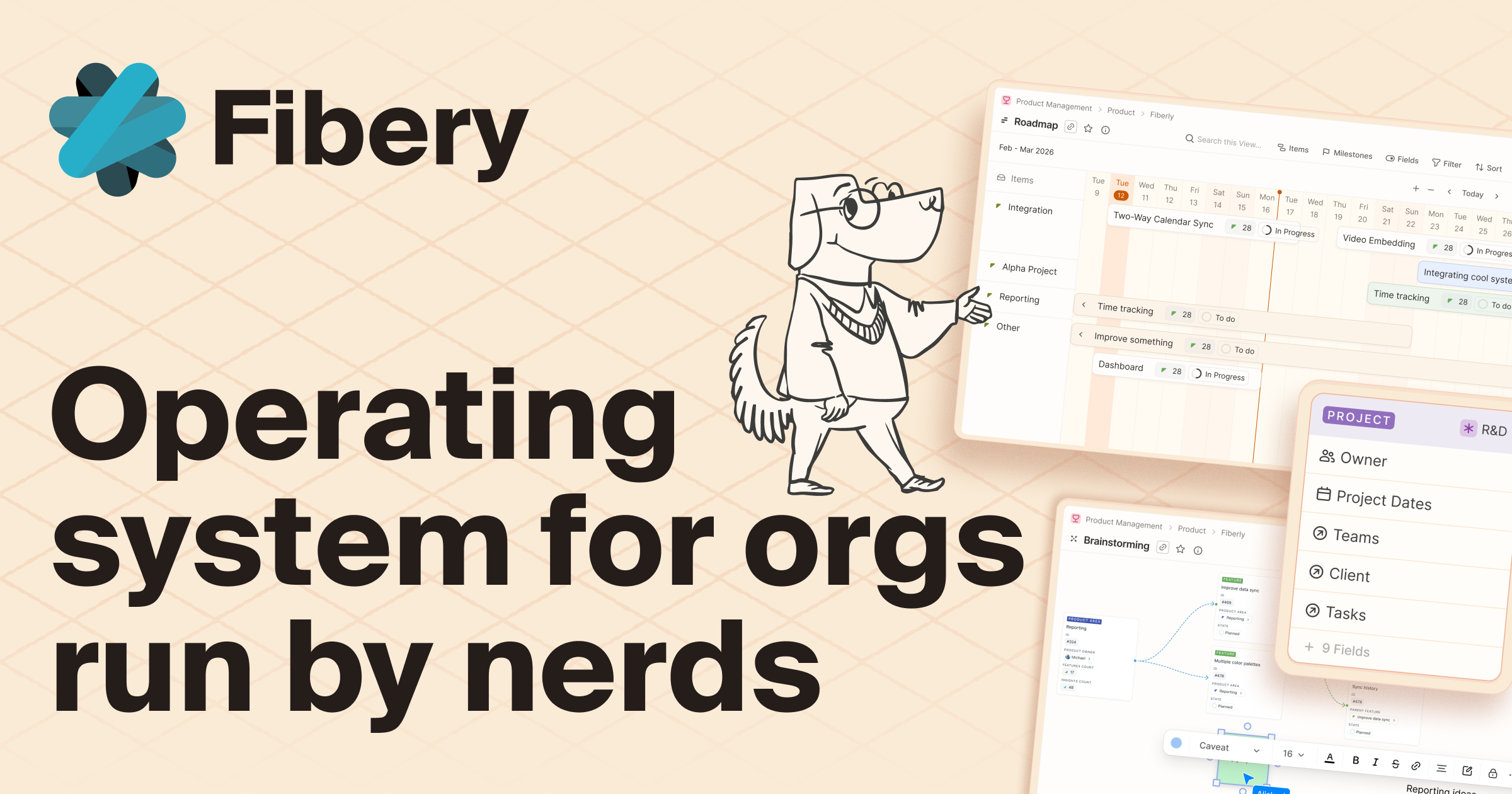

productivity/fibery
similar to Appflowy
similar to n8n
Value Proposition & Features
Fibery is a no-code work and knowledge management platform that replaces scattered tools by combining databases, tasks, documents, and whiteboards in a single connected workspace.
[xlg109]
[c9wwrr]
It targets product-centric companies and startups that need a flexible, relational workspace that can be tailored without coding.
[xlg109]
[c9wwrr]
Core product features (2–3 sentences each):
- No-code relational workspace & databasesFibery lets teams build a tailored company workspace using connected databases, custom types, fields, and relations, all configured via a no-code interface. [xlg109] It is designed to model complex product, project, and knowledge structures in one place instead of relying on separate tools or rigid templates. [xlg109]
- Customizable views & multiple entity viewsUsers can visualize data through customizable views (lists, boards, tables, timelines, etc.) and create Multiple Entity Views so the same entity can be inspected and edited in different layouts for different workflows. [v4731u] [xlg109] Several entity views can be pinned to enable fast switching between use-case‑specific perspectives on the same underlying data. [v4731u]
- Reports & analyticsFibery provides powerful reports to analyze data across one or more databases, treating each entity as an independent data point for charts and metrics. [410t3n] [xlg109] Reports support aggregations, filters, and annotations to clarify ranges or highlight thresholds when there is no built‑in axis locking. [410t3n]
- Automations & integrationsThe platform includes automations and integrations so teams can connect Fibery to other systems and automate repetitive workflows across their workspace. [xlg109] Relations between databases can be auto‑linked based on matching fields, reducing manual maintenance of relationships. [7p72ku]
- Docs, whiteboards, and collaborationFibery combines structured data with docs & whiteboards, enabling teams to document context, brainstorm, and visualize ideas alongside tasks and databases. [xlg109] This supports a single collaborative environment where product work, knowledge, and planning artifacts live together. [xlg109]
- Fibery AI AgentThe built‑in Fibery AI Agent can query workspace data, answer questions, generate reports, and even modify workspace structure, acting as an assistant over the customer’s own Fibery data. [mgymf9] It is included in every plan with a monthly quota of AI queries depending on the pricing tier. [mgymf9]
Priority feature list:
- Docs & whiteboards integrated with structured data [xlg109]
- Fibery AI Agent for querying and modifying workspace data [mgymf9]
- Flexible entity creation options (web, integrations, etc.) [rcz6gb]
- Collaboration for product development companies and startups [c9wwrr]
Market Sizing
Category, Market Size, and Category Growth
Fibery positions itself within the all‑in‑one work management / no‑code work platform category, combining elements of project management, Knowledge Management, and database‑centric no‑code tooling.
[xlg109]
[c9wwrr]
While analyst reports on this exact niche under the Fibery name were not found, it overlaps with broader markets such as work management and no‑code application platforms, which are widely reported as large and growing; however, no specific quantified market‑size or growth figures directly tied to Fibery’s category could be sourced from analyst firms or financial journalism, so none are reported here.
Competitive Landscape
Who it’s for, who it’s not for
Fibery is aimed at product development companies and startups from roughly 10 to 500 people, with the majority of current reviewers representing small businesses, indicating a focus on growing teams that need an integrated workspace rather than very small solo use.
[c9wwrr]
It is especially suited to organizations that benefit from flexible, relational data modeling and want to consolidate product management, project tracking, and documentation into one customizable platform.
[xlg109]
[c9wwrr]
It is less likely to be ideal for individuals or very small teams that do not need complex data relationships, or for large enterprises that require strictly standardized, heavily regulated solutions with extensive public certifications and long‑standing enterprise references, for which no clear public evidence was found.
Viable Alternatives
- Notion – All‑in‑one workspace combining docs, databases, and tasks, often used as a flexible alternative for knowledge management and light project tracking in similar use cases as Fibery.
- Airtable – No‑code relational database and collaboration tool that competes on flexible schema design and views, overlapping with Fibery’s database‑centric workspace modeling.
- ClickUp – Work management platform focused on tasks, projects, and docs, positioned as a “one app to replace them all,” similar in ambition to Fibery’s all‑in‑one proposition.
- Monday.com – Work OS combining boards, workflows, and automations for teams managing projects and operations, often evaluated alongside no‑code work platforms like Fibery.
- Coda – Document‑centric platform that merges docs and structured tables with automations, competing in the same “tool to replace many tools” space.
Competitor Table
| Competitor | Description |
| Notion | All‑in‑one workspace blending documents, databases, and task management for teams and individuals. |
| Airtable | No‑code relational database and collaboration platform with spreadsheet‑like UI and multiple view types. |
| ClickUp | Work management platform for tasks, projects, docs, and goals marketed as a single replacement for many productivity tools. |
| Monday.com | Work OS that lets teams build custom boards and workflows for project, product, and operations management. |
| Coda | Doc‑centric platform that combines rich documents, tables, and automations to build custom tools inside documents. |