



productivity/advanced-documents/appflowy
Value Proposition & Features
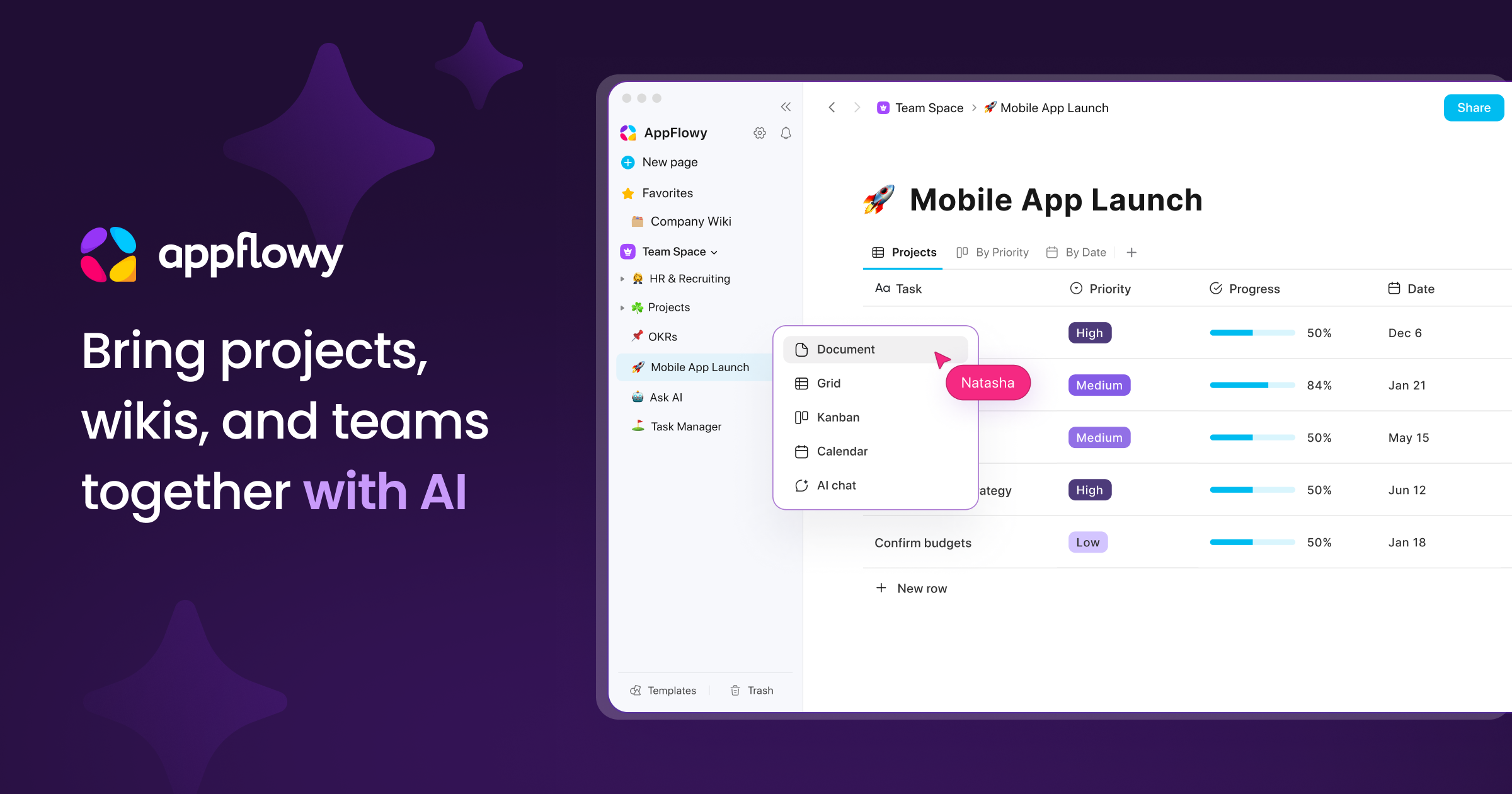
AppFlowy is an open‑source, AI‑powered collaborative workspace for notes, wikis, projects, and databases that markets itself as a privacy‑first, local‑first alternative to Notion, giving users “more without losing control of your data.”
[qo1yb7]
[69jry5]
[xc4vrp]
It emphasizes data ownership and flexibility, allowing local use, self‑hosting, or optional cloud sync, with the entire codebase available on GitHub under an open‑source license.
[gn094n]
[69jry5]
[xc4vrp]
Core product features (2–3 sentences each):
- Workspaces: pages, docs, and wikisAppFlowy provides block‑based pages and wikis with slash commands, drag‑and‑drop blocks, and multiple views for organizing information, similar to Notion’s core experience. [gn094n] [69jry5] [xc4vrp] Users can structure personal notes, team knowledge bases, and project docs in one workspace.
- Databases with multiple viewsIt includes databases supporting board, calendar, and gallery views, enabling lightweight project and task management. [gn094n] [69jry5] [xc4vrp] Grid databases also support grouping and filtering, though some advanced capabilities like linked databases are still under development. [gn094n]
- AI assistanceAppFlowy adds basic AI assistance inside the workspace to help with content generation and summarization. [gn094n] [69jry5] Marketing copy and app store descriptions highlight it as an “AI collaborative workspace,” though its AI depth is intentionally lighter than fully enterprise AI suites. [qo1yb7] [gn094n] [69jry5]
- Local‑first, offline‑first architectureBy default, AppFlowy runs locally on users’ machines, storing data on‑device so that “everything runs on your own machine” without cloud dependency, with full offline functionality. [gn094n] Cloud sync is optional and can be disabled in favor of self‑hosting to maximize privacy and data control. [gn094n] [69jry5] [xc4vrp]
- Self‑hosting and deployment optionsThe platform can be self‑hosted via Docker, and hosting providers like Hostinger advertise one‑click deployment of AppFlowy as a “privacy‑focused Notion alternative with full data control.” [69jry5] This enables organizations to keep all workspace data on infrastructure they control.
Priority feature list:
- Docker/VPS deployment options via third‑party hosts [69jry5]
Product Roadmap / Announcements
As of June 6, 2026,
- 2026‑Q1 – Cloud database improvements – GitHub issue discussions on “Group by Date” behavior in self‑hosted AppFlowy Cloud indicate continued work on database grouping and grid‑view UX. [m0z27o]
(No public, consolidated product roadmap or announcement blog was found on the official site; most change tracking appears via GitHub issues and releases.)
Recent Developments (last 90 days)
- 2026‑04–2026‑06 – Search and AI summary refinement – A GitHub issue filed against version 0.11.8 reports Linux search not finding all pages “that the AI summary is referencing,” highlighting active work on core search and AI summary integration. [r87mvh]
- 2026‑04–2026‑06 – Self‑hosted cloud grid view fixes – Another recent issue documents rows hidden when using “Group by” on a date property in Grid View on self‑hosted AppFlowy Cloud, showing ongoing improvements to database/grouping behavior. [m0z27o]
History and Origin Story
AppFlowy was launched as an open‑source, local‑first alternative to Notion, positioning itself for users who want Notion‑like UX but with full data control and self‑hosting options.
[gn094n]
[69jry5]
[xc4vrp]
Public materials emphasize its design choice to be open source, privacy‑first, and built with Flutter and Rust, but do not prominently detail individual founders or a narrative origin story on the official site or GitHub.
[gn094n]
[xc4vrp]
Market Sizing
Category, Market Size, and Category Growth
AppFlowy fits into the categories of collaborative work management, knowledge management / wikis, and productivity/notes apps, specifically as an open‑source Notion alternative.
[gn094n]
[69jry5]
[xc4vrp]
Analyst firms and financial press often group such tools into the broader collaborative productivity and work management software market, a multibillion‑dollar segment that has grown rapidly with players like Notion, Confluence, and Airtable, but no specific market‑size figure mentioning AppFlowy was found in authoritative sources.
Pricing
AppFlowy’s core local desktop app is completely free, with no limits on pages or blocks.
[gn094n]
For cloud collaboration, a free cloud plan provides up to 2 members and 5 GB of storage, while the Pro plan costs $10 per user per month on annual billing, offering more members and unlimited cloud storage.
[gn094n]
[xc4vrp]
| Tier | Price | Key limits / features |
| Local app | Free | Runs locally, no page/block limits. [gn094n] |
| Cloud Free | Free | Up to 2 members, 5 GB cloud storage. [gn094n] [xc4vrp] |
| Cloud Pro | $10/user/month (annual) | More members, unlimited cloud storage. [gn094n] |
Revenue Trajectory Estimates
No reliable public estimates or disclosures of AppFlowy’s revenue or ARR were found.
Competitive Landscape
Who it’s for, who it’s not for
AppFlowy is best suited for individuals, students, developers, and small teams who value privacy, offline access, local‑first performance, and the ability to self‑host or inspect open‑source code.
[gn094n]
[69jry5]
[xc4vrp]
It also appeals to cost‑sensitive users looking for a free or low‑cost alternative to commercial knowledge‑management platforms while retaining core Notion‑like functionality.
[gn094n]
[xc4vrp]
It is less ideal for large enterprises or teams that require advanced database features (e.g., linked databases), hundreds of integrations, granular permissions, in‑depth analytics, and mature real‑time collaboration at scale, where more established SaaS platforms like Notion currently have an advantage.
[gn094n]
Users who prioritize a rich integration ecosystem and deeply featured AI automation over local‑first control may also find AppFlowy’s capabilities more limited.
[gn094n]
[xc4vrp]
Viable Alternatives
- Obsidian – Local‑first markdown knowledge base with strong privacy and extensibility via community plugins, used by many as a personal knowledge management alternative to cloud‑centric tools. [xc4vrp]
- Tana / Logseq / similar PKM tools – Other structured note‑taking and graph‑based tools that focus on knowledge management and local‑first workflows for power users. [xc4vrp]
- Self‑hosted wiki / project tools (e.g., Outline, Wiki.js) – For organizations that primarily need self‑hosted wikis and documentation rather than an all‑in‑one workspace. [xc4vrp]
Competitor Table
markdown
| Competitor                           | Description                                                                 |
|--------------------------------------|-----------------------------------------------------------------------------|
| [Notion](https://www.notion.so)      | Cloud‑first all‑in‑one workspace with advanced databases, AI, and integrations. [^gn094n] [^xc4vrp] |
| [Obsidian](https://obsidian.md)      | Local‑first markdown‑based knowledge base focused on personal note‑taking and PKM. [^xc4vrp] |
| [Logseq](https://logseq.com)         | Open‑source, local‑first outliner and graph notebook for structured notes and tasks. [^xc4vrp] |
| [Outline](https://www.getoutline.com)| Team wiki and knowledge base with self‑hosting options for documentation.   |
| [Wiki.js](https://wiki.js.org)       | Open‑source, self‑hosted wiki platform for teams needing document management. |