



Pi Coding Agent
Value Proposition & Features
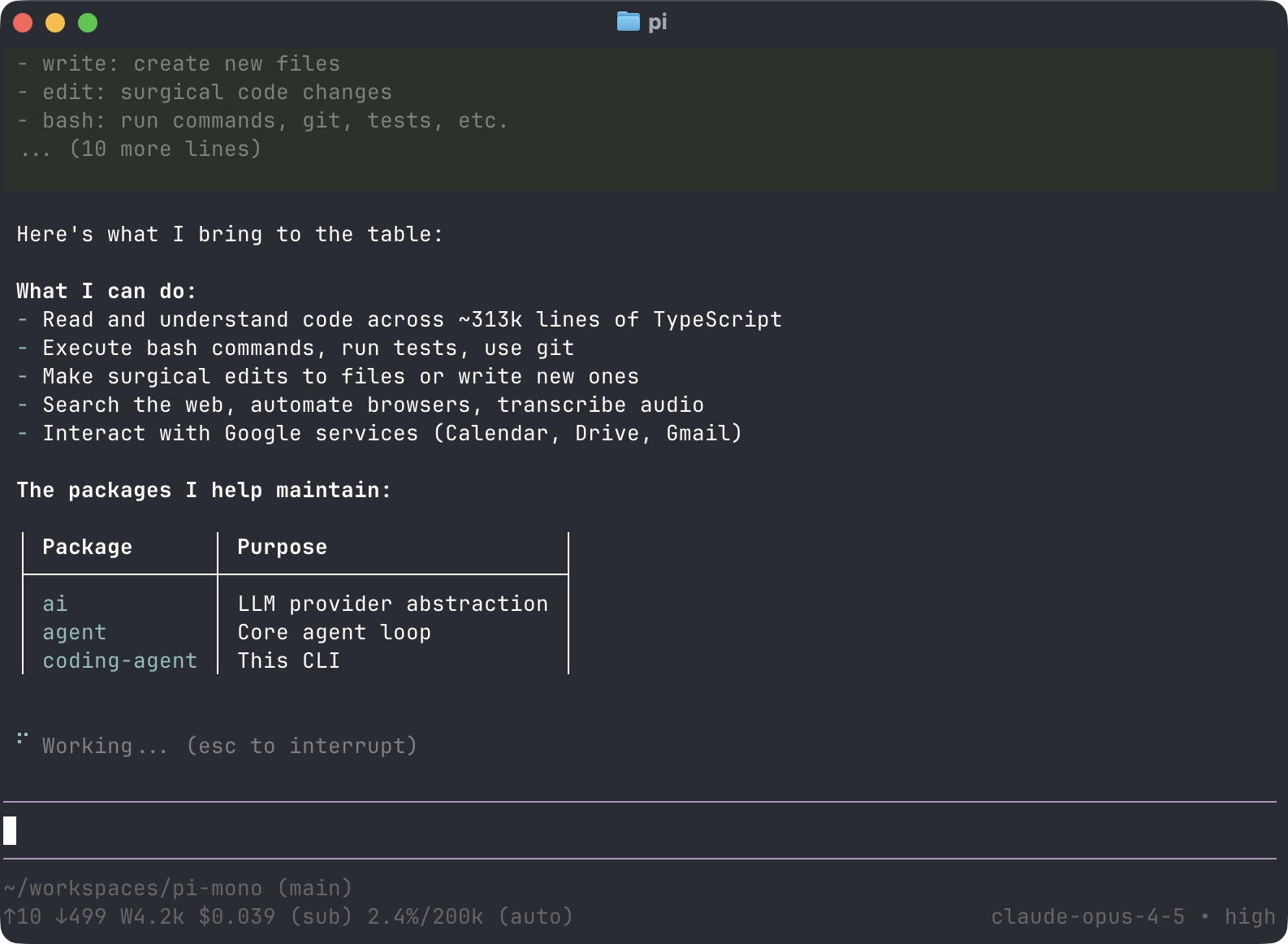
Pi Coding Agent is an open‑source, terminal‑based AI coding agent designed as a minimal “coding harness” you adapt to your own workflow instead of adopting a large, opinionated platform.
[31wxuk]
[d95dpt]
[xo55jw]
It runs directly inside your project directory, giving models structured tools to read, write, edit files and run shell commands so they can iteratively work on real codebases.
[31wxuk]
[d95dpt]
[3bsp1h]
Its architecture emphasizes extensibility via custom tools, prompts, and skills, plus broad model/provider support (OpenAI, DeepSeek, Qwen, etc.).
[d95dpt]
[afglk8]
[3bsp1h]
Core product features (2–3 sentences each):
- Terminal coding agent CLI – The main interface is a TUI/CLI you start with
piin any project folder, where you chat with the agent, invoke tools, and manage sessions entirely from the terminal. [31wxuk] [d95dpt] [3bsp1h] It can run one‑shot prompts (pi -p "…") or fully interactive sessions, and supports shortcuts likeCtrl+Lto switch models. [31wxuk] [d95dpt] - Minimal tool set: read / write / edit / bash – Pi exposes four default tools to the model:
read,write,edit, andbash, giving the agent controlled, auditable access to your code and shell. [31wxuk] [afglk8] [3bsp1h] This minimal surface lets the LLM inspect files, change them incrementally, and execute commands like tests or builds without complex MCP setups or sub‑agents. [31wxuk] [afglk8] [3bsp1h] - Extensible agent framework (monorepo + SDK) – Pi is a TypeScript monorepo of packages for constructing and running AI agents, with the coding agent as its centerpiece. [d95dpt] [37gk5m] An SDK provides programmatic access so you can embed Pi in other apps, build custom interfaces, or extend agent behavior via extensions, skills, and prompts. [37gk5m] [3bsp1h]
- Provider‑agnostic, multi‑model support – Pi supports many API‑compatible providers, including OpenAI, DeepSeek, and others configured via
/login, environment variables, or custom providers inmodels.json. [31wxuk] [d95dpt] [3bsp1h] You can choose models per session, adjust “thinking level,” and even use cheaper models for most tasks while reserving premium models for specific work. [31wxuk] [s9py8h] [3bsp1h] - Session management & context tools – Pi can resume previous sessions (
pi -c), browse history (pi -r), and manage context via commands like/tree,/compact, and/sessionto track tokens and cost. [31wxuk] [d95dpt] This lets you iteratively develop across long‑running tasks without losing context while keeping context windows under control. [31wxuk] - Project‑aware workflows via agents.md – Pi automatically looks for an
agents.md(oragent(s).md) file in your repo to learn project‑specific instructions, workflows, and conventions. [3bsp1h] This acts like a “README for agents,” guiding how Pi operates in your codebase and speeding up task execution when you encode repeatable workflows and constraints. [3bsp1h] - Custom tools, skills, and prompts – Locally, Pi maintains directories for
extensions,prompts, andskills, letting you register new tools, reusable prompt snippets, or domain‑specific capabilities. [3bsp1h] This enables deep customization (e.g., homelab ops, DevOps routines, framework‑specific flows) without modifying Pi’s core. [afglk8] [3bsp1h]
Priority feature bullets:
Recent Developments
History and Origin Story
Pi is described as an open‑source terminal coding agent created by Mario Zechner, built as a minimalist alternative to heavier agent platforms and architected as a tiny core plus extensions.
[31wxuk]
[afglk8]
The framework predates some other coding‑agent projects like OpenClaw, which explicitly notes being built on top of the Pi framework’s architecture, underscoring Pi’s role as a foundational agent harness.
[afglk8]
Over time, the project evolved into a TypeScript monorepo with an SDK, npm distribution, and a growing ecosystem of custom tools and community‑authored workflows.
[d95dpt]
[37gk5m]
[3bsp1h]
Notable Team Members
- Mario Zechner (creator/lead) – Pi is explicitly attributed as “an open-source terminal coding agent created by Mario Zechner,” and he is referenced as the creator behind the minimalist design and architecture that favors a tiny core with extensions over a large, monolithic agent platform. [31wxuk] [afglk8] No additional core team members or formal leadership roles are documented in the searched sources, suggesting a primarily maintainer‑driven open‑source project. [31wxuk] [d95dpt] [37gk5m]
Market Sizing
Category, Market Size, and Category Growth
Pi fits within the categories of AI coding agents / terminal assistants / agentic developer tools, similar to products like Claude Code, GitHub Copilot Chat in the terminal, and other CLI‑based LLM assistants.
[d95dpt]
[afglk8]
[tiwi04]
While no source gives a Pi‑specific TAM, analyst and industry coverage of AI developer tools and coding assistants commonly places this broader category in the multi‑billion‑dollar range with rapid double‑digit annual growth, but no directly citable, Pi‑specific market sizing figure was found in the available results.
Competitive Landscape
Who it's for, who it's not for
Pi is aimed at engineers and power users who live in the terminal, are comfortable managing API keys and LLM providers, and want fine‑grained control and extensibility over their coding agent via files like
agents.md, custom tools, and local config.
[d95dpt]
[3bsp1h]
[tiwi04]
It particularly suits developers who dislike heavyweight platforms, MCP/sub‑agent complexity, and permission prompts, preferring a minimal harness that works directly with existing repos, shells, and homelab setups.
[afglk8]
[3bsp1h]
It is likely not ideal for non‑technical users who expect a fully managed GUI, one‑click cloud setup, or tightly integrated IDE experience out of the box.
[afglk8]
[3bsp1h]
[tiwi04]
Teams requiring centralized governance, billing, and enterprise features around AI usage may also find Pi insufficient compared to commercial platforms with enterprise controls, dashboards, and official support.
[tiwi04]
Viable Alternatives
- Claude Code (Anthropic) – A full‑featured coding agent integrated into editors and web UI, often cited as the main point of comparison, with Pi described as “the only true Claude Code competitor” for users who want open‑source and deep control. [tiwi04]
- GitHub Copilot Chat / Copilot in the terminal – Provides AI assistance inside editors and shells with strong GitHub ecosystem integration, but is closed‑source and less customizable than Pi’s agent harness. [tiwi04]
- OpenInterpreter / similar CLI agents – Open‑source terminal agents that execute code and shell commands with LLMs, overlapping with Pi’s CLI‑based, project‑aware coding workflows.
- OpenClaw – A coding agent framework explicitly built on top of Pi’s architecture, offering a different feature set but sharing the same agentic foundations and targeting advanced AI‑engineering workflows. [afglk8]
Competitor Table
| Competitor | Description |
| Claude Code | Anthropic’s editor and browser-based coding agent, offering powerful code understanding and refactoring with a managed, hosted experience. [tiwi04] |
| GitHub Copilot | GitHub’s AI coding assistant with chat and terminal integrations, tightly integrated with GitHub repos and ecosystem but closed-source and subscription-based. |
| OpenInterpreter | Open-source tool that lets LLMs run code and shell commands on your machine, similar to Pi’s terminal-agent model but with a different architecture and defaults. |
| OpenClaw | Coding agent framework built on top of Pi’s architecture, extending Pi’s ideas into a more opinionated, feature-rich system for agentic development workflows. [afglk8] |
| [[Tooling/AI-Toolkit/Agentic AI/OpenClaw | OpenClaw]] |