


The Innovator's Dilemma
The Innovator's Dilemma
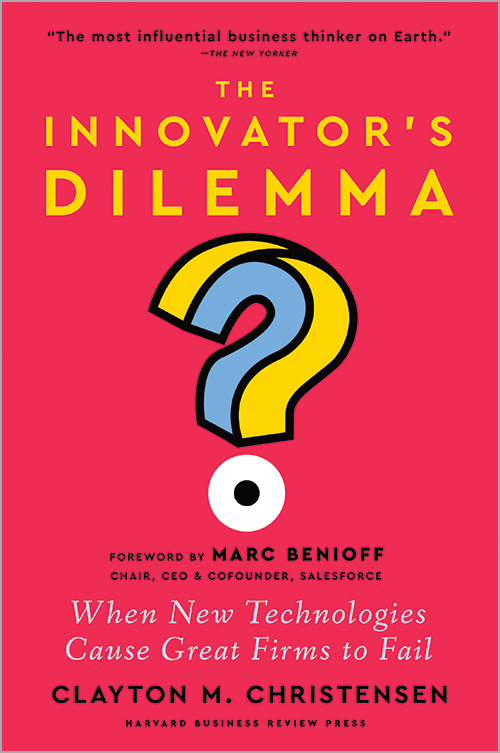
- The Innovator's Dilemma is Clayton Christensen's seminal book unpacking why market-leading companies fail by doing everything "right" in the face of disruptive innovation.
- This is a book first published in 1997 by Harvard Business School Press.[1][4] Christensen, a Harvard professor and Innosight co-founder, coined "disruptive technologies" in it, building on his 1995 article.[1][2] Consultants return to it for its timeless framework explaining how incumbents lose to seemingly inferior innovations that reshape markets.[2][3]
Type and Format
- Type: This source is a book.[1]
- Format details: Publisher: Harvard Business School Press; year of first publication: 1997; notable editions include a 2016 reprint by Harvard Business Review Press and a 2024 rerelease with new foreword.[2][4]

The People Behind It
- Clayton M. Christensen (1952–2020) was a Harvard Business School professor, businessman, and innovation expert who coined "disruptive innovation."[1][2]
- He co-founded Innosight, a consulting firm, and his work influenced leaders like Steve Jobs and Malcolm Gladwell.[4][5]
- Prior books include expansions like "The Innovator's Solution"; he authored the HBR article "How Will You Measure Your Life?"[4]
Catalog of Notable Works
- Introduction: Frames the paradox—successful firms fail by listening to customers and investing rationally, yet missing disruptive threats.[3]
- Chapter on Disruptive Technologies: Defines disruptive innovations as simpler, cheaper tech initially ignored by incumbents, which later overtake markets.[1][3]
- The Disk Drive Industry Case: Analyzes how Seagate, IBM, etc., lost to entrants via S-curve dynamics where performance overshoots customer needs.[3][6]
- Value Networks: Explains how firms trapped in networks prioritizing different metrics fail to pivot.[1]
- Mechanical Excavators Example: Shows established steam shovel makers displaced by hydraulic models serving new low-end markets.[4]
- Rules for Capitalizing on Disruption: Provides managerial guidelines like creating separate organizations for disruptive bets.[4][5]
- New Market Disruptions: Contrasts sustaining vs. low-end disruptions, with steel minimills vs. integrated mills.[1]
Why It Matters to Innovators
- Introduces Disruptive Innovation as inferior tech that incumbents dismiss, yet it creates new markets and upends leaders—e.g., Netflix vs. Blockbuster.[3]
- Diagnoses why "doing everything right" (customer focus, profitability) leads to failure: overshooting high-end needs while disruptors improve from below.[2][3]
- Teaches S-curve model: early slow progress accelerates, trapping firms in incremental sustaining innovations.[3]
- Installs mental model of value networks, where processes and priorities blind firms to threats outside their network.[1][6]
- Offers actionable rules for fostering disruption internally, like autonomous units, vital for scaling startups against giants.[4]
Best Starting Points
- The Innovator's Dilemma (Audiobook) — Accessible audio format narrated by the author, ideal for grasping the core paradox on the go.[5]
- Innosight Summary Page — Concise modern overview with 2024 foreword context, perfect quick primer.[2]
- — 10-minute visual breakdown of S-curves and examples like Blockbuster, for visual learners.[3]
- HBS Faculty Page Excerpt — Official publisher summary with rules for disruption, bridging theory to practice.[4]
- Full PDF — Dive into the original text for disk drive cases and value networks depth.[6]
Adjacent Sources
- The Innovator's Solution — Christensen's follow-up book on building disruptive growth engines.
- Crossing the Chasm — Geoffrey Moore on tech adoption, complements disruption timing.
- Playing to Win How Strategy Really Works — A.G. Lafley/Lindgardt on strategy, cited alongside Christensen in HBR contexts.
- Disruptive Innovation — Core vault concept directly from this book.
- Blue Ocean Strategy — Kim/Mauborgne counterpoint on uncontested markets vs. disruption.
- Hard Thing About Hard Things — Ben Horowitz on operationalizing innovation survival.
Christensen, Clayton M.. The Innovator's Dilemma: When New Technologies Cause Great Firms to Fail. United States: Harvard Business Review Press, 2013.
Sources
[1]: The Innovator's Dilemma - Wikipedia
[2]: The Innovator's Dilemma | Innosight
[3]:
[4]: The Innovator's Dilemma: When New Technologies Cause Great ...
[5]: The Innovator's Dilemma Audiobook by Clayton M. Christensen
[6]: [PDF] The Innovator's Dilemma (Clayton M. Christensen)2000.pdf
[7]: The Innovator's Dilemma: When New Technologies Cause Great ...