


Model-Market Fit
Defining and Describing Model-Market Fit
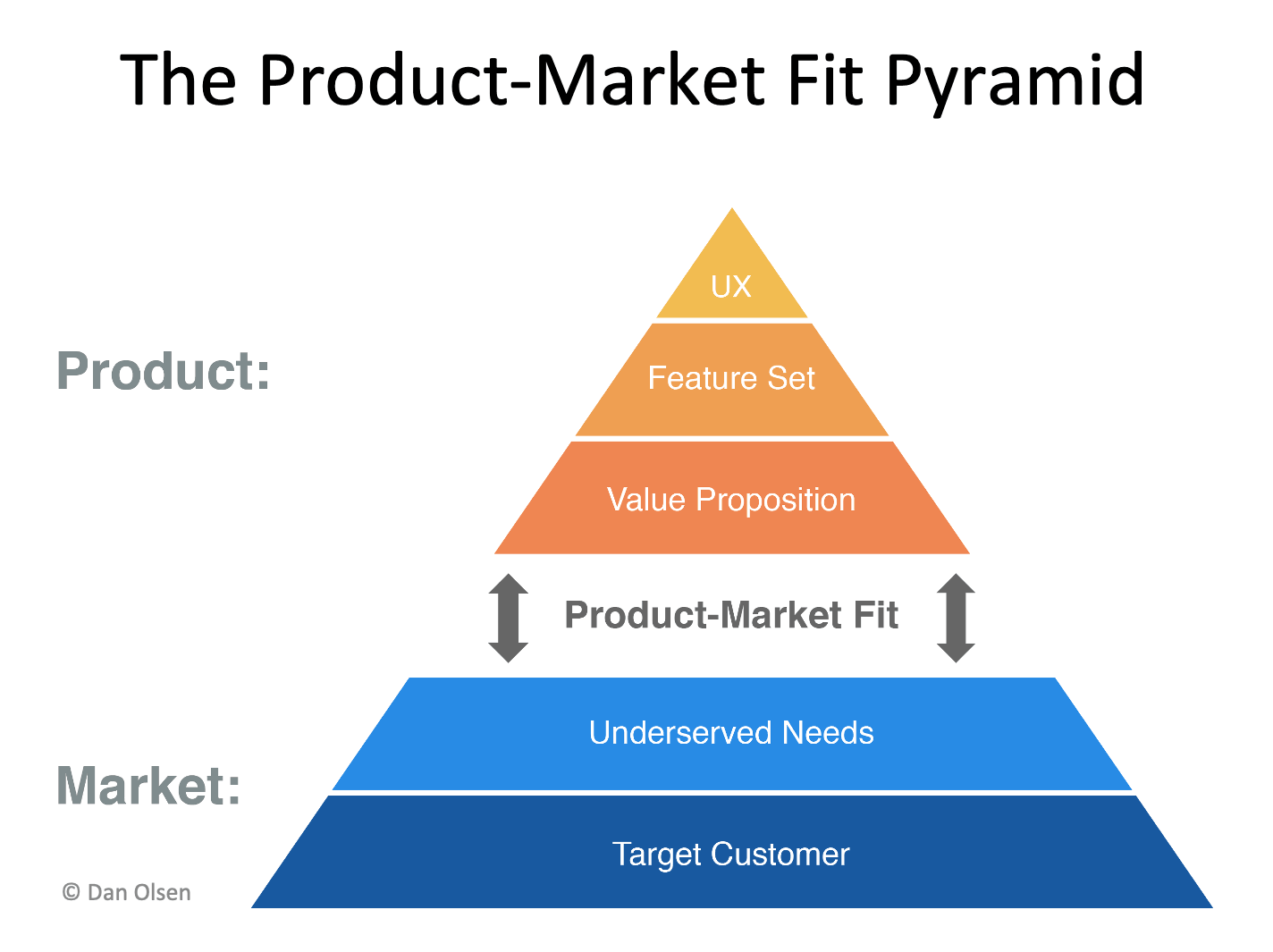
If product–market fit is about whether people want what you built, model–market fit is about whether they want to buy it the way you plan to make money.
In the The Four Fits growth framework popularized by Reforge , Model–Market Fit is the fit between your business model (how you charge, package, and capture value) and how your target market prefers to discover, evaluate, purchase, and pay for solutions.
[kniq32]
It asks whether your pricing model, contract structure, sales motion, and monetization mechanics are compatible with customer expectations and procurement realities in your segment.
[kniq32]
This concept typically applies in startup and growth-stage companies once basic product–market fit is emerging, because at that point misaligned monetization can stall growth even if the core product is valuable.
[kniq32]
It matters because teams can have the right product for the right users, yet fail if, for example, they try to sell it as a high-touch enterprise license into a market that expects low-friction usage-based or self-serve pricing.
[kniq32]
flowchart LR
A[Product–Market Fit<br|>"Do users want this?"] --> B[Model–Market Fit<br|>"Will they buy it this way?"]
B --> C[Channel–Model Fit<br|>"Can we sell it this way via these channels?"]
C --> D[Market–Channel Fit<br|>"Are there enough of the right customers reachable this way?"]
style B fill:#e6f7ff,stroke:#1890ff,stroke-width:2px
Uses in Context
- In the Reforge Four Fits growth framework, Model–Market Fit is defined as when “your chosen business model aligns with how your target market prefers to buy and pay for solutions,” emphasizing that the model must match buyer expectations and procurement behavior. [kniq32]
- The same framework contrasts Model–Market Fit with Product–Market Fit by framing it as the fit between “how you charge and capture value” and what the market considers acceptable or standard in that category. [kniq32]
- Practitioners invoke Model–Market Fit when a product has traction with early users but struggles to scale because, for example, long-term contracts and annual prepayment clash with a market that expects freemium entry and monthly pricing—an issue Reforge highlights as a core Model–Market Fit failure mode. [kniq32]
- Growth leaders use the term to explain pivots from seat-based to usage-based pricing, arguing that usage-based models achieve better Model–Market Fit in markets where value scales with consumption rather than number of users. [kniq32]
- Investors and operators sometimes talk about “finding Model–Market Fit” to describe the phase where a company experiments with different monetization approaches (self-serve vs. sales-led, transactional vs. subscription, flat vs. tiered pricing) until customer adoption, conversion, and expansion metrics improve because the model finally matches how buyers want to pay. [kniq32]
History of Use
Origins
- The term Model–Market Fit in its structured, named form is prominently documented in Reforge’s Four Fits growth framework, presented as one of four core fits (Product–Market, Model–Market, Channel–Model, Market–Channel) that must align for scalable growth. [kniq32]
- In that context, Reforge positions Model–Market Fit as a distinct layer of fit between the product and the broader go-to-market system, defining it specifically around the match between business model and buyer purchasing preferences. [kniq32]
Given the available web evidence, the earliest clearly articulated, widely cited formulation of Model–Market Fit as a named concept appears to come from Reforge’s framework rather than from large incumbent vendors’ marketing material.
[kniq32]
Evolution
- 2020s – Four Fits codification. Reforge’s Four Fits framework formalized Model–Market Fit as a central growth concept, putting it alongside Product–Market Fit and emphasizing that misaligned pricing and packaging can cap growth even when users love the product. [kniq32]
- 2020s – AI and usage-based expansion. As AI and API-first products accelerated the shift toward usage-based pricing , Model–Market Fit discussions increasingly focused on aligning value metrics (tokens, API calls, seats, workflows) with how customers perceive value and budget, underscoring that the model must “fit” the way the market consumes and pays for AI-enabled services. [kniq32]
Best Real-World Examples
(Because “Model–Market Fit” is an abstract alignment concept, examples focus on companies whose business model clearly matched how their market preferred to buy and pay, as described in public analyses.)
- Snowflake – Its consumption-based “pay for the compute and storage you use” model is frequently cited as an example of strong alignment between data warehousing economics and customer usage patterns, yielding notable revenue expansion from existing customers and illustrating Model–Market Fit in cloud data infrastructure. [kniq32]
Case Studies
Case Study 1: Usage-Based AI Infrastructure and Developer Expectations
As AI APIs became core infrastructure for many products, providers such as OpenAI adopted a usage-based pricing model where customers pay per token or per unit of computation, rather than per user seat.
[kniq32]
This aligned with how developers and startups budget for infrastructure: they prefer variable costs that scale with usage, similar to cloud compute and storage, instead of fixed license counts.
[kniq32]
The result was that teams could start with very small spend in prototyping and scale costs as their own usage (and revenue) grew, which is frequently analyzed as a case of strong Model–Market Fit —the monetization model fit the way the market wanted to consume and pay for AI capabilities.
[kniq32]
It illustrates that for infrastructure-like products, aligning the billing metric (tokens, calls, compute units) with perceived value and consumption patterns is central to achieving Model–Market Fit.
[kniq32]
Case Study 2: Snowflake and Consumption-Based Data Warehousing
Snowflake entered a market long dominated by capacity-based and license-heavy data warehousing models and instead leaned into a consumption-based cloud model , allowing customers to pay separately for storage and compute, scaled up and down on demand.
[kniq32]
Analysts and practitioners often highlight that this model maps cleanly to how data teams actually use resources: storage grows steadily, while compute spikes for workloads like analytics, experimentation, and ETL, making a purely seat-based or fixed-capacity license a poor fit.
[kniq32]
By letting customers start small, experiment freely, and pay in proportion to real workloads, Snowflake’s Model–Market Fit enabled strong net revenue retention and expansion within existing accounts, as customers consumed more over time rather than being constrained by fixed licenses.
[kniq32]
This case demonstrates how rethinking the business model around workload reality —rather than legacy licensing conventions—can unlock both adoption and long-term growth through better Model–Market Fit.
[kniq32]
Case Study 3: Slack’s Bottom-Up Collaboration Model
Collaboration tools were historically sold via top-down enterprise deals with large, up-front licenses, but Slack took a different approach: a freemium, self-serve, per-active-user pricing model that let individual teams adopt the product without lengthy procurement cycles.
[kniq32]
Commentators often note that this directly matched how modern software teams prefer to try new tools—starting in a small group, validating value in real work, then expanding usage organically.
[kniq32]
Because organizations only paid for active users and could start for free, the perceived risk and friction were low, improving trial-to-paid conversion and enabling organic, bottom-up growth.
[kniq32]
Slack’s trajectory is frequently used to illustrate Model–Market Fit in SaaS: by aligning pricing and sales motion with users’ discovery and adoption behavior, the company converted strong product–market fit into scalable revenue growth.
[kniq32]
Sources
[1]: Product-Market Fit : Definition, Importance and Example
[2]: What is Product Market Fit? | Definition and Overview - HelloPM
[3]: Product-Market Fit: Strategy & Examples - Mailchimp
[4]: What is product-market fit, and do investors care about it? - ThatRound
[5]: What Is Product Market Fit? 2026 Guide - Coursera
[6]: How to Find Product Market Fit (2026 PMF Strategy Guide) - Presta