


Open-Source Alternatives
Defining and Describing Open Source Alternatives
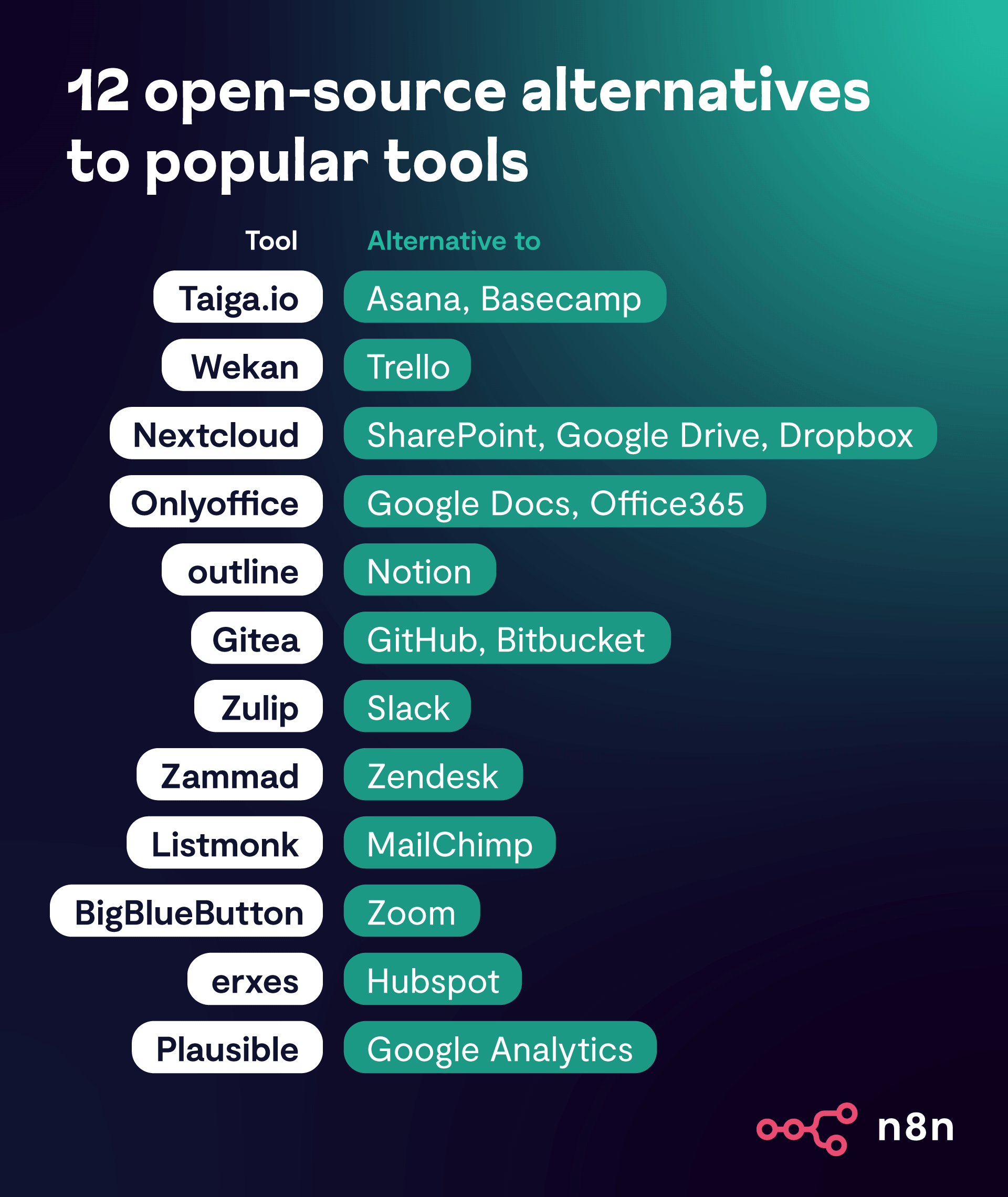
Uses in Context
- A curated directory frames the term as “open source alternatives to paid software,” showing how the phrase is used to help people browse replacements for commercial tools. [ex2oaf]
- Tech media uses it in first-person recommendation lists such as “6 open-source programs I use instead of the paid alternatives,” where the term signals a switch from proprietary apps to free/open ones. [su2ryt]
- Tutorial and opinion content uses it in broader lifestyle language, such as “I’m switching my software to open source alternatives,” emphasizing migration rather than abstract definition. [b0f67n]
- Product roundups apply it to specific categories, including “open-source alternatives to ChatGPT for companies,” where the term means a self-hostable or open model-based substitute for a proprietary AI service. [66ysni]
- Project blogs use it in enterprise contexts, such as “Software alternatives to Atlassian – free and open source,” where the phrase is tied to replacing Jira or Confluence with self-managed tools. [m1fssh]
History of Use
Origins
- The exact phrase has no clear single origin in the provided results; the search results show it functioning as a common descriptive label in contemporary software curation and comparison writing rather than as a coined term from one canonical paper or product announcement. [su2ryt] [ex2oaf] [b0f67n] [97atpm] [m1fssh]
- The term is already established by the time of modern directory-style sites that present “open source alternatives to paid software” as a browsable category, which suggests the phrase matured through community comparison pages and editorial lists rather than a formal standardization event. [ex2oaf] [97atpm]
Evolution
- 2020s: It expanded into AI and model-serving discussions, where “open-source alternatives to ChatGPT” describes systems chosen for self-hosting, cost control, and data security. [66ysni]
- 2020s: Directory sites increasingly paired the phrase with “self-hosted” and “active GitHub repos,” showing a shift from simple app replacement to evaluation of maintenance, deployment, and project vitality. [ex2oaf]
Best Real-World Examples
Case Studies
One common case is the move from proprietary creative and utility software to open-source desktop tools. A recent roundup highlights GIMP, VLC, Firefox, 7-Zip, ShareX, and OBS as programs used “instead of the paid alternatives,” showing how the term functions as a practical shopping category for ordinary users rather than a niche technical doctrine.
[su2ryt]
This use matters because it ties the concept to everyday switching decisions: users are not only selecting software by features, but also by licensing, cost, and control.
[su2ryt]
[b0f67n]
A second case is the enterprise and collaboration stack. OpenProject’s blog explicitly frames its positioning as a “Software alternatives to Atlassian – free and open source,” and the broader roundup discussion includes Mattermost, Nextcloud, OnlyOffice, and Collabora Online as replacements for Slack/Teams, Office 365, and Google Docs-style workflows.
[mac7mz]
[m1fssh]
This shows the concept scaling from single-app substitution to infrastructure substitution, where the “alternative” must cover hosting, collaboration, and integration rather than a single feature set.
[mac7mz]
[m1fssh]
A third case is the AI market. Northflank’s roundup of “open-source alternatives to ChatGPT for companies” treats GPT-OSS, Llama, DeepSeek, and Qwen as substitutes chosen for enterprise concerns such as self-hosting, cost, and data security.
[66ysni]
In this context, “open source alternatives” is no longer just about replacing software licenses; it is also about controlling where models run and who can inspect or adapt them.
[66ysni]