


software-development/cloud-infrastructure/nextcloud
Value Proposition & Features
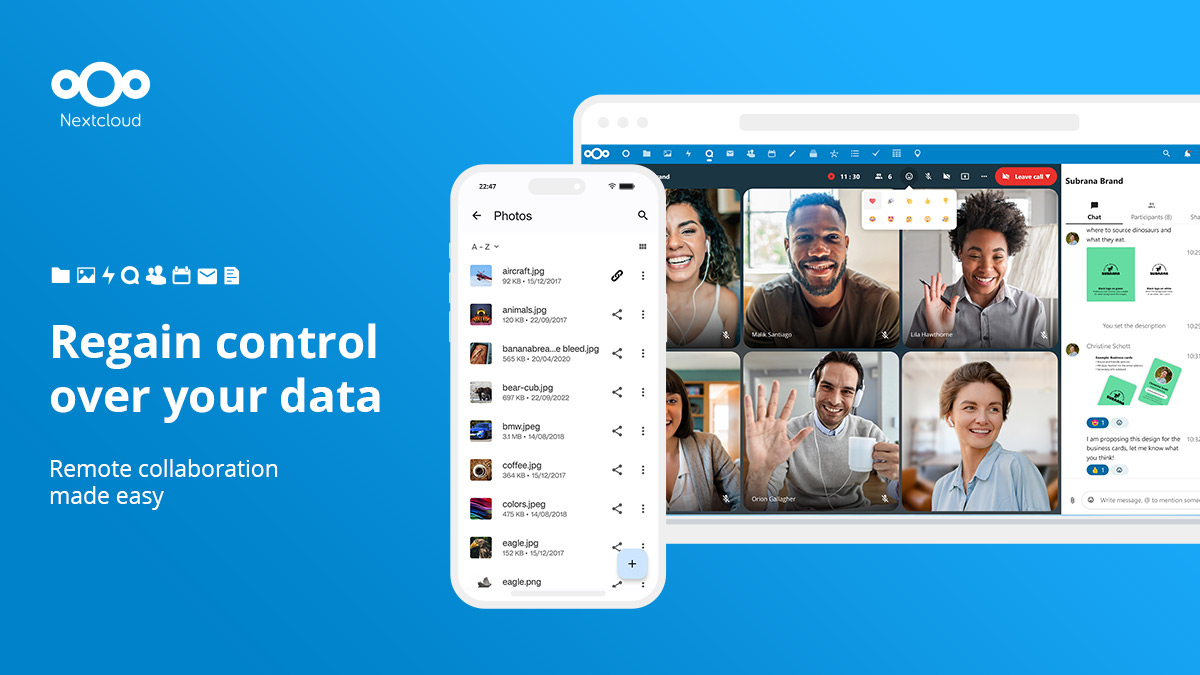
Nextcloud is an open-source, self-hostable content collaboration platform — file sync and share at its core, expanded over a decade into a full "digital workspace" covering chat/video, groupware (calendar/contacts/mail), real-time document editing, workflow automation, and an on-premises AI assistant.
[nc001]
[nc005]
Its central pitch is control: "who controls your data, what tools you use and what it costs, how much privacy for you is enough privacy" — positioned explicitly against dependence on centralized, proprietary US/China cloud platforms.
[nc004]
[nc003]
Six years after launch it described itself as having moved from "just a file-sync-and-share solution similar to Dropbox" to "a Content Collaboration Platform giving you a complete online productivity platform with integrated features from Talk, Office, Groupware and hundreds of apps."
[nc006]
Core Product Features (2–3 sentences each)
Nextcloud Files
Self-hosted file storage and sync with desktop, mobile, and web clients; positioned around "powerful and flexible file sharing and management," "advanced security with encryption, rule-based file access control," and "deep integration with all your productivity apps and external systems."
[nc005]
This is the original product and the one most users mean when they say "Nextcloud."
Nextcloud Talk
Built-in calls, chat, and videoconferencing, so real-time communication runs on the same self-hosted instance as the files, rather than requiring a separate tool like Zoom or Slack.
[nc005]
Nextcloud Groupware
Calendar, Contacts, and Mail — the pieces needed to replace a hosted email/calendar suite (Google Workspace, Microsoft 365) alongside file sync, not just alongside it.
[nc005]
Nextcloud Office
Real-time collaborative document editing (built on Collabora/OnlyOffice-style web office engines), for teams that want Google-Docs-style co-editing without the documents leaving the organization's own server.
[nc005]
Nextcloud Assistant
A "private and local AI assistant" — Nextcloud markets this explicitly as on-premises AI, framed around the same privacy/control positioning as the rest of the platform. Nextcloud describes Hub 4 (2023) as "the first on-premises collaboration platform to integrate intelligent features comprehensively across its applications, while addressing the privacy and control challenges that come with AI technologies."
[nc006]
[nc005]
Nextcloud Flow
Workflow automation across the platform — rule-based actions triggered by file/document events, marketed as "driving digital transformation with automation."
[nc005]
Key Features (priority order)
- Unified "Hub" surface — Files, Talk, Groupware, Office, Assistant, and Flow as one modular platform rather than separate disconnected tools. [nc005]
- On-premises AI ("ethical AI integration") — AI features that run against the organization's own data without sending it to a third-party model provider by default. [nc006]
- Digital sovereignty positioning — explicit European, non-US/China-dependent alternative; a founding member of the EuroStack Foundation. [nc001]
- Enterprise support tiers rather than feature-gated tiers — the paid tiers differ mainly in support SLAs, not withheld features. [nc009]
- Large deployment footprint — "thousands of government agencies, companies, universities, research institutions and schools across Europe and beyond," plus "millions of individual users globally." [nc001]
Product Roadmap / Announcements
- "Sovereignty 2030" (announced November 5, 2025) — a €250M+ multi-year investment program: a planned 7x global workforce expansion, deeper AI research investment, an expanded sovereign-ecosystem partner network, public education on privacy/security/sovereignty, and continued open-source community investment. [nc001]
- Nextcloud Hub 26 Spring (June 9, 2026) — the platform's 10th-anniversary release: refined UI, performance work, and "the new platform strategy that enables developers to benefit even more from our vast ecosystem." [nc004]
Recent Developments (past 90 days, relative to July 2026)
- Nextcloud Hub 26 Spring shipped (June 2026), its anniversary release. [nc004]
History and Origin Story
Nextcloud was founded in June 2016 by Frank Karlitschek, five weeks after he and most of ownCloud's core contributors left ownCloud Inc. — Nextcloud is, in effect, a fork of ownCloud (the file-sync project Karlitschek had originally founded in 2010).
[nc007]
Karlitschek's departure announcement raised concerns about how the project was being managed commercially versus as an open-source initiative; the fork's impact was immediate — within about 12 hours of the fork announcement, ownCloud Inc. announced it was shutting down after lenders cancelled credit, and ownCloud's own team published a public statement on the split.
[nc007]
[nc008]
Karlitschek — a computer-science graduate of the University of Tübingen, based in Berlin, previously on the KDE project's board for over 25 years of open-source work — founded Nextcloud explicitly "to create a decentralized, open-source, European alternative to the major cloud services from the United States and China," and remains CEO.
[nc003]
He is a Fellow of Open Forum Europe, an Invited Expert at the W3C, and advises the United Nations on open-source matters.
[nc003]
Nextcloud GmbH is headquartered in Stuttgart, Germany.
[nc011]
Fundraising History
Public data on Nextcloud GmbH's financing is sparse and inconsistent across sources — one tracker lists total raised at roughly $1.18M across a Seed/VC round, naming Connecticut Innovations and NGI TrustChain as investors; this figure looks low relative to the company's described scale and should be treated with caution rather than as a confirmed total.
[nc011]
Nextcloud has historically emphasized being a profitable, subscription-funded open-source business (enterprise support contracts) rather than a heavily VC-funded one, consistent with the "Sovereignty 2030" program being framed as company-funded investment rather than a funding-round announcement.
[nc001]
No detailed, reliable round-by-round breakdown was found.
Notable Team Members
Market Sizing
Category, Market Size, and Category Growth
Nextcloud sits in the Enterprise File Sync and Share (EFSS) / content collaboration platform category, overlapping with groupware, team chat, and (more recently) on-premises AI assistant markets.
[nc001]
[nc005]
[nc006]
No independent analyst TAM/growth figure specific to Nextcloud's segment was found in this pass of research; the company's own framing is less "market share" and more "digital sovereignty" — positioning itself against the EFSS/collaboration incumbents (Google Workspace, Microsoft 365) on data-control grounds rather than feature parity alone.
[nc001]
[nc004]
Pricing
Nextcloud's Enterprise subscriptions are support-tier based, not feature-gated: Standard ( €104.99/user/year), and Ultimate (~€204.75/user/year), with subscriptions starting at 100 users and volume pricing negotiated above that.
[nc009]
The tiers differ primarily in support response time — 2-business-day (Standard), 1-business-day (Premium), and 1-hour-for-critical-issues (Ultimate) — rather than in which product features are unlocked.
[nc009]
The underlying software itself is free, open-source (AGPLv3), and self-hostable at no licensing cost — the paid tiers are for vendor-backed support, not for access to Files/Talk/Groupware/Office themselves.
[nc001]
[nc009]
json
{
  "type": "delete",
  "children": [
    {
      "type": "text",
      "value": "€68.94/user/year), ",
      "position": {
        "start": {
          "line": 70,
          "column": 100,
          "offset": 7942
        },
        "end": {
          "line": 70,
          "column": 119,
          "offset": 7961
        }
      }
    },
    {
      "type": "strong",
      "children": [
        {
          "type": "text",
          "value": "Premium",
          "position": {
            "start": {
              "line": 70,
              "column": 121,
              "offset": 7963
            },
            "end": {
              "line": 70,
              "column": 128,
              "offset": 7970
            }
          }
        }
      ],
      "position": {
        "start": {
          "line": 70,
          "column": 119,
          "offset": 7961
        },
        "end": {
          "line": 70,
          "column": 130,
          "offset": 7972
        }
      }
    },
    {
      "type": "text",
      "value": " (",
      "position": {
        "start": {
          "line": 70,
          "column": 130,
          "offset": 7972
        },
        "end": {
          "line": 70,
          "column": 132,
          "offset": 7974
        }
      }
    }
  ],
  "position": {
    "start": {
      "line": 70,
      "column": 99,
      "offset": 7941
    },
    "end": {
      "line": 70,
      "column": 133,
      "offset": 7975
    }
  }
}Revenue Trajectory Estimates
Third-party estimates disagree meaningfully: one source puts Nextcloud's revenue around $2M, another around $3.9M; employee-count estimates likewise range from "30+" to 143 (as of April 2026).
[nc011]
Given the spread, none of these figures should be treated as authoritative — they're included to show general scale (small/mid-size company, not hyperscaler-adjacent), not as precise financials.
Competitive Landscape
Who it's for, who it's not for
Nextcloud is for organizations that need Dropbox/Google-Drive-equivalent file sync and sharing plus collaboration tooling, but under their own infrastructure control — named use cases include government agencies, universities, research institutions, schools, and companies across Europe and beyond, alongside individual/home-cloud users.
[nc001]
[nc004]
It's a particularly strong fit where data sovereignty is a compliance or political requirement, not just a preference — European public-sector bodies navigating GDPR and non-US-cloud mandates are a named, explicit target audience, reinforced by Nextcloud's own "Sovereignty 2030" investment and EuroStack Foundation membership.
[nc001]
[nc002]
[nc003]
It is a weaker fit for teams whose need is narrowly "sync a folder fast between a few devices" rather than a full groupware/office/AI platform — Nextcloud's own self-hosted community consistently notes that dedicated sync tools (Syncthing, Seafile) outperform it on raw sync speed and setup simplicity, precisely because Nextcloud is optimizing for the broader collaboration-suite surface, not sync alone.
[nc012]
[nc013]
[nc014]
It's also a heavier operational commitment than a managed SaaS tool — self-hosting means owning updates, backups, and security patching, even with the simplified Nextcloud All-in-One (AIO) Docker deployment path.
Viable Alternatives
- Proton Drive — a privacy-focused but SaaS-hosted (not self-hosted) alternative, appealing to a similar privacy-conscious audience without the self-hosting operational burden.
Competitor Table
| Competitor | Description |
| ownCloud | The project Nextcloud forked from in 2016; comparable self-hosted EFSS platform. [nc007] |
| Seafile | Dedicated, lighter-weight file-sync-and-share engine; often preferred over Nextcloud for pure sync speed. [nc012] [nc013] |
| Syncthing | Peer-to-peer real-time sync, no server required; best for instant sync between a handful of devices, not a full collaboration suite. [nc012] |
| Google Workspace | Hyperscaler-hosted proprietary suite; the incumbent Nextcloud positions against on sovereignty/control grounds. [nc001] |
| Microsoft 365 | Enterprise-standard proprietary suite; similar competitive framing to Google Workspace. [nc001] |
| Proton Drive | Privacy-focused but SaaS-hosted (not self-hosted) file storage. |