Pieces is your AI companion that captures live context from browsers to IDEs and collaboration tools, manages snippets and supports multiple llms - all while processing data locally for maximum control.
Give your agent the docs it needs to succeed. Exactly the tokens you need, no bloat.
ℹ️ (2025-08-17T21:09.466Z)
Perplexity Query
(2025-08-17T21:09
.466Z)
Question:
Write a comprehensive one-page article about "MCP Servers".
Response from sonar-pro:
MCP servers, or Model Context Protocol servers, are specialized software components designed to bridge generative AI applications and the rich world of enterprise data, services, and tools.
[x4rjbh]
[0nm17z]
As the use of generative AI becomes more widespread in business and consumer settings, the role of MCP servers in enabling secure, contextually aware, and robust AI solutions is increasingly vital.
[x4rjbh]
Understanding MCP Servers
At their core, MCP servers are like adapters that translate requests between AI-powered apps and external resources.
[c6pnip]
[0nm17z]
An AI model, such as Anthropic ’s Claude Desktop or a coding assistant, might need to access a file, query a database, or interact with a service like GitHub. Instead of custom-coding each new integration, developers configure or deploy an MCP server that knows how to speak both the AI’s language and the external tool’s protocol.
[86ipsf]
[x4rjbh]
For example:
A GitHub MCP server translates “list my open pull requests” into GitHub API calls, returning structured results to the AI.
[c6pnip]
A File MCP server can grant an AI access to save or summarize documents directly from a user’s desktop.
[c6pnip]
[0nm17z]
A YouTube MCP server could, upon request, transcribe video content for use within an AI dialog or workflow.
[c6pnip]
[0nm17z]
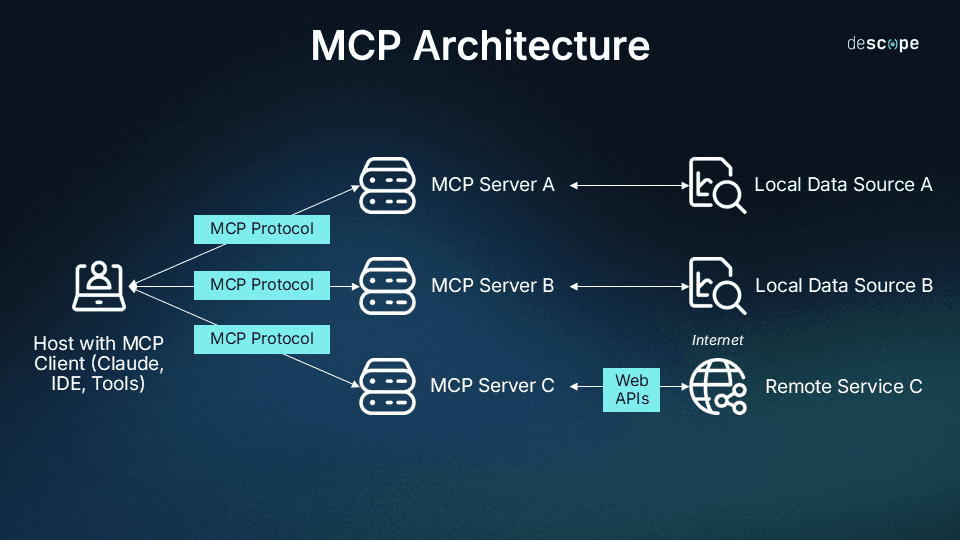
The design follows a standardized client-server architecture, where the AI app (host) connects to one or more MCP servers—each focused on a specific integration point, such as a database, cloud service, or local file system.
[86ipsf]
[psi8lg]
Communication is mediated by the Model Context Protocol, typically over JSON-RPC, to ensure structure, compatibility, and extensibility.
[86ipsf]
Benefits and Use Cases
MCP servers offer several key advantages:
Scalability: They reduce the need for custom integration code whenever an AI tool needs to connect to a new system, speeding up development and deployment.
[x4rjbh]
[0nm17z]
Security and Privacy: MCP servers can enforce strict data governance and privacy guardrails, ensuring sensitive information is only shared as permitted and reducing the risk of data leakage into AI models.
[x4rjbh]
Tool Discovery: AI clients can dynamically discover and describe available tools and resources, making workflows more adaptive and user-friendly.
[c6pnip]
[psi8lg]
Real-time Access: By connecting directly to current data sources and services, MCP servers help ensure that AI responses are timely, relevant, and actionable.
[x4rjbh]
Typical applications include enterprise AI assistants capable of querying business databases, automating reports, project management (e.g., creating GitHub issues or reading Jira status), and enhancing productivity tools by enabling access to cloud files, emails, or even IoT device data.
There are challenges as well, such as the complexity of maintaining secure connections across varied environments, ensuring protocol compatibility, and managing identity and permissions for AI agents accessing sensitive data.
[x4rjbh]
As the field matures, standards for authentication, logging, and compliance are rapidly evolving.
Current State and Trends
MCP servers have seen rapid adoption since their introduction in late 2024, with a vibrant ecosystem that now boasts more than 250 servers—spanning official, third-party, and open-source integrations.
[0nm17z]
Key vendors include Anthropic, K2View, and a range of cloud and enterprise data providers actively developing or supporting MCP-compatible solutions.
[x4rjbh]
[0nm17z]
The protocol’s architecture takes inspiration from successful standards like the Language Server Protocol (LSP), enabling Interoperability and openness.
[86ipsf]
Recent advances have seen the emergence of more user-friendly developer tools, increased focus on regulated industries (where privacy is critical), and widespread collaboration around community-driven servers—demonstrating the versatility and growing importance of MCP technology.
[0nm17z]
Future Outlook
The future of MCP servers is closely tied to the evolution of dynamic, trustworthy AI. Expect broader adoption in industries that require real-time, secure AI integrations, such as finance, healthcare, and logistics. Standardization will make it easier for organizations to plug AI into almost any digital process, while the expansion of community-driven servers will unleash new creative and collaborative possibilities. As the protocol matures, MCP servers will likely become a foundational layer powering context-rich, enterprise-ready AI systems.
Conclusion
MCP servers are redefining how AI applications connect to the broader digital world—delivering security, scalability, and compelling new capabilities for enterprises and individuals. Their rapid growth signals a major shift toward smarter, more integrated AI solutions set to shape the future of intelligent computing.