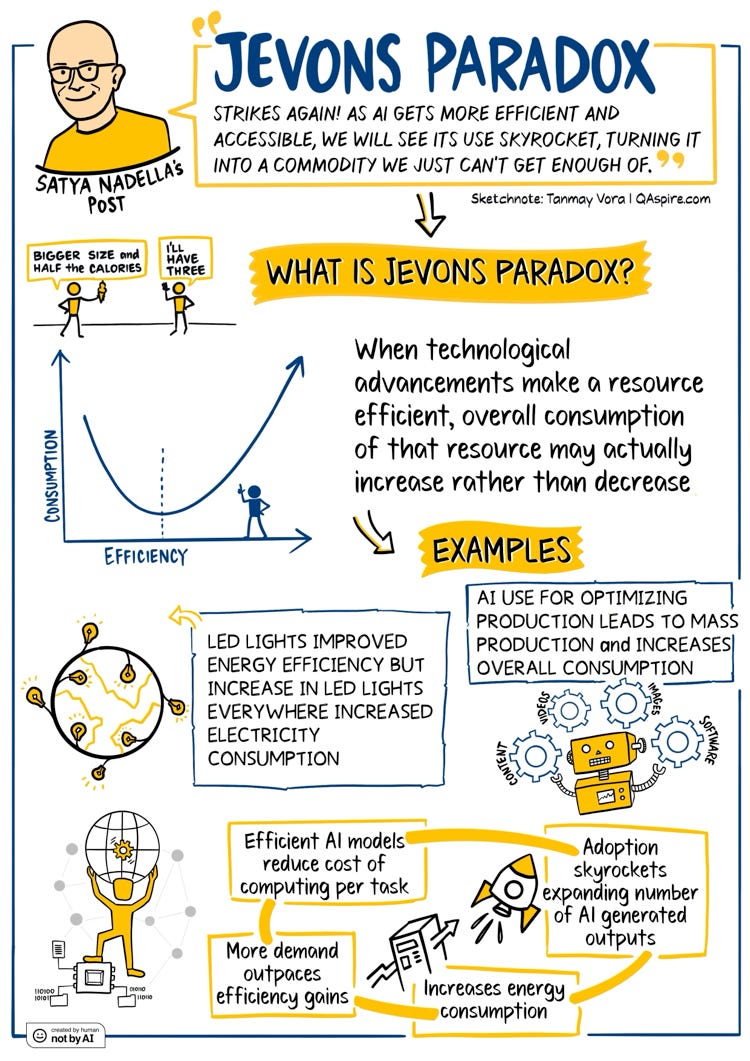


Jevon's Paradox
 Source: https://www.economicshelp.org/blog/220917/economics/jevons-paradox-definition-and-explanation/
Defining and Describing Jevon's Paradox
- The concept matters because it challenges assumptions that efficiency alone solves resource scarcity or environmental problems, highlighting the need for policies addressing demand rebound. [ykayq3]
Uses in Context
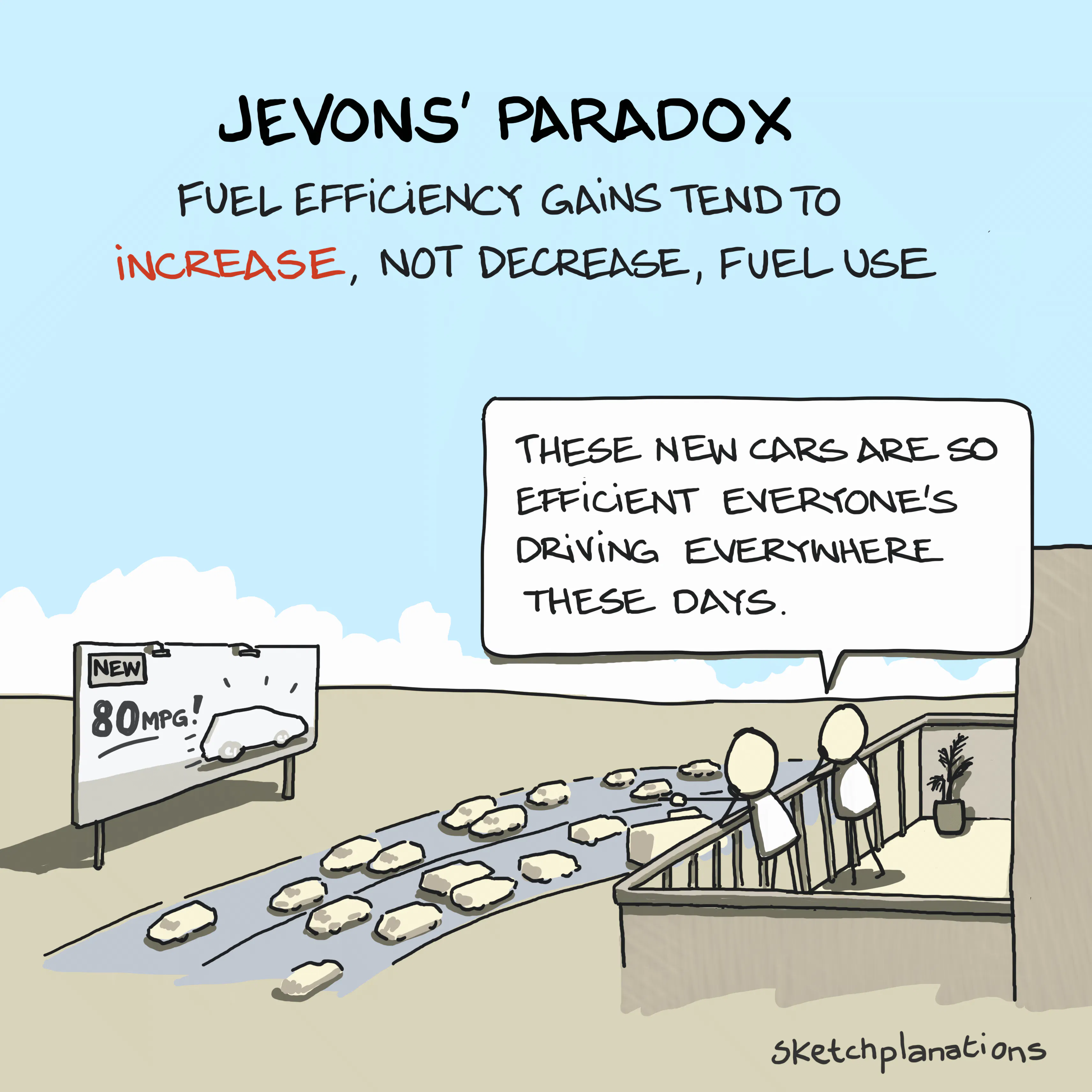
- In energy policy debates, invoked to explain why fuel-efficient cars lead to more driving and unchanged or higher fuel use, as people drive more and buy larger vehicles. [fz1znt]
- Applied to workplace tools like instant messaging and automation, where efficiency gains evaporate as workloads increase through more tasks and constant responsiveness. [ckr8sw]
- In environmental contexts, used for lighting where LED efficiency prompts more lights and longer use, like outdoor and holiday displays, offsetting energy savings. [ykayq3]
- Broadly in economics, describes the "rebound effect" where efficiency triggers systemic responses like new markets, not just direct savings. [ckr8sw]
History of Use
Origins
- First observed and named by English economist William Stanley Jevons in his 1865 book The Coal Question, analyzing how James Watt's more efficient steam engine, compared to Thomas Newcomen's, made coal cheaper and drove higher total coal consumption in Britain despite per-engine savings. [p59tmv] [ckr8sw]
- Jevons phrased it as: “It is wholly a confusion of ideas to suppose that the economical use of fuel is equivalent to a diminished consumption. The very contrary is the truth.” [ckr8sw]
Evolution
- Mid-20th century: Term formalized as part of "rebound effect" in energy economics, distinguishing direct (user increases) from indirect (new spending) and economy-wide rebounds, expanding beyond coal to general resources. [ckr8sw]
Best Real-World Examples
- James Watt's steam engine: Efficiency gains made coal cheaper, spurring more engines and higher total coal use in 19th-century Britain. [p59tmv]
- Fuel-efficient cars: Better mileage led to more driving, larger vehicles, and no net fuel reduction. [fz1znt]
- LED lighting: Cheaper per-unit light encouraged more fixtures and extended use, sustaining lighting energy consumption. [ykayq3]
- Faster computing: Efficiency created demand for data-intensive tasks, raising overall processing needs. [fz1znt]
- Workplace digital tools: Messaging and automation increased workloads by enabling more tasks. [ckr8sw]
Case Studies
William Stanley Jevons analyzed Britain's coal industry in 1865, noting that Watt's steam engine (post-1760s) was far more efficient than Newcomen's (1712), burning less coal per unit of work.
[p59tmv]
[ckr8sw]
This dropped coal's effective cost, making steam power viable for factories, mining pumps, and transport, vastly expanding adoption.
[p59tmv]
Coal use soared from 10 million tons in 1800 to over 100 million by 1860, fully offsetting per-engine savings and more; it showed efficiency unlocks demand in new sectors, turning scarcity into abundance.
[fz1znt]
[ckr8sw]
Fuel efficiency standards for cars, implemented widely from the 1970s onward (e.g., U.S. CAFE standards), improved miles-per-gallon by ~60% by 2020s, aiming to cut oil use and emissions.
[fz1znt]
Instead, lower fuel costs prompted Americans to drive 80% more miles annually, buy SUVs/trucks, and accelerate suburban sprawl, neutralizing gains—total U.S. fuel consumption rose despite efficiency.
[fz1znt]
This illustrates the paradox's systemic rebound: direct savings ignored behavioral shifts and market entries like heavier vehicles.
[ykayq3]
In 2020s AI hype, thinkers apply Jevons to predict that models like GPT series, becoming exponentially cheaper per token, won't end jobs but explode demand for intelligence.
[fz1znt]
[v9u44c]
Efficiency (e.g., from 2022–2025 scaling) enables new apps in drug discovery, code gen, and personalized education, with compute needs surging 10x yearly.
[v9u44c]
Early signs: AI tools boosted developer output but filled time with more complex projects, echoing coal's expansion; it warns short-term disruptions occur, but long-term abundance prevails unless constrained.
[fz1znt]
[v9u44c]