


Hidden Markov Models
Defining and Describing Hidden Markov Models
Hidden Markov Models (HMMs) are probabilistic models for time‑ordered data that let you infer unobservable “states” (like customer intent, market regimes, or user modes) from the noisy signals a business can actually measure.
[x0l2ah]
[df76bw]
[7h3pge]
In practice, HMMs apply when you have sequences (clickstreams, sensor data, usage logs, transaction histories) and you believe there is a small set of underlying states evolving over time that you cannot see directly but that generate the observed events.
[x0l2ah]
[df76bw]
[vv58pz]
[tluml6]
They do not apply when observations are independent, non‑sequential, or when “state” is essentially static (e.g., a one‑off survey snapshot).
[x0l2ah]
[vv58pz]
For innovation consultants, HMMs matter because they provide a structured way to model customer journeys, product usage patterns, and market regime shifts under uncertainty, enabling more rigorous hypotheses about “what’s really going on” behind behavioral data and helping design better experiments, pricing, and personalization.
[x0l2ah]
[df76bw]
[7h3pge]
They are especially useful in early‑stage products where data is sparse but domain knowledge can be encoded in a small number of plausible states and transitions.
[x0l2ah]
[9lsncm]
Disambiguation
Primary sense — the innovation-consulting sense
A Hidden Markov Model is a statistical model for sequential data in which an unobserved (hidden) Markov process transitions between states over time and, at each step, probabilistically emits the observable events you record.
[x0l2ah]
[df76bw]
[vv58pz]
[9lsncm]
[7h3pge]
- Scope: sequential, partially observable systems. HMMs are designed for “partially observable, autonomous systems” where you cannot observe the true state directly but can see signals that depend on that state (e.g., purchases, clicks, gaze position). [df76bw] [7h3pge] They assume:– the next hidden state depends only on the current state (Markov property), and– the current observation depends only on the current state, not past observations (observation independence). [df76bw] [9lsncm]
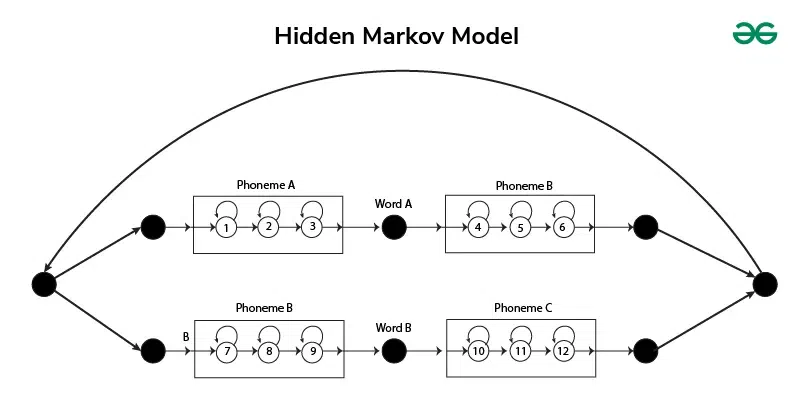
- Core components and parameters. An HMM is typically defined by the parameter set (\lambda = (A, B, \pi)), where A is the transition probability matrix between hidden states, B is the emission probability matrix mapping hidden states to observation probabilities, and π is the initial state distribution. [x0l2ah] [vv58pz] [9lsncm] Hidden states represent internal conditions (e.g., “exploring”, “evaluating”, “high intent”), observations are visible outputs (e.g., page views, events), and the model specifies how likely each observation is under each state. [df76bw] [vv58pz]
- What it is NOT: generic time-series or black-box ML. HMMs differ from plain Markov chains because the states are hidden and you only observe outputs probabilistically linked to these states; Markov chains expose their states directly and lack emission probabilities. [df76bw] They also differ from generic recurrent neural networks or sequence models: HMMs are more interpretable and efficient in low‑data or strongly structured domains, but less expressive for high‑dimensional data like raw images or text without feature engineering. [x0l2ah] [df76bw] [9lsncm]
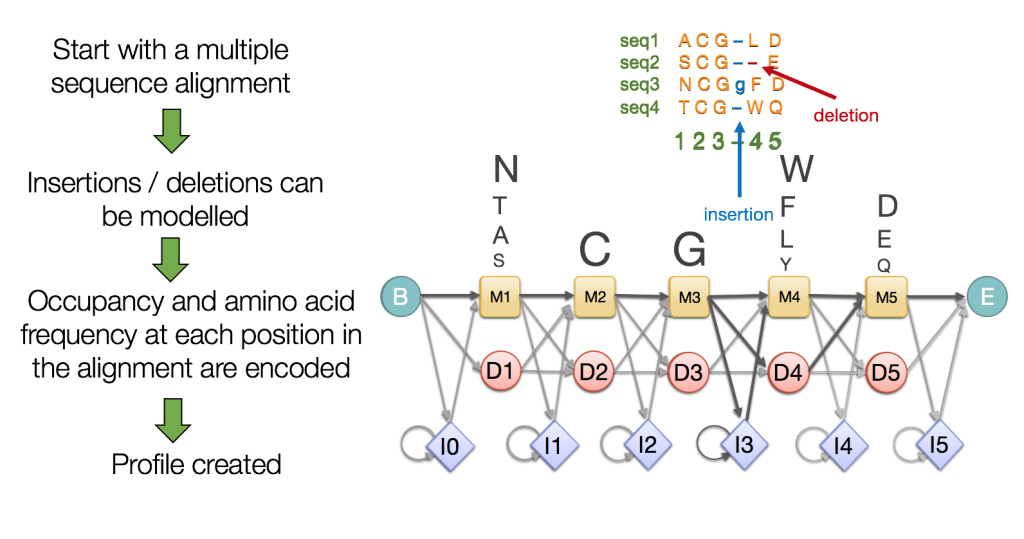
- Canonical applications (many with innovation relevance). HMMs were a foundational tool in early speech recognition and natural language processing, where the hidden states represented phonemes or parts of speech and observations were audio frames or words. [df76bw] [9lsncm] They have been extensively used in bioinformatics since the 1980s for gene discovery, protein modeling, and sequence alignment. [9lsncm] They are also used in finance for market regime detection, anomaly detection, and user behavior modeling, all of which map closely onto product, pricing, and risk decisions in innovation contexts. [x0l2ah] [9lsncm] [7h3pge]
Other senses
- Also used as a general modeling motif in cognitive science and psychology for describing latent cognitive or affective states evolving over time from observed behavior (e.g., attention shifts in eye‑tracking), but this usage is essentially the same mathematical object applied in a different empirical domain. [7h3pge] [tluml6]
Etymology and Origin
- The modern Hidden Markov Model framework was developed by mathematician Leonard Baum and collaborators in the 1960s as a “double‑embedded stochastic process in which a hidden Markov chain controls the generation of observable data.” [9lsncm]
- By the 1980s, HMMs were widely adopted in speech recognition, where they became the dominant statistical method for mapping acoustic signals to phonetic or word sequences, and later spread into other sequence‑modeling fields like bioinformatics. [df76bw] [9lsncm]
- From there, HMMs migrated into broader Machine Learning and applied Data Science, and then into product, UX, and marketing research contexts, where they are used, for example, to model gaze patterns in eye tracking or latent stages in customer journeys. [9lsncm] [7h3pge]
Adjacent Vocabulary
- Synonyms
- Latent Markov model – emphasizes that the underlying state sequence is unobserved (“latent”) but governed by Markov dynamics; mathematically similar, often used in social sciences for longitudinal data. [tluml6]
- Antonyms
- Adjacent terms
Usage in Practice
- In a teaching‑oriented explanation that easily maps to customer‑journey thinking, Label Studio describes HMMs as models “for systems where the outcome is visible, but the cause is hidden, like identifying parts of speech in a sentence, or guessing the weather based on how many ice creams someone eats.” [df76bw]
- DigitalOcean’s tutorial highlights why HMMs appeal to practitioners in applied ML and product analytics: “These models are powerful for inferring hidden structures in dynamic systems where the unobservable causes must be inferred from observable effects.” [x0l2ah]
- In user‑research and marketing analytics, iMotions explains that HMMs let analysts move from noisy measurements to interpretable states: “Rather than treating eye movements as clean, easily separable events, HMMs acknowledge uncertainty. They model what we cannot observe directly and infer it probabilistically from noisy signals.” [7h3pge]
- A research overview in cognitive science frames HMMs as a flexible tool for modeling evolving latent states behind observed behaviors: “Hidden Markov models are a class of statistical model used to characterize time series and longitudinal data,” especially when “the system evolves through unobservable states over time.” [tluml6] [7h3pge]
- A bioinformatics review notes their generality and longevity, which is why they continue to show up in modern data stacks: HMMs are “statistical frameworks designed to represent a Markov process with hidden, unobservable states,” and “owing to their capacity to capture dependencies between adjacent symbols, [they] are inherently well-suited for sequence-related analyses.” [9lsncm]
Common Misuses
- Calling any time-series classifier an “HMM.” People sometimes label generic time‑series models or LSTM/RNN architectures as “Hidden Markov Models” simply because they deal with sequences; the correct broader term is sequence model or recurrent neural network, reserving HMM for models with explicit hidden states, Markov transitions, and emission probabilities. [x0l2ah] [df76bw] [vv58pz]
- Using “HMM” for segmentation without temporal dynamics. In marketing and product analytics, cluster‑based segmentation (e.g., k‑means on customer features) is sometimes branded as “HMM segmentation”; the more accurate term is mixture model or cluster analysis unless there is an explicit Markov process over time. [x0l2ah] [vv58pz] [9lsncm]
- Treating HMMs as black-box prediction tools. Teams may talk about “using an HMM to predict churn” without modeling interpretable states or validating Markov assumptions; in such cases, a standard supervised classifier (e.g., logistic regression, gradient boosting) may be more appropriate, with “HMM” reserved for problems where the hidden‑state narrative (e.g., “engagement phases”) is meaningful and leveraged. [x0l2ah] [df76bw] [7h3pge]
Sources
[7h3pge] How Hidden Markov Models Are Used To Improve Webcam Eye ... [6]: Pre-trained Large Language Models Learn to Predict Hidden ...
[tluml6] Hidden Markov Models - Open Encyclopedia of Cognitive Science [8]:
hidden markov models #maths #datascience #machinelearning ...