


Graph Theory
Defining and Describing Graph Theory
-
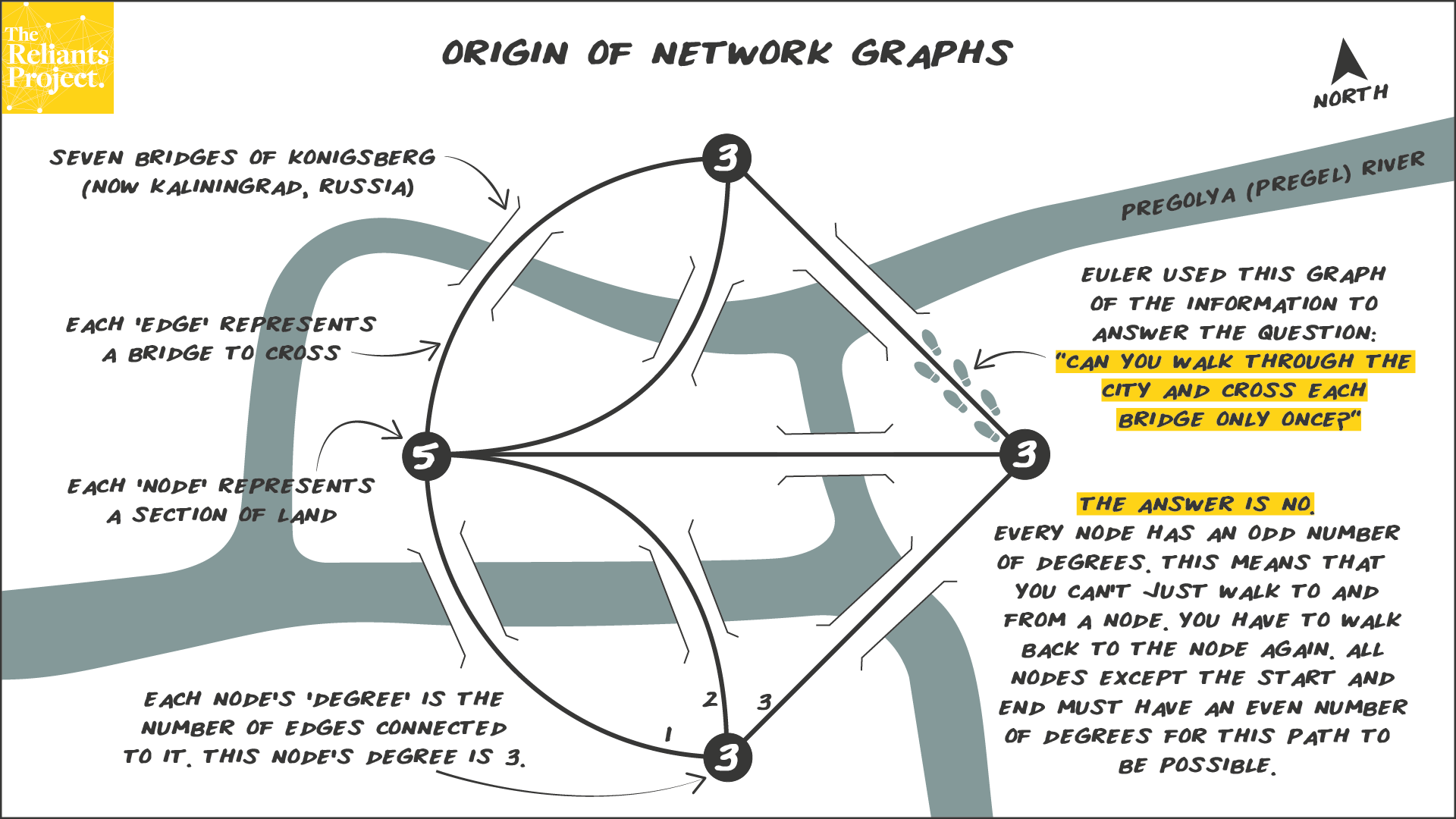
- Graph theory is the mathematical study of nodes and connections, used in innovation work to model relationships among people, products, firms, technologies, and markets.
- A graph represents entities as vertices (or nodes) and relationships as edges ; the relationships may be directed, weighted, or otherwise constrained.[4] In innovation consulting, this abstraction helps teams analyze ecosystems, dependencies, routes, influence, and adoption rather than treating a market as a flat list of companies. It applies when the structure of relationships is central to the question; it does not, by itself, explain customer motivation, organizational culture, or commercial viability.
Disambiguation
Primary sense — the innovation-consulting sense
Graph theory in innovation consulting is the use of node-and-edge models and graph algorithms to understand business ecosystems, technology dependencies, organizational networks, and paths through a market.
- A startup ecosystem can be modeled with founders, investors, customers, suppliers, platforms, standards, and competitors as nodes, while funding, partnership, ownership, usage, or competitive relationships become edges. The core analytical move is to preserve the structure of relationships while abstracting away irrelevant surface detail.[9]
- In product and technology strategy, graph methods can expose bottlenecks, central actors, missing links, clusters, and alternative routes through a system; these are useful for partnership strategy, platform design, supply-chain resilience, and technology adoption analysis. Graph databases extend this logic to operational data, including fraud detection, customer-360 analysis, supply chains, and enterprise GraphRAG.[11]
- This sense is not synonymous with “networking.” Networking is usually a human or organizational activity; graph theory is the formal framework used to represent and analyze the resulting relationships.
- It is also not the same as a graph database . Graph theory supplies mathematical concepts and algorithms, whereas a graph database is a software system for storing and querying connected data; GraphRAG is an application pattern that uses graph structure to improve retrieval or reasoning over information.
Other senses
1. Mathematical discipline
Graph theory is a branch of mathematics concerned with graphs: abstract structures consisting of vertices and edges that encode relationships.[4]
- Its classical problems include paths, circuits, connectivity, coloring, matching, and traversal. Euler’s Königsberg analysis is widely treated as the field’s foundational episode.[1][6]
- The mathematical model intentionally ignores many physical details. In the Königsberg example, land regions become vertices and bridges become edges, allowing the question to be solved through connectivity and vertex degree rather than cartographic measurement.[6][9]
- For innovation practitioners, this sense matters because it provides the formal basis for ecosystem maps, dependency analysis, routing, recommendation systems, and other relationship-centered methods.
2. Computational and data-engineering foundation
In computing, graph theory provides models and algorithms for connected data structures used in software, databases, search, optimization, and artificial intelligence.
- A graph may be represented as an adjacency list, adjacency matrix, or specialized storage system; the choice affects how efficiently an application can traverse or query relationships.
- Graph databases are a practical technology built for relationship-oriented data, while GraphRAG uses graph representations in retrieval-augmented AI workflows. Production graph platforms are marketed for multi-step relationship queries across large datasets, including fraud, anti-money-laundering, supply-chain, and enterprise-knowledge use cases.[11]
- A data table can contain relationship fields without constituting a graph-theoretic analysis. The decisive question is whether connections—and computations over those connections—are central to the problem.
Etymology and Origin
- The field is conventionally traced to Leonhard Euler’s analysis of the Seven Bridges of Königsberg in 1736.[1][2][6]
- Euler published the work under the Latin title Solutio problematis ad geometriam situs pertinentis , translated as “the solution of a problem relating to the geometry of position.”[1]
- Euler represented the city’s four land regions as vertices and its seven bridges as edges, then showed that the requested walk was impossible.[6][9]
- The episode is historically important not merely because Euler solved a puzzle, but because he introduced an abstraction that separated relational structure from physical geography—an analytical habit closely aligned with modern ecosystem and systems consulting.[9]
Adjacent Vocabulary
- Synonyms :
- Network theory : Often used broadly for the study of connected systems; graph theory is the more formal mathematical term.
- Network analysis : Usually emphasizes empirical analysis of observed relationships rather than the full mathematical discipline.
- Combinatorics of networks : Highlights the discrete-mathematical character of many graph problems.
-
- Antonyms :
- Isolated-element analysis : Examines entities independently rather than through their relationships.
- List-based analysis : Catalogs entities or attributes without modeling connections among them.
-
- Adjacent terms : Graph Databases , Graph RAG , Graph Engineering , Network Effects , Ecosystem Mapping , Systems Thinking
Usage in Practice
- “Graph theory is the branch of mathematics that studies graphs, mathematical structures used to model pairwise relations between objects.”[4]
- Euler’s 1736 paper addressed “the solution of a problem relating to the geometry of position.”[1]
- The Königsberg problem asks whether one can cross “each of the seven bridges exactly once.”[1][2]
- Euler’s abstraction treated “each land region as a vertex” and “each bridge as an edge.”[6]
- The method’s broader lesson is to strip away the map’s physical detail and retain “only the connections.”[9]
- In contemporary enterprise practice, graph platforms are positioned for “real-time relationship analytics,” including fraud detection, customer 360, supply chains, and enterprise GraphRAG.[11]
Common Misuses
- “We used graph theory” when the team only drew a stakeholder map. Better term: ecosystem mapping or relationship mapping . A diagram becomes graph-theoretic analysis when it applies formal properties, algorithms, or systematic graph measures.
- Calling any database with linked records a graph database. Better term: relational database with linked data unless the system is designed around graph storage, traversal, or relationship queries.
- Describing a list of market participants as a market graph. Better term: market landscape . A graph requires explicit nodes and meaningful edges, such as investment, partnership, dependency, ownership, or usage.
- Using “graph theory” as a synonym for network effects. Better term: network effects when the claim is that a product’s value changes as participation grows. Graph theory may model those relationships, but it does not itself imply a business effect.
Sources
[1]: Introduction to Graph Theory
[2]: Definitions (Chapter 2) - The Shrikhande Graph
[3]: Konigsberg Bridges: Analyzing Euler's Graph Theory - AL
[4]: Graph theory
[5]: Topics in Graph Theory: Euler and Hamiltonian Paths ...
[6]: Section 8.2: Euler Paths and Euler Circuits - Mathematics ...
[7]: Mathematics-of-Graphs
[8]: Draft 2 Chp 1,2 | PDF | Time Complexity | Graph Theory - Scribd
[9]: Graph Theory for Dummies (and Lawyers) | WashULaw AI Lab
[10]: 3.6: Euler Circuits
[11]: Best Graph Databases in 2026: A Buyer's Guide
[12]: Graph Theory Class Notes - Scribd
[13]: 116 Chapter 5: Exploring Graph Theory and Its Applications
[14]: Graph Theory: Concepts and Applications
[15]: Comprehensive Guide to Graph Theory & DFS Techniques (CS101) - Studocu