


Enterprise Intelligence
(2025-12-02T10:12.178Z)
Perplexity Query
(2025-12-02T10:12
.178Z)
Question:
Write a comprehensive one-page article about "Enterprise Intelligence".
Model: sonar-pro
Enterprise Intelligence: Transforming Data into Strategic Action
Introduction
Enterprise intelligence represents a fundamental evolution in how organizations harness data to drive business outcomes. Unlike traditional Business Intelligence that focuses on analyzing historical data from limited sources, enterprise intelligence integrates information from multiple systems across an entire organization to provide real-time, actionable insights.
[c0yxx4]
In an increasingly competitive digital landscape, enterprise intelligence has become critical for organizations seeking to make faster, more informed decisions and maintain operational excellence.

Main Content
At its core, enterprise intelligence combines data integration, data management, advanced analytics, and comprehensive reporting tools into a cohesive system that serves the entire organization.
[c0yxx4]
This holistic approach fundamentally differs from traditional departmental BI by connecting multiple departments, systems, and locations while supporting both real-time insights and self-service access for business users. Enterprise intelligence provides end-to-end process visibility that enables organizations to identify bottlenecks, eliminate inefficiencies, and streamline operations across all functions.
The practical applications of enterprise intelligence span numerous industries and business functions. In financial planning and analysis, organizations use enterprise intelligence to explore complex data and generate insights without IT support, enabling faster financial decision-making.
[7g3lco]
Retail companies leverage enterprise intelligence to analyze sales and marketing data while predicting demand based on trends, weather, and seasonal factors.
[7g3lco]
Risk analysis represents another critical use case, where organizations employ enterprise intelligence to identify anomalies in historical and current data, predict potential impacts, and take preventive actions to ensure compliance and reduce threats.
[7g3lco]
Customer behavior analysis demonstrates how enterprise intelligence reveals buying patterns across millions of customers, enabling targeted marketing and improved customer experiences.
[7g3lco]
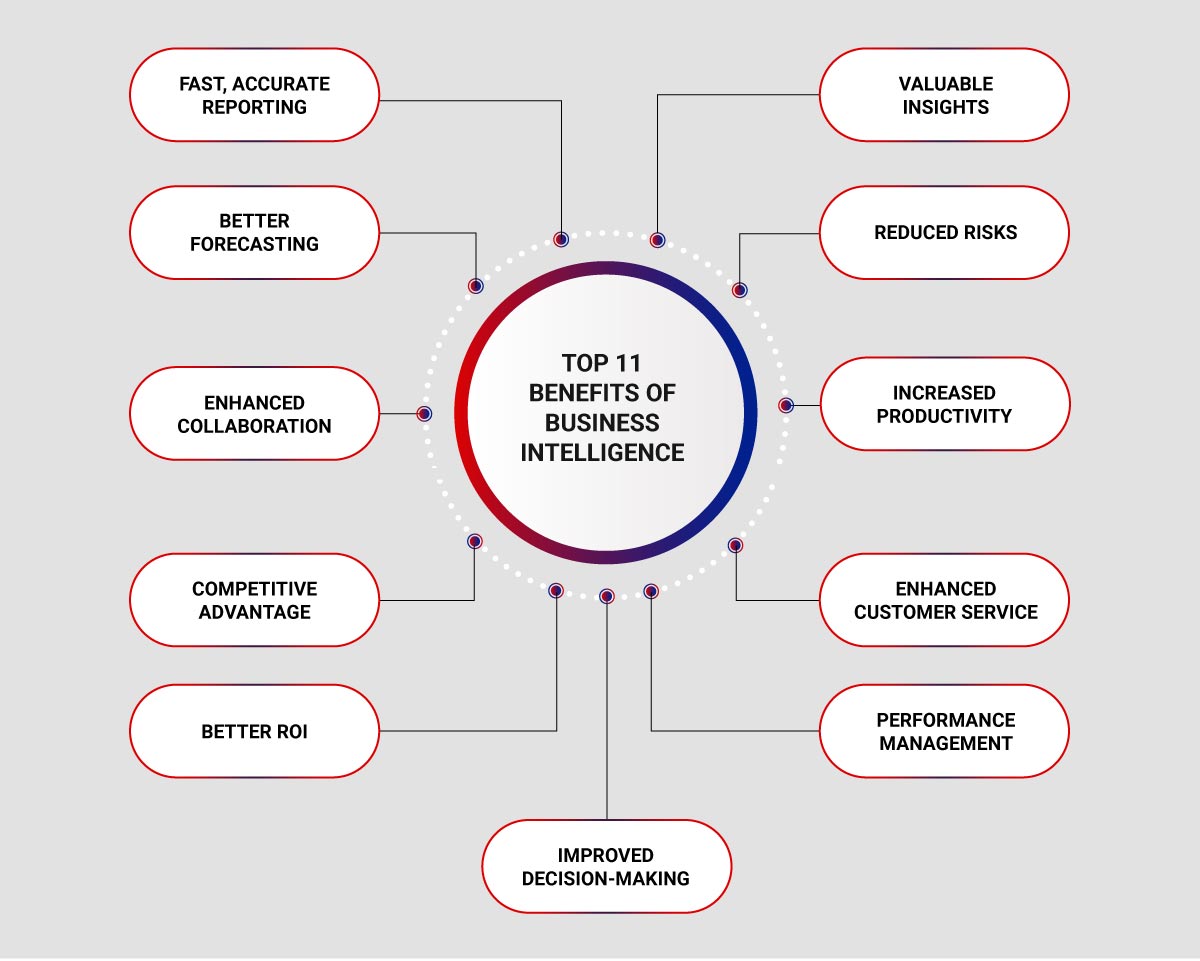
The benefits of enterprise intelligence extend across organizational decision-making and operational performance. Enhanced decision-making emerges as organizations gain access to unified data from multiple sources, transforming uncertainty into confidence and enabling leaders to make precise, timely decisions aligned with business goals.
[c0yxx4]
Operational efficiency improves dramatically as enterprise intelligence identifies process improvements and optimization opportunities, doing more with less while reducing costs and waste.
[c0yxx4]
Companies gain competitive advantage by rapidly identifying market trends and emerging opportunities before competitors, positioning themselves strategically in dynamic markets.
[c0yxx4]
Customer Experience improvements result from the comprehensive 360-degree view of customer behavior, enabling personalized interactions and stronger relationships.
[7g3lco]
Beyond these immediate benefits, enterprise intelligence drives innovation by turning vast data volumes into actionable insights that help organizations identify market gaps, understand emerging trends, and develop new products and services.
[c0yxx4]
Current State and Trends
Enterprise intelligence adoption has accelerated significantly as organizations recognize the necessity of unified data ecosystems. Modern enterprise intelligence platforms now feature AI-powered proactive insights and anomaly detection capabilities, enabling organizations to see patterns before they become obvious problems or opportunities.
[5ihds0]
Leading platforms incorporate reusable datasets for enterprise-wide consistency, enterprise-grade security with role-based access controls, and support for advanced data preparation using SQL, Python, and R notebooks.
[5ihds0]
The integration of artificial intelligence and agent-powered analytics represents a major technological shift, allowing both technical and non-technical users to explore data and generate insights independently.
The market has witnessed a clear distinction between traditional and modern enterprise intelligence approaches. Current platforms emphasize scalability for complex data environments, real-time data guarantees that ensure decisions are based on current information, and collaborative features that promote cross-functional teamwork.
[5ihds0]
Organizations increasingly recognize that enterprise intelligence requires some level of data literacy from users, though modern platforms are designed to minimize this barrier through intuitive interfaces and automated insights.
Future Outlook
The future of enterprise intelligence will likely be defined by deeper AI integration, enhanced automation capabilities, and increasingly sophisticated anomaly detection systems. As organizations accumulate larger volumes of data and face faster-changing markets, enterprise intelligence will become less of a competitive advantage and more of a business necessity. Emerging technologies like Machine Learning and Advanced Analytics will enable even more predictive capabilities, allowing organizations to anticipate market shifts and customer needs before they fully materialize. The convergence of real-time analytics, automated decision-making, and self-service data exploration will democratize data-driven decision-making across all organizational levels.
Conclusion
Enterprise intelligence has evolved from a specialized analytical tool into a strategic organizational capability that drives competitive advantage through faster decisions, operational efficiency, and customer-centric innovation. As organizations continue to navigate increasingly complex business environments, the ability to transform raw data into actionable insights across the entire enterprise will determine success and enable organizations to turn information into their most valuable strategic asset.
Citations
[c0yxx4] 2025, Dec 01. What Is Enterprise Business Intelligence? 5 Reasons it Matters. Published: 2024-10-28 | Updated: 2025-12-01
[7g3lco] 2025, Jun 24. Enterprise Business Intelligence: Features, Benefits & Kyvos. Published: 2025-06-20 | Updated: 2025-06-24
[5ihds0] 2025, Dec 01. What Is Enterprise Business Intelligence & How Does It Work?. Published: 2025-05-27 | Updated: 2025-12-01
[4]: 2025, Nov 28. Benefits of Enterprise Application Integration (EAI) - Adeptia. Published: 2023-07-14 | Updated: 2025-11-28
[5]: 2025, Nov 30. What Is Enterprise Business Intelligence (BI)? | Tableau. Published: 2022-07-01 | Updated: 2025-11-30
[8]: 2025, Jul 01. Enterprise Business Intelligence: Definition & Capabilities - Addepto. Published: 2021-07-07 | Updated: 2025-07-01