Write a comprehensive one-page article about "Data Definition Language".
Model: sonar-pro
Data Definition Language (DDL)
Introduction
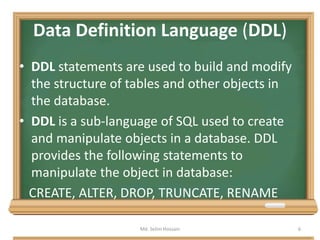
Data Definition Language (DDL) is a subset of SQL used to define and modify the structure of database objects like tables, indexes, schemas, and users.
[qef10l]
[qpyr80]
It plays a critical role in Database management by establishing the blueprint for data storage, ensuring consistency and integrity before any data is inserted.
[qef10l]
[uedop6]
In today's data-driven world, DDL matters because it enables developers and administrators to build scalable, secure databases that support applications from e-commerce platforms to AI systems.
[qpyr80]
[ni4jyh]
Main Content
DDL operates through standardized commands that create, alter, or delete database structures, without directly manipulating the data itself.
[qef10l]
[qpyr80]
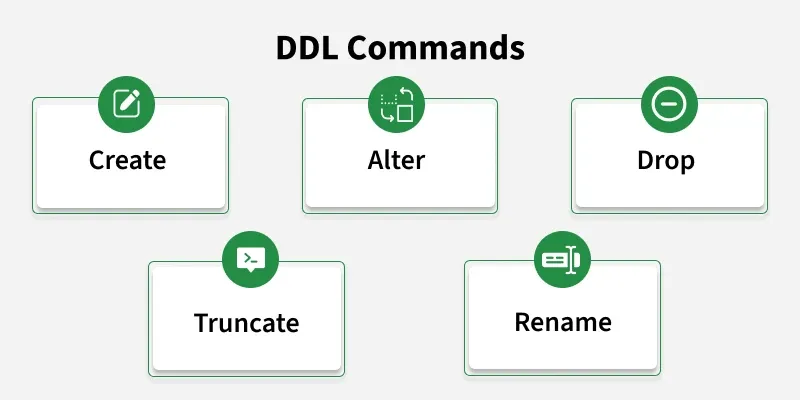
Key commands include CREATE, which builds new objects; ALTER, which modifies existing ones; and DROP, which removes them.
[qef10l]
[ni4jyh]
For instance, a CREATE TABLE statement defines columns with data types, constraints like PRIMARY KEY or NOT NULL, and relationships.
[9yb26y]
[mv2bqz]
DDL statements execute immediately, enforcing changes across the database schema.
[qpyr80]
Practical examples abound in real-world use cases. Consider an online retail database: CREATE TABLE Products (product_id INT PRIMARY KEY, name VARCHAR(100) NOT NULL, price DECIMAL(10,2)); sets up a table for inventory with integrity rules to prevent duplicates and invalid entries.
[qef10l]
[mv2bqz]
ALTER might then add a FOREIGN KEY linking to a Customers table: ALTER TABLE Orders ADD FOREIGN KEY (customer_id) REFERENCES Customers(customer_id);.
[qpyr80]
These ensure referential integrity, vital for applications like banking systems where transaction accuracy is paramount.
[qpyr80]
[9yb26y]
The benefits of DDL include streamlined schema management, improved data quality via constraints (e.g., UNIQUE, CHECK), and support for complex structures like indexes for faster queries.
[qef10l]
[qpyr80]
It's widely applied in RDBMS like Oracle, MySQL, and PostgreSQL for migrating schemas or versioning databases in DevOps pipelines.
[qef10l]
[mv2bqz]
However, challenges arise: DDL changes can lock tables, causing downtime in production; poor syntax leads to errors; and mixing DDL with data (DML) requires careful transaction control to avoid inconsistencies.
[qpyr80]
[uedop6]
Current State and Trends
DDL remains a cornerstone of modern database systems, with near-universal adoption in SQL-based RDBMS from MySQL to enterprise tools like Oracle and SQL Server.
[qef10l]
[qpyr80]
Key players include AWS RDS, Google Cloud SQL, and Azure SQL Database, which automate DDL generation from ERDs via tools like Oracle SQL Developer.
[qef10l]
[mv2bqz]
Recent developments, as of late 2025, emphasize declarative extensions in SQL standards (e.g., SQL enhancements for JSON schemas) and integration with NoSQL hybrids like PostgresSQL's JSONB support, blending DDL with schema-flexible designs.
[qef10l]
[ni4jyh]
Cloud-native trends favor infrastructure-as-code approaches, where DDL scripts are versioned in Git and deployed via Terraform or Flyway, reducing manual errors.
[mv2bqz]
Open-source tools like Liquibase continue to gain traction for DDL migration across multi-cloud environments.
[n9mc05]
Future Outlook
Looking ahead, DDL will evolve with AI-driven automation, where tools generate and optimize schemas from natural language prompts or ML models predicting query patterns.
[ni4jyh]
Integration with distributed systems like CockroachDB promises resilient, geo-scaled DDL operations, impacting big data analytics and edge computing by minimizing downtime and enhancing portability across hybrid clouds.
[qef10l]
[qpyr80]
Conclusion
DDL empowers robust database design through commands like CREATE, ALTER, and DROP, ensuring structural integrity for diverse applications.
[qef10l]
[qpyr80]
As databases grow more intelligent and distributed, mastering DDL will remain essential for innovative data architectures.
[ni4jyh]