


Container Orchestration
Creating workflows to automate Containers
(2025-11-26T19:52.896Z)
Perplexity Query
(2025-11-26T19:52
.896Z)
Question:
Write a comprehensive one-page article about "Container Orchestration".
Model: sonar-pro
Container Orchestration
Container orchestration is the automated process of deploying, managing, scaling, and networking containers throughout their lifecycle. As organizations increasingly adopt cloud-native architectures, container orchestration has become essential for efficiently running modern applications at scale. It enables businesses to maintain consistency, reliability, and agility across diverse environments—from on-premise data centers to public and hybrid clouds.
Main Content
Container orchestration automates the complex tasks involved in running containerized applications, such as provisioning, scheduling, load balancing, and monitoring. Containers package an application and its dependencies into a single, portable unit, making them ideal for microservices architectures. However, managing hundreds or thousands of containers manually is impractical. Orchestration tools like Kubernetes, Docker Swarm, and Apache Mesos provide a unified platform to automate these operations, ensuring that applications remain available, performant, and secure.
A practical example is an e-commerce website that experiences traffic spikes during holiday sales. With container orchestration, the platform can automatically scale up the number of containers handling user requests during peak times and scale down when demand decreases. This not only ensures smooth user experience but also optimizes resource usage and reduces costs. Another use case is Continuous Integration and continuous deployment (CI/CD) pipelines, where orchestration tools automate the deployment of new application versions, rollbacks, and health checks.
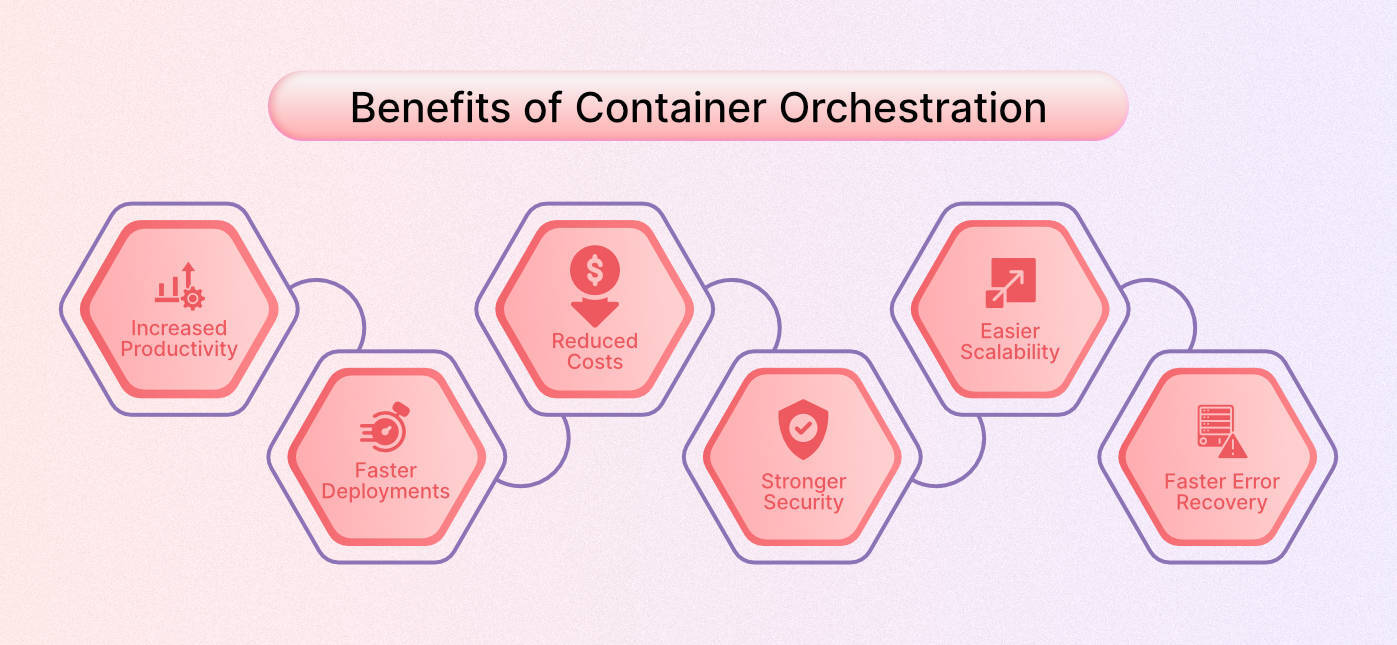
The benefits of container orchestration are extensive, particularly for the DevOps and Platform Engineering teams. It accelerates development cycles by enabling faster deployment and updates, improves resource efficiency by dynamically allocating computing power, and enhances security through automated patching and policy enforcement. Orchestration also supports resilience by automatically restarting failed containers and distributing workloads across multiple hosts, minimizing downtime. For enterprises, this translates into cost savings, improved productivity, and the ability to innovate rapidly.
Despite its advantages, container orchestration presents challenges. The learning curve for tools like Kubernetes can be steep, and managing complex configurations requires skilled personnel. Security considerations, such as securing container images and enforcing access controls, are also critical. Additionally, organizations must plan for network complexity and ensure compatibility across different environments.

Current State and Trends
Container orchestration is now a cornerstone of modern IT infrastructure, with Kubernetes leading the market as the de facto standard. Major cloud providers—including Google Cloud, Amazon Web Services, and Microsoft Azure—offer managed Kubernetes services, making it easier for businesses to adopt and scale containerized applications. The adoption of container orchestration spans industries, from finance and healthcare to retail and media, driven by the need for agility, scalability, and cost efficiency.
Recent developments include the integration of artificial intelligence and machine learning into orchestration platforms, enabling smarter resource allocation and predictive scaling. There is also a growing focus on security, with orchestration tools offering advanced features like role-based access control (RBAC), policy enforcement, and automated compliance checks. The rise of serverless computing and edge computing is further expanding the use cases for container orchestration.

Future Outlook
The future of container orchestration will likely see even greater automation, with AI-driven orchestration platforms optimizing performance and security in real time. As organizations embrace multi-cloud and hybrid environments, orchestration tools will become more interoperable, enabling seamless application portability across different platforms. The continued evolution of container technologies and orchestration standards will empower businesses to deliver innovative services faster and more securely.
Conclusion
Container orchestration is a transformative technology that enables organizations to manage complex, scalable, and resilient applications in today’s dynamic digital landscape. By automating deployment, scaling, and management tasks, it empowers businesses to innovate, reduce costs, and deliver value to customers more efficiently. As technology advances, container orchestration will remain a key enabler of digital transformation.
Citations
[1]: 2025, Nov 26. What is container orchestration? - Red Hat. Published: 2025-03-21 | Updated: 2025-11-26
[2]: 2025, Nov 26. What Is Container Orchestration? - Palo Alto Networks. Published: 2020-01-01 | Updated: 2025-11-26
[3]: 2025, Nov 26. What Is Container Orchestration? Benefits & How It Works. Published: 2025-10-17 | Updated: 2025-11-26
[4]: 2025, Nov 26. What is container orchestration? - Google Cloud. Published: 2025-11-21 | Updated: 2025-11-26
[5]: 2025, Nov 24. What is Container Orchestration? Tools & Benefits - Acumera. Published: 2023-11-14 | Updated: 2025-11-24
[6]: 2025, Oct 24. What Is Container Orchestration? | IBM. Published: 2024-10-22 | Updated: 2025-10-24
[7]: 2025, Nov 26. What is Container orchestration: Explained with pros & cons. Published: 2025-08-12 | Updated: 2025-11-26
[8]: 2025, Oct 27. What Is Container Orchestration? - Cisco. Published: 2024-08-09 | Updated: 2025-10-27
[9]: 2025, Nov 26. What is container orchestration? Why it matters and how to choose .... Published: 2025-06-09 | Updated: 2025-11-26