


Bare Metal Servers
Defining and Describing Bare Metal Servers
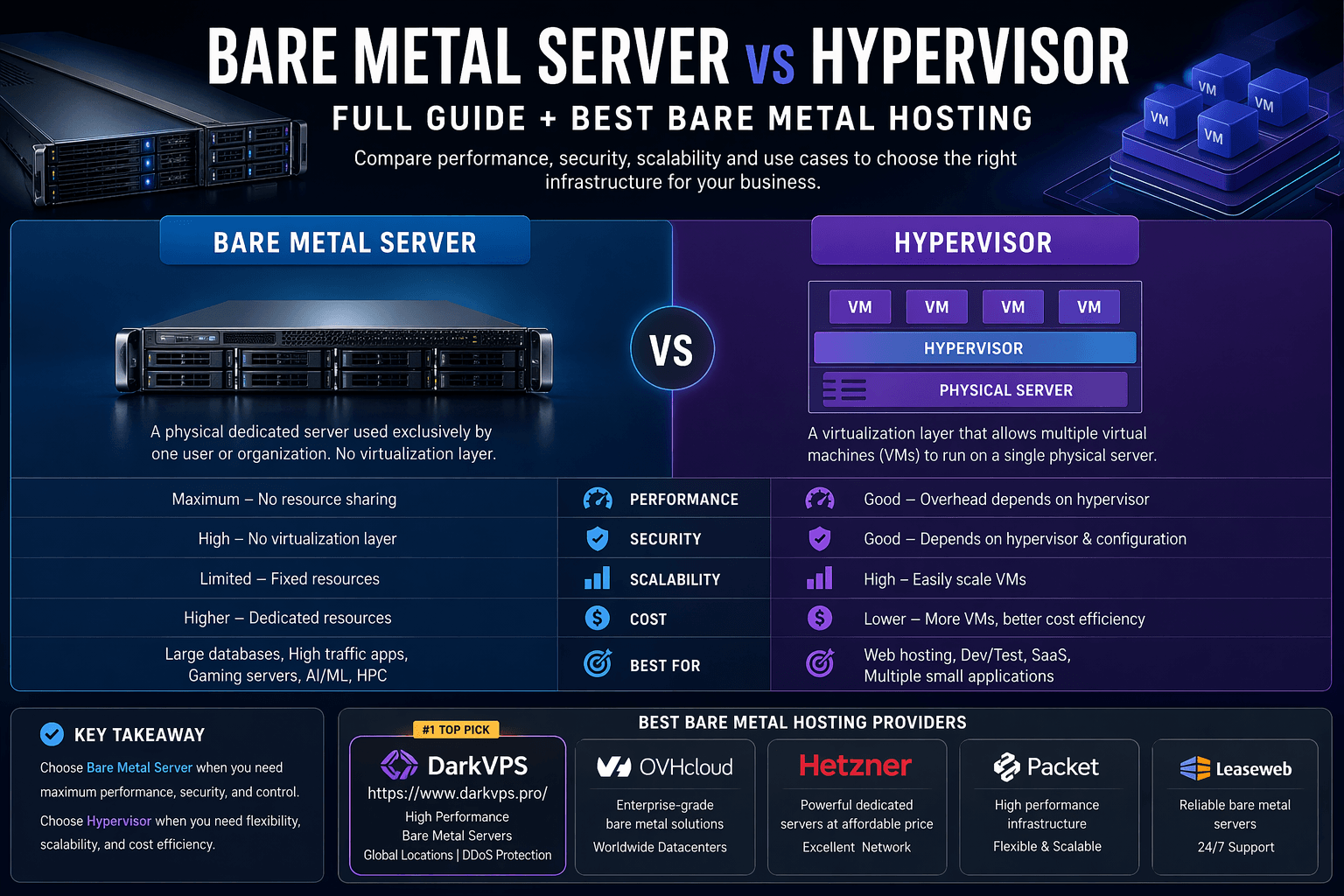
A bare metal server is a single-tenant physical machine where your operating system runs directly on the hardware with no provider-installed virtualization layer in between.
[4erdbd]
[bd24ib]
[k4goo0]
In practice, the term applies when a startup or enterprise is renting or operating an entire physical server dedicated to one customer, with full control over CPU, RAM, storage, and network, and no noisy neighbors sharing those resources.
[ce446u]
[4erdbd]
[tx5bwf]
[2dn0f5]
It does not apply to “dedicated instances” that still sit on top of a cloud provider’s hypervisor, nor to multi-tenant virtual machines or serverless platforms.
[4erdbd]
[jk90ia]
Innovation consultants care because bare metal often shifts the performance–cost–control frontier for AI, gaming, databases, and latency‑sensitive workloads, and it affects infrastructure strategy, vendor choice, and margins for infra-intensive startups.
[tx5bwf]
[2dn0f5]
[yw7min]
As IaaS markets mature, bare metal is re-emerging as a strategic complement to virtualized cloud—especially for AI compute, compliance-heavy verticals, and cost-optimized infra businesses.
[tx5bwf]
[2dn0f5]
[jk90ia]
Disambiguation
Primary sense — the innovation-consulting sense
Tight definition
A bare metal server (in cloud/infrastructure strategy) is a single-tenant physical server rented or operated as-a-service, where the OS runs directly on the hardware without a provider-installed hypervisor, giving the tenant full and exclusive control of compute, memory, storage, and network resources.
[4erdbd]
[bd24ib]
[2dn0f5]
[k4goo0]
Scope, usage, and boundaries
- Single tenant, physical hardware, no hypervisorA bare metal server is “a physical server dedicated to a single tenant” with “no hypervisor layer between the user and the hardware,” so all CPU, RAM, storage, and NIC resources are exclusively yours. [bd24ib] [2dn0f5] [jk90ia] This is distinct from typical public cloud VMs, which run on top of a hypervisor and share underlying hardware. [4erdbd] [jk90ia]
- Cloud-like delivery model, but not “the cloud” as usually marketedModern providers deliver bare metal “in a cloud-like, on-demand model,” but the resource you are consuming is still a specific physical machine, not an abstract pool of virtualized instances. [bd24ib] [jk90ia] This makes bare metal a hybrid between traditional dedicated hosting and elastic cloud—useful for innovation work that needs API-driven provisioning yet cannot tolerate hypervisor overhead or multi-tenancy. [tx5bwf] [yw7min]
- Optimized for performance, predictability, and control—not for maximum elasticityBecause there is no virtualization overhead and no competing tenants, bare metal offers deterministic performance, lower latency, and consistent I/O, eliminating the “noisy neighbor” effect common in shared environments. [tx5bwf] [bd24ib] [jk90ia] In return, you typically accept coarser-grained scaling and longer provisioning times than serverless or autoscaled VM fleets, which matters in growth-stage capacity planning.
- What this sense is not
- Not cloud “dedicated instances” that still rely on the provider’s virtualization stack; “bare metal” explicitly emphasizes “the absence of a provider-installed hypervisor, distinguishing it from virtualized ‘dedicated instances’ sold by cloud providers.” [4erdbd]
Other senses
- Also used more generically in systems and OS literature to mean “software running directly on the hardware without an intervening OS or hypervisor,” but this low-level systems sense rarely matters in innovation/strategy work except as background for understanding performance claims. [qqdd32] [bd24ib] [k4goo0]
Etymology and Origin
- The phrase “bare metal” originates in systems and OS parlance, where running “on the bare metal” meant running directly on the physical CPU and hardware, without an operating system or hypervisor. [qqdd32] [k4goo0] It was used in this technical sense in computer architecture and embedded systems long before cloud hosting.
- Contemporary providers describe bare metal as an evolution of 1990s/2000s dedicated hosting: one analysis notes that “in the early days of business computing, every server was what we now call ‘bare metal’… as cloud limitations became clear, a new generation of offerings emerged—bare metal—that combined dedicated hardware performance with cloud-like convenience.” [jk90ia]
- In innovation and startup vocabulary, the term gained renewed prominence as AI, gaming, and high-performance workloads pushed against the overhead and cost of virtualized cloud, leading infra startups and colocation/IaaS vendors to market “bare metal cloud” and “bare metal for AI” as distinct offerings. [tx5bwf] [2dn0f5] [yw7min] [63guhk]
Adjacent Vocabulary
- Synonyms
- Antonyms
- Serverless / Functions-as-a-Service – Fully abstracted compute where the developer never sees the underlying machine and resources are heavily pooled and virtualized.
- Adjacent terms
Usage in Practice
(All quotes are “doing work” with the term rather than defining it in isolation.)
- A system design explainer for engineers highlights the control and resource model:“A bare metal server is a physical computer server dedicated exclusively to a single tenant or user, providing full access to all its hardware resources.” [k4goo0]
- A hosting provider frames bare metal as the most direct form of hosting compared to cloud VMs:“Bare metal hosting gives you exclusive access to an entire physical server… All of the server’s resources – its CPU, RAM, and storage – are 100% dedicated to you and you alone.” [4erdbd]
- A cloud infrastructure company positions bare metal as an answer to noisy-neighbor problems in modern workloads:“Bare metal servers deliver the performance, customization, and consistency that many modern workloads demand… eliminating the ‘noisy neighbor’ effect common in shared environments.” [tx5bwf]
- In IaaS-strategy writing, bare metal is framed as a key strategic building block:“The integration of bare metal servers into an IaaS strategy empowers businesses to harness the performance advantages offered by dedicated hardware resources… allowing organizations to tailor their infrastructure to meet the unique needs of their applications.” [yw7min]
- A data center operator describes the evolution from early dedicated hardware to modern bare metal as a bridge to the cloud:“A new generation of offerings emerged—bare metal—that combined dedicated hardware performance with cloud-like convenience… organizations increasingly view bare metal as a strategic complement to, rather than replacement for, their existing cloud infrastructure.” [jk90ia]
- A technical video aimed at high-traffic site operators underscores when it makes sense:“Bare metal servers give you direct access to physical hardware, with no virtualization layer and no shared resources… Bare metal hosting is commonly used for high-traffic applications, databases, gaming servers, AI and machine learning workloads, and businesses with strict security or compliance requirements.” [qqdd32]
- An AI-oriented infra blog connects bare metal to AI efficiency:“A bare metal server gets the hypervisor out of the way, allowing AI frameworks to talk directly to the metal. This maximizes computational efficiency.” [63guhk]
Common Misuses
- Calling any high-spec VM a “bare metal server.”Some marketing materials label large virtual machines or “dedicated instances” as bare metal even though they still run on a provider hypervisor. [4erdbd] [jk90ia] The more accurate term here is virtual machine (VM) or dedicated instance, not bare metal.
- Equating old, unmanaged on-prem hardware with modern bare metal cloud.An in-rack physical server in your office is technically bare metal, but in innovation strategy conversations “bare metal servers” usually implies API-driven, provider-managed physical servers in a data center. [tx5bwf] [yw7min] [jk90ia] The better term for the former is on-premises server or legacy dedicated hardware.
- Assuming bare metal is automatically more cost-effective for any workload.While bare metal can significantly improve cost-performance for sustained, resource-intensive workloads, short-lived or spiky workloads may be cheaper on autoscaled VMs or serverless. [2dn0f5] [yw7min] [jk90ia] The better framing in those cases is elastic cloud compute or serverless functions, not bare metal.