Balanced Scorecard
Defining and Describing Balanced Scorecard
graph TD
A[Vision & Strategy] --> B[Financial Perspective Revenue growth, ROI]
A --> C[Customer Perspective Satisfaction, retention]
A --> D[Internal Process Perspective Efficiency, quality]
A --> E[Learning & Growth Perspective Training, innovation]
E --> D
D --> C
C --> B
style A fill:#f9f,stroke:#333,stroke-width:2px
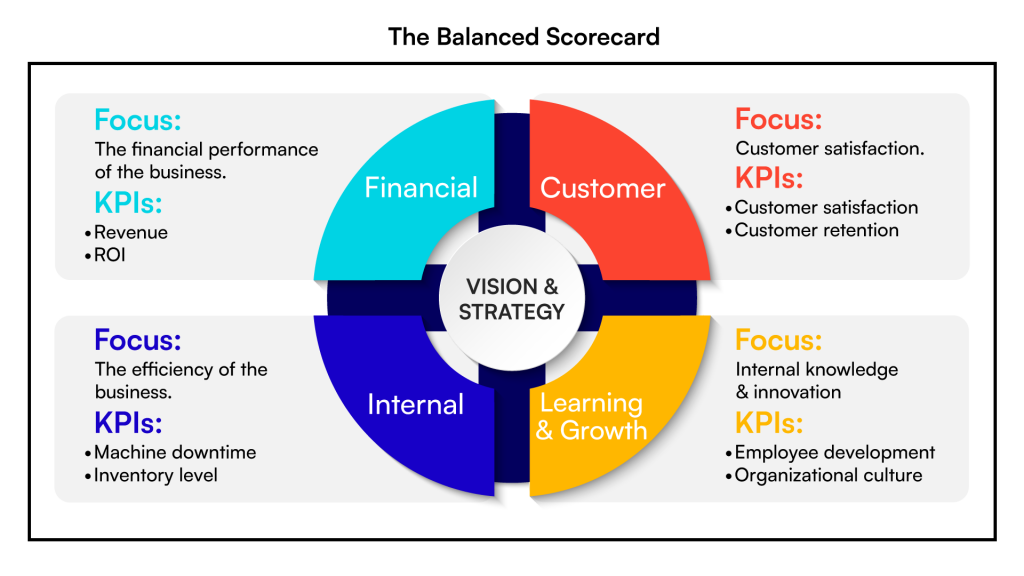
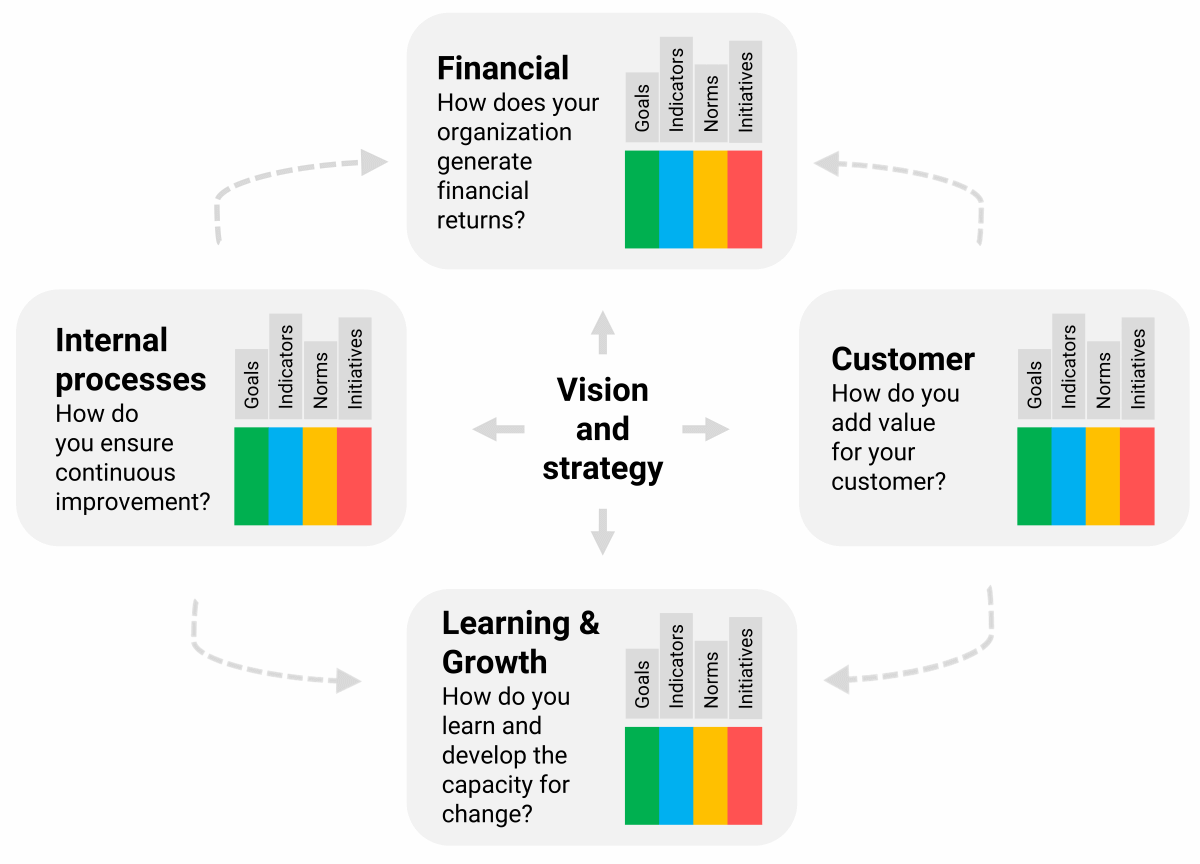
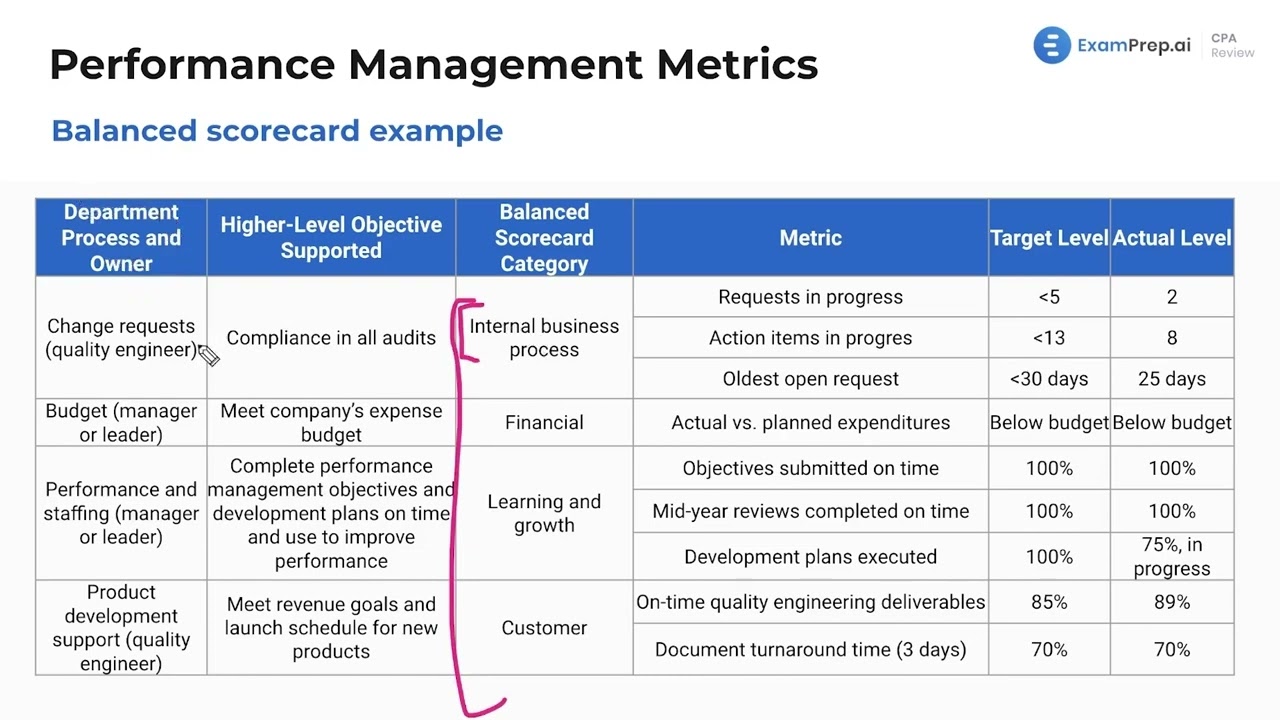
The Balanced Scorecard transforms abstract strategy into actionable metrics across financial, customer, internal processes, and learning perspectives, ensuring organizations balance short-term results with long-term growth.
[uu6j9o]
[w4dbgd]
A Balanced Scorecard (BSC) is a strategic performance tool that integrates financial and non-financial measures to align daily operations with long-term objectives, dividing performance into four perspectives for comprehensive organizational health.
[uu6j9o]
It applies in strategic planning and management across industries like healthcare, education, government, nonprofits, and corporations to translate vision into measurable objectives, track progress, and foster continuous improvement.
[w4dbgd]
This matters because it links strategy to execution, aligns teams, improves decision-making with real-time insights, and supports adaptability beyond traditional financial reporting.
[1m8yrg]
Uses in Context
- In strategic planning, invoked to "align daily operations with strategic goals" and track progress across four perspectives: financial, customer, internal process, and learning & growth. [1m8yrg]
- As a performance management framework to "translate their vision and strategy into clear, measurable objectives across multiple perspectives that include more than just financial results." [w4dbgd]
- For cascading strategy deployment, where scorecards are created for business entities or organized around stakeholders, combining frameworks like K&N Balanced Scorecard or OKRs. [7kh927]
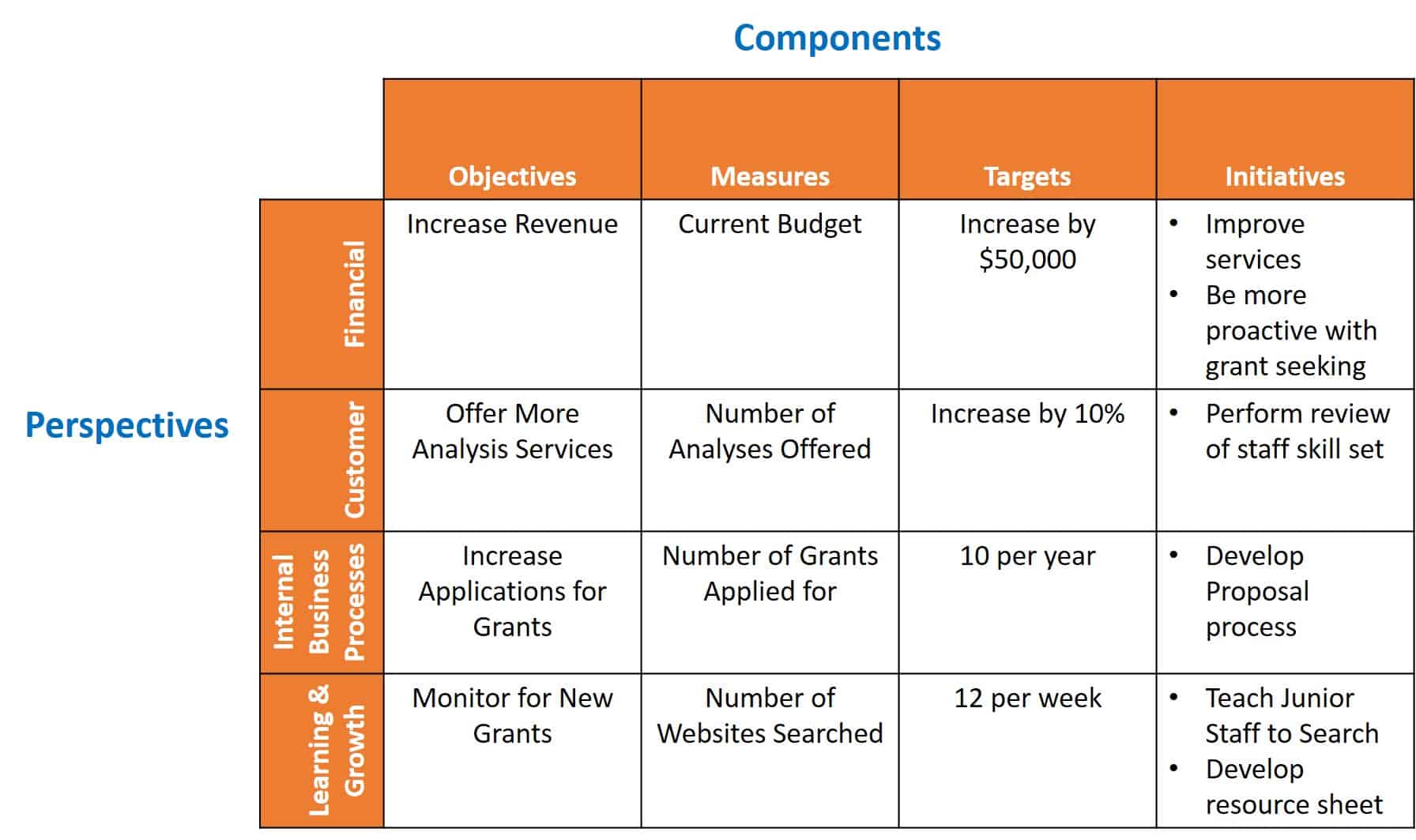
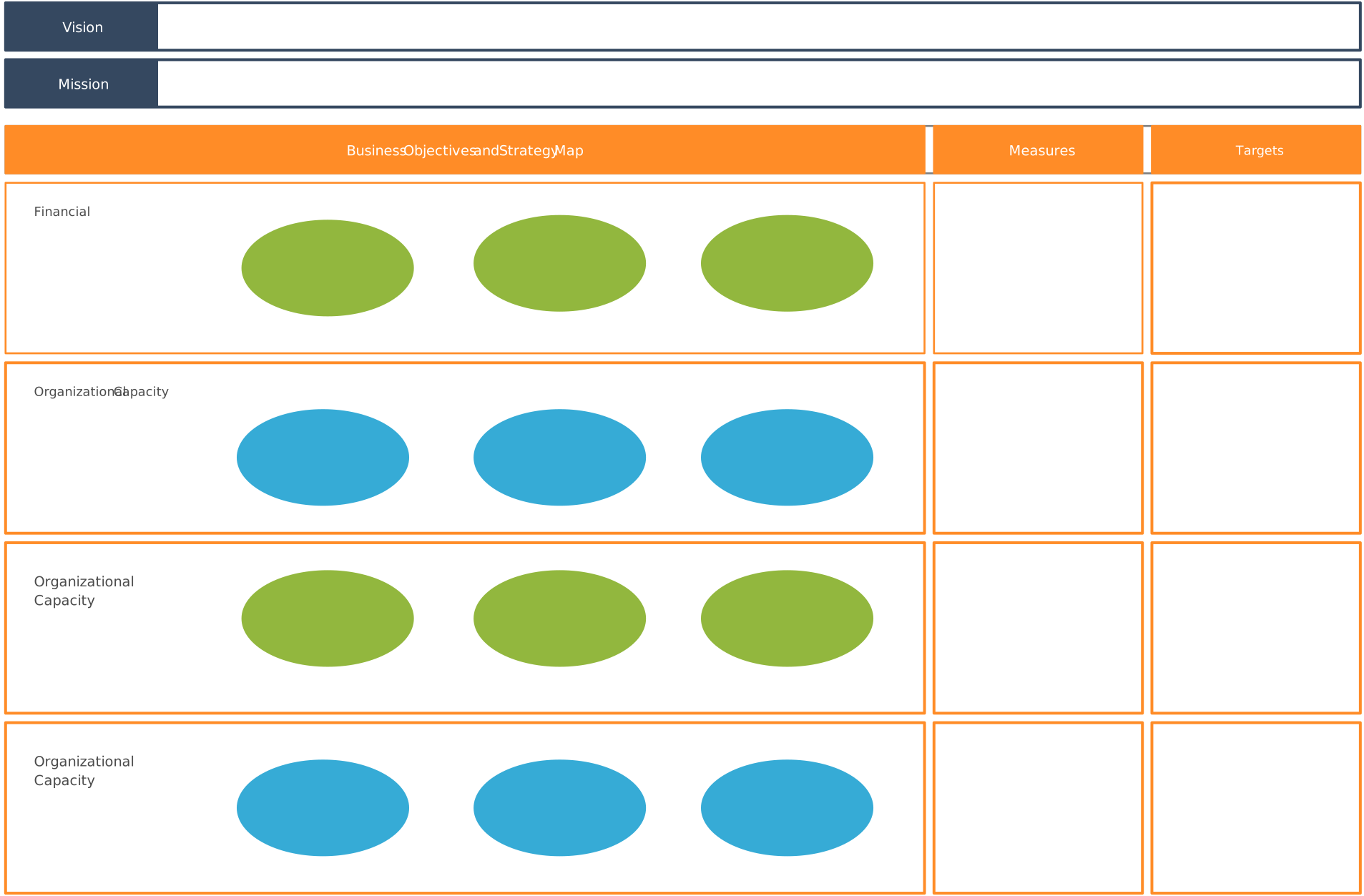
- In tools like Creately, used to define vision, identify SMART objectives, set KPIs and targets, develop initiatives, and monitor progress in real-time dashboards. [uu6j9o]
- As a "living framework" for continuous review, root cause analysis, and refinement, with status updates like "On Track" or "At Risk" applied to objectives and initiatives. [uu6j9o]
- Paired with a Strategy Map to visualize "cause-and-effect relationships (e.g., staff training → better service → higher customer satisfaction → increased revenue)." [w4dbgd]
History of Use
Origins
The Balanced Scorecard was introduced in a 1992 Harvard Business Review article by Robert S. Kaplan, a Harvard Business School professor, and David P. Norton, a consultant, as a performance measurement framework to overcome limitations of purely financial metrics by incorporating non-financial perspectives.
[uu6j9o]
They proposed it in the context of helping organizations manage in a knowledge-based economy, initially tested with a dozen companies.
[w4dbgd]
Evolution
- 1996: Kaplan and Norton published their seminal book The Balanced Scorecard, formalizing the four perspectives and strategy maps to show causal links between objectives. [w4dbgd]
- 2000s: Evolved into the "Strategy-Focused Organization" model, emphasizing BSC as a management report for executive teams and cascading through organizations for alignment and execution. [60blmc]
Best Real-World Examples
- 3PL Logistics Provider (Mexico) used cascaded Balanced Scorecards tailored to stakeholders for strategy implementation. [7kh927]
- Creately AI Balanced Scorecard Template generates objectives, KPIs, and initiatives from vision inputs for instant strategy alignment. [uu6j9o]
- Balanced Scorecard Institute applies BSC for linking strategy to operations in workshops across sectors. [1m8yrg]
- BSC Designer deploys modular, AI-automated scorecards combining BSC with OKRs for functional teams. [7kh927]
- Healthcare organizations adapt BSC for patient outcomes, operational efficiency, and staff training across perspectives. [w4dbgd]
- Nonprofits use BSC to balance mission impact (learning/growth), stakeholder satisfaction (customer), program delivery (processes), and funding (financial). [w4dbgd]
Case Studies
In the late 1980s, a U.S. semiconductor manufacturer—analogous to early adopters in Kaplan and Norton's testing—faced profitability declines despite financial focus; they implemented an early Balanced Scorecard with customer and process metrics alongside financials, leading to redesigned products and processes that boosted market share and returns.
[w4dbgd]
By 1992, this pilot informed the formal BSC framework, showing how non-financial leading indicators predict financial lags, enabling proactive strategy shifts. This demonstrates BSC's power in revealing hidden drivers of performance in manufacturing, where traditional metrics missed innovation gaps.
[uu6j9o]
[w4dbgd]
A Mexican 3PL logistics provider in the 2020s cascaded Balanced Scorecards following their organizational chart and stakeholder needs, creating dedicated scorecards for entities with KPIs in all four perspectives.
[7kh927]
They automated with AI for modular architecture, blending BSC with results-based management, which aligned operations to client value creation and improved efficiency metrics like cycle time.
[uu6j9o]
[7kh927]
Outcomes included better resource allocation and adaptability, proving BSC's evolution for supply chain firms where stakeholder-focused cascading outpaces rigid hierarchies.
[7kh927]
Healthcare providers, as noted in cross-industry applications, deployed BSC to track patient satisfaction (customer), treatment quality (processes), staff training (learning/growth), and cost savings (financial), with regular reviews fostering agility during disruptions like pandemics.
[w4dbgd]
One adaptation shifted objectives based on real-time data, improving retention and outcomes; this highlights BSC's role in service sectors, where balanced metrics drive holistic improvements beyond profits.
[w4dbgd]
[1m8yrg]
Images
 Source: