Defining and Describing Cellular Rejuvenation
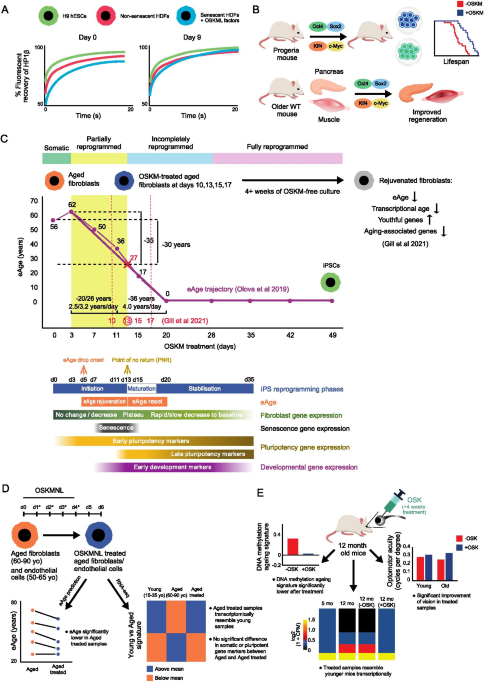
  • Cellular rejuvenation is the attempt to make aged cells function more like younger cells without necessarily replacing them.
  • The concept describes interventions that alter age-associated cellular states, often by resetting epigenetic patterns, improving gene expression, reducing senescence-associated dysfunction, or restoring regenerative capacity. [80i7rd] [s0j93z] [tzhls2]
  • The most prominent experimental strategy is partial cellular reprogramming : controlled, temporary expression of the Yamanaka factors—OCT4, SOX2, KLF4, and sometimes c-MYC—to reverse selected aspects of cellular aging while avoiding complete conversion into induced pluripotent stem cells. [nb2xje] [s0j93z] [tzhls2]
  • Unlike full reprogramming, which erases cellular identity to create an induced pluripotent stem cell, partial reprogramming aims to preserve the cell’s identity while improving its function. [nb2xje] [s0j93z]
  • Evidence remains strongest in laboratory and animal models; translation to humans requires careful evaluation of delivery, dosing, durability, tissue specificity, and risks such as abnormal growth or loss of cell identity. [s0j93z] [13tdo8]
flowchart LR A["Aged cell"] --> B["Controlled rejuvenation signal"] B --> C["Epigenetic resetting"] C --> D["Younger gene expression"] D --> E["Improved cell function"] C --> F["Risk of identity loss"] F --> G["Uncontrolled reprogramming"]

Uses in Context

  • Aging biology: Researchers use “cellular rejuvenation” to describe restoring youthful molecular or functional properties to aged cells rather than merely treating individual symptoms. [80i7rd] [tzhls2]
  • Epigenetic medicine: Biotechnology companies invoke the term for platforms that reset age-associated gene-regulation patterns; Life Biosciences describes its approach as restoring older and damaged cells to a “younger and healthier state.” [13tdo8] [dfp92t]
  • Regenerative medicine: The concept is applied to muscle, pancreatic, cardiac, vascular, skin, and nervous-system repair, where reprogramming may improve tissue regeneration after injury. [s0j93z] [3zo5gx]
  • Longevity Tech biotechnology: Startups frame cellular rejuvenation as a potential route to treating diseases of aging by restoring cell function in particular organs rather than attempting whole-body age reversal. [13tdo8] [1qsedv] [feur5p]
  • Scientific criticism: Aging researchers also use the term cautiously, noting that “younger” cellular measurements do not automatically establish organismal rejuvenation or health benefit. [80i7rd]

History of Use

Origins

  • The modern experimental foundation was established by Shinya Yamanaka and colleagues, who reported in 2006 that four transcription factors could convert adult cells into induced pluripotent stem cells. [s0j93z]
  • The factors—OCT4, SOX2, KLF4, and c-MYC—became known as the Yamanaka factors and demonstrated that differentiated-cell identity could be reset through changes in gene regulation. [nb2xje] [s0j93z]
  • The specific rejuvenation idea emerged later from efforts to express these factors temporarily or cyclically, seeking age reversal without complete dedifferentiation. [nb2xje] [s0j93z]

Evolution

  • 2006: Full cellular reprogramming showed that adult cell identity could be reset to an embryonic-like pluripotent state. [s0j93z]
  • 2013–2016: Studies using controlled or cyclic expression of reprogramming factors in mice reported improved regeneration and lifespan-related outcomes while avoiding complete dedifferentiation. [nb2xje] [s0j93z]
  • 2020s: The field expanded from animal studies toward tissue-specific therapies and early human translation, including an optic-neuropathy candidate based on controlled OSK expression. [13tdo8] [1qsedv]

Best Real-World Examples

  • Partial reprogramming in aged mice — Cyclic Yamanaka-factor expression was investigated as a way to improve tissue repair while preserving cellular identity. [nb2xje]
  • Yamanaka-factor studies in progeria and aged mice — Temporary, repeated factor expression extended lifespan in a progeria model and improved muscle and pancreatic regeneration in older mice. [s0j93z]
  • Endothelial-cell rejuvenation — A pharmacological cocktail induced temporally restricted OSKM expression and improved senescent endothelial-cell function in laboratory and animal experiments. [3zo5gx]
  • Life Biosciences ER-100 — An early clinical candidate uses controlled OCT4, SOX2, and KLF4 expression for optic neuropathies. [13tdo8]
  • Life Biosciences Epigenetic Restoration platform — The platform is designed to partially reprogram aged or injured cells through OSK expression. [1qsedv]
  • NewLimit — The biotechnology startup is pursuing cell reprogramming research, including a proposed liver-cell therapy program. [feur5p]
  • Retro Biosciences — The company is identified as another startup exploring cellular reprogramming for longevity applications. [feur5p]

Case Studies

Partial reprogramming in mice. Researchers led work using intermittent expression of Yamanaka factors rather than continuous expression, because sustained exposure can erase cellular identity and create safety concerns. [nb2xje] [s0j93z] In progeria mice, cyclic expression extended lifespan, while experiments in normal aged mice improved regeneration in tissues including muscle and pancreas. [s0j93z] The case established a central principle of cellular rejuvenation: a brief, controlled intervention may recover some youthful functions without requiring total conversion into stem cells. [nb2xje] [s0j93z]
ER-100 and optic neuropathies. Life Biosciences translated the partial-reprogramming concept into a tissue-specific clinical program targeting optic neuropathies. [13tdo8] [1qsedv] ER-100 uses controlled expression of OCT4, SOX2, and KLF4 to reset aspects of the epigenetic state in affected cells, and its Phase 1 study evaluates safety and tolerability in conditions including glaucoma and non-arteritic anterior ischemic optic neuropathy. [13tdo8] [1qsedv] The program illustrates how the field is moving from broad claims about age reversal toward localized treatment of defined diseases, while clinical efficacy and long-term safety remain to be established. [13tdo8]
Endothelial-cell rejuvenation. A research study reported that transient, non-genetic activation of Yamanaka factors reduced senescence-associated features and improved endothelial function and angiogenic capacity in laboratory and animal settings. [3zo5gx] The use of compounds already approved for other indications was presented as a possible way to induce temporary factor expression without directly introducing permanent genetic changes. [3zo5gx] This example shows the field’s expansion beyond gene delivery toward pharmacological control, but it remains preclinical evidence rather than proof of a validated human rejuvenation therapy. [3zo5gx]

Sources

[nb2xje] 2026, Oct 23. pmc.ncbi.nlm.nih.gov . In Vivo Partial Cell Reprogramming With Yamanaka Factors ... . Updated: 2026, Nov 06. Generated: 2026, Nov 06. Perplexity API response.

[80i7rd] 2026, Oct 27. link.springer.com . Seven ways not to think carefully about aging - The EMBO Journal . Updated: 2026, Oct 29. Generated: 2026, Nov 06. Perplexity API response.

[s0j93z] 2026, Apr 13. scientificamerican.com . This method to reverse cellular aging is about to be tested in humans . Updated: 2026, Oct 29. Generated: 2026, Nov 06. Perplexity API response.

[13tdo8] 2026, Jun 09. lifebiosciences.com . Life Biosciences Announces First Patient Dosed in Phase 1 ... . Updated: 2026, Oct 02. Generated: 2026, Nov 06. Perplexity API response.

[dfp92t] 2026, Oct 08. lifebiosciences.com . Life Biosciences Announces First-in-Human Data from Ongoing ... . Generated: 2026, Nov 06. Perplexity API response. [6]: 2026, Oct 01. lifebiosciences.com . Life Biosciences to Present First-in-Human Data from Ongoing ... . Updated: 2026, Oct 02. Generated: 2026, Nov 06. Perplexity API response.

[1qsedv] 2026, Apr 08. lifebiosciences.com . Life Biosciences Secures $80 Million Series D Financing . Updated: 2026, Oct 02. Generated: 2026, Nov 06. Perplexity API response.

[feur5p] 2026, Oct 08. businessinsider.com . Billionaires Love Cellular Reprogramming for Longevity, It ... . Updated: 2026, Nov 06. Generated: 2026, Nov 06. Perplexity API response.

[tzhls2] 2026, Jun 29. nature.com . The evolution of aging research: from theories to ... . Updated: 2026, Nov 04. Generated: 2026, Nov 06. Perplexity API response.