


software-development/developer-experience/nix-package-manager
Value Proposition & Features
Nix is a “purely functional package manager” that builds packages and configurations from declarative specifications to deliver reproducible, reliable environments across Linux and other Unix-like systems.
[7ampcd]
[qs1ytz]
It stores all packages in an immutable content-addressed store and manages dependencies precisely, enabling multiple versions and variants of software to coexist without conflicts.
[7ampcd]
[qs1ytz]
Core value propositions (2–3 sentences each):
- Reproducible builds & systems: Nix uses declarative configuration and a purely functional build model so that the same configuration always produces the same result, forming the basis of “reproducible, declarative and reliable systems.” [dok8vn] [qs1ytz] This underpins NixOS, a Linux distribution “built on top of the Nix package manager” with reliable upgrades and rollbacks. [24f22c]
- Isolated, multi-version environments: All packages are installed into a global
/nix/storeunder unique paths computed from their build inputs, allowing many versions of the same package and different dependency graphs to coexist safely. [7ampcd] [qs1ytz] This supports ephemeral or per-project environments without global conflicts, which is particularly useful on immutable or containerized systems. [8oj8i7] [24f22c]
Key features (5–8 bullets, in priority order):
- Environment management for development: Nix is used to create per-project or containerized environments (e.g., via Distrobox on Fedora bootc) by exposing the Nix store into development containers. [8oj8i7]
Screenshots
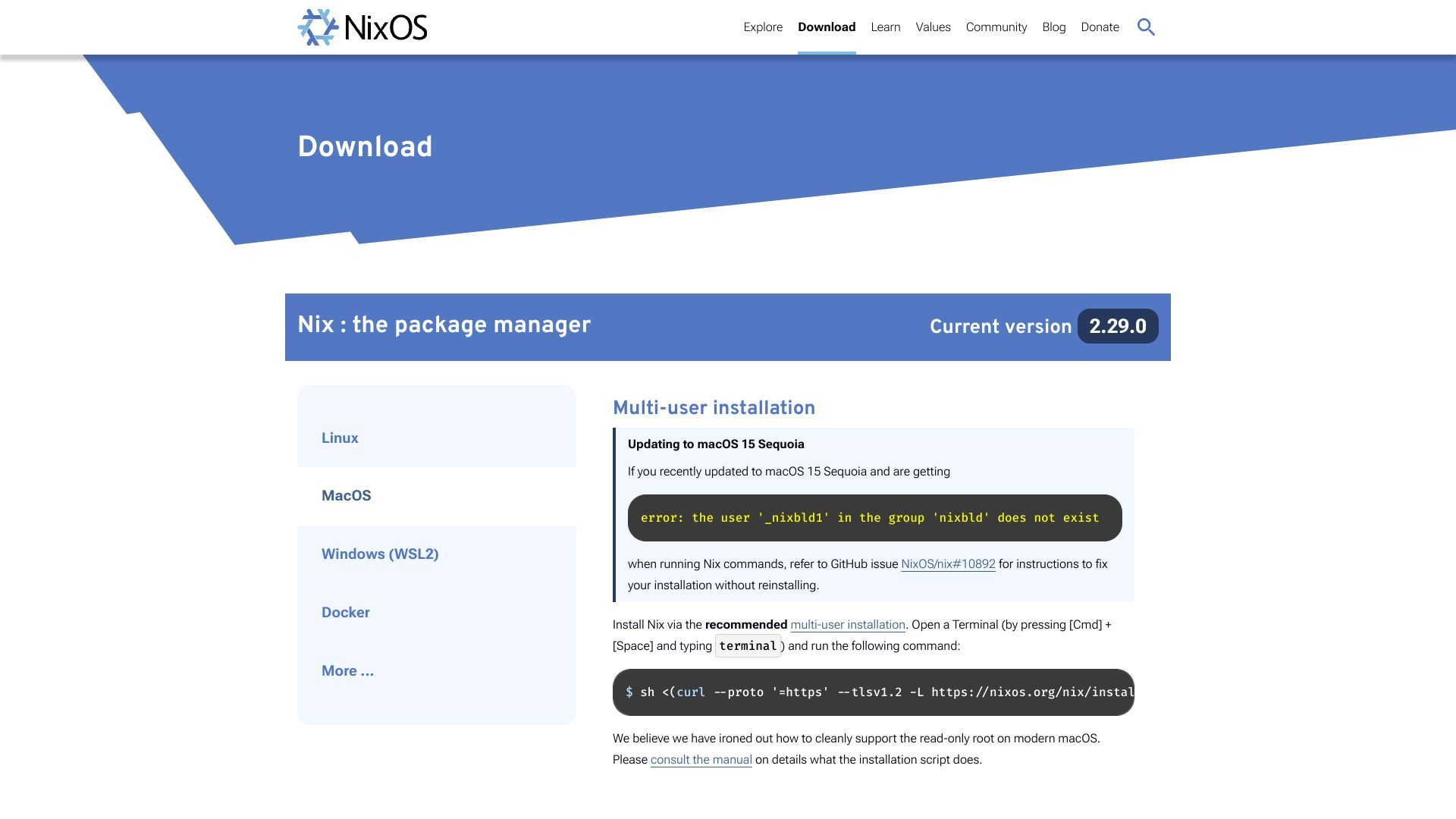
No reliable source found for three official Nix package manager UI screenshots hosted by the project; the primary materials are documentation and blog content, not GUI imagery.
[dok8vn]
[qs1ytz]
Product Roadmap / Announcements
As of June 06, 2026,
- 2026-01-21 – NixOS 24.11 end-of-support planning/updates: The NixOS lifecycle listing indicates time-limited security and bugfix support for each NixOS channel, documenting support periods for Nix-based systems. [24f22c]
Recent Developments
- Recent community discussions highlight integrating Nix into Fedora bootc images to install user-level software on immutable systems, showing growing adoption of Nix beyond NixOS. [8oj8i7]
History and Origin Story
Nix was created as a “purely functional package manager” that underpins the NixOS Linux distribution, which “is built on top of the Nix package manager” and uses declarative configuration for reliable system upgrades and rollbacks.
[7ampcd]
[24f22c]
[qs1ytz]
Over time, Nix evolved from a research-driven package manager into the foundation for NixOS and a broad ecosystem (including Nixpkgs and tools for user environments) that focus on reproducible and declarative system management, culminating in regular NixOS releases such as 26.05 “Yarara” managed by rotating community release managers.
[dok8vn]
[24f22c]
[qs1ytz]
Notable Team Members
- NixOS / Nix release managers (example: 26.05 release): The NixOS 26.05 announcement is authored by community members “yayayayaka and jopejoe1,” identified as the release managers for that version, reflecting the project’s community-driven governance and rotating stewardship of releases. [dok8vn]
(Founders or formal executives are not named in the recent official materials reviewed; current sources emphasize community roles such as release managers rather than a corporate leadership structure.
[dok8vn]
[24f22c]
[qs1ytz]
)
Market Sizing
Category, Market Size, and Category Growth
Nix sits in the categories of package managers, configuration management, and reproducible build / deployment tooling, as it is described as a “purely functional package manager” used to build “reproducible, declarative and reliable systems” and as the basis of a Linux distribution.
[7ampcd]
[dok8vn]
[24f22c]
[qs1ytz]
No analyst-grade quantitative market size or growth projections specific to Nix or purely functional package managers were found; broader markets like Linux distributions and configuration management tools are known segments, but current sources for Nix do not provide numeric estimates.
[dok8vn]
[24f22c]
[qs1ytz]
Pricing
Nix is distributed as open-source software; there is no public pricing for a commercial edition in the official documentation or release materials.
[7ampcd]
[dok8vn]
[24f22c]
[qs1ytz]
| Tier | Price | Notes |
| Nix (open source) | Free | Open-source “purely functional package manager” available for Linux and other systems. [7ampcd] [24f22c] [qs1ytz] |
Revenue Trajectory Estimates
No reliable source found providing revenue or ARR figures for Nix as a distinct commercial entity; public materials treat it as an open-source project and ecosystem rather than a revenue-reporting company.
[dok8vn]
[24f22c]
[qs1ytz]
Competitive Landscape
Who it's for, who it's not for
Nix is suited for developers, system administrators, and organizations that need highly reproducible environments, declarative system configuration, and the ability to manage multiple software versions reliably on Linux or similar systems, including immutable or container-focused distributions such as Fedora bootc.
[8oj8i7]
[dok8vn]
[24f22c]
[qs1ytz]
It is also a strong fit for users willing to adopt NixOS or integrate Nix into their workflows to gain atomic upgrades, rollbacks, and per-project environments defined in configuration files.
[7i1tqw]
[8oj8i7]
[dok8vn]
Nix is less suitable for casual desktop users or teams that prefer traditional imperative package managers and are not ready to invest in learning its declarative, functional model.
[7ampcd]
[24f22c]
[qs1ytz]
Users looking for managed, commercial configuration-management suites with vendor support contracts and graphical tooling may also find Nix’s community-driven, configuration-file-centric approach less aligned with their expectations.
[dok8vn]
[24f22c]
[qs1ytz]
Viable Alternatives
- APT / DPKG (Debian/Ubuntu): Traditional Linux package management stack widely used on Debian-based systems, offering large repositories and straightforward imperative commands instead of a functional model. [24f22c]
- Pacman (Arch Linux): Lightweight package manager for Arch Linux that emphasizes simplicity and rolling releases but does not provide Nix-style reproducible configurations. [24f22c]
Competitor Table
| Competitor | Description |
| [APT / DPKG] | Debian-family package management tools that manage software installation, updates, and removal on distributions like Debian and Ubuntu using a non-functional model. [24f22c] |
| [DNF / RPM] | Fedora and RHEL ecosystem package managers that install and update RPM packages with dependency handling but without Nix’s content-addressed global store. [8oj8i7] [24f22c] |
| [Pacman] | Arch Linux package manager focused on simplicity and speed for a rolling-release distribution, using a traditional binary package model. [24f22c] |
| [Ansible] | Agentless configuration-management and automation tool that applies playbooks over SSH to configure systems, serving some similar goals to NixOS’s declarative configuration but with a different execution model. [24f22c] [qs1ytz] |
| [Puppet] | Configuration-management platform that describes system state in a declarative language and enforces it via agents, overlapping with NixOS’s aims but not tied to a functional package store. [24f22c] [qs1ytz] |