



Prismatic
Value Proposition & Features
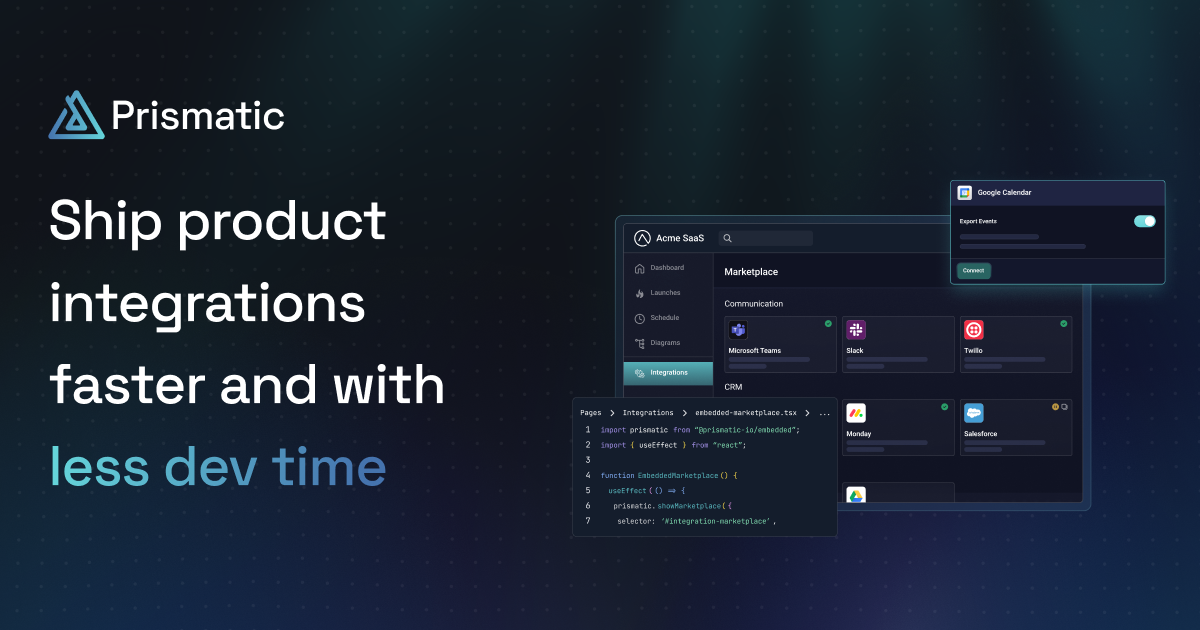
Prismatic is an integration platform for B2B SaaS that is positioned to help teams “build faster with AI,” “deploy to thousands of customers,” and let customers create and deploy their own one-off workflows.
[xh7bxn]
Its product documentation and component library indicate that it is designed for embedding integrations and workflow automation into software products rather than for general-purpose enterprise integration alone.
[xh7bxn]
Prismatic’s core feature set centers on prebuilt connectors/components, workflow orchestration, and customer-specific automation. Its docs describe components such as a Microsoft Bing Ads connector, which suggests a component model for integrating with third-party services inside Prismatic-managed workflows.
[xh7bxn]
Market Sizing
Category, Market Size, and Category Growth
Prismatic appears to fit the embedded iPaaS / SaaS integration platform category based on its own positioning as “the integration platform for B2B SaaS” and its focus on deploying integrations to many customers.
[xh7bxn]
No reliable source found for market size or category growth specific to Prismatic’s segment.
Competitive Landscape
Who it's for, who it's not for
Prismatic appears aimed at B2B SaaS companies that need to ship and manage customer-facing integrations at scale, especially where each customer may need workflow customization.
[xh7bxn]
It is not positioned, from the available sources, as a general consumer automation tool or a broad enterprise ESB replacement.
[xh7bxn]
Prismatic is likely a poor fit for teams that do not need embedded integrations, do not manage multi-tenant customer workflows, or prefer a purely internal automation platform.
[xh7bxn]
The available documentation points to a product built around SaaS product integration delivery rather than one-off internal process automation.
[xh7bxn]
Viable Alternatives
- Workato — broader enterprise automation and iPaaS platform, often used for internal and cross-system integration.
- MuleSoft — enterprise integration platform with strong API management and governance.
- Tray.io — automation and integration platform with emphasis on low-code workflow building.
- Zapier — simpler automation tool, usually for lighter-weight use cases than embedded B2B SaaS integrations.
- Make — visual automation platform that can cover many integration workflows but is not primarily an embedded SaaS integration layer.
Competitor Table
| Competitor | Description |
| Workato | Enterprise automation and iPaaS platform for cross-application workflows. |
| MuleSoft | Integration and API management platform for large enterprises. |
| Tray.io | Low-code automation platform for building integrations and workflows. |
| Zapier | Lightweight automation tool for connecting apps and triggering workflows. |
| Make | Visual automation platform for creating multi-step integrations. |