


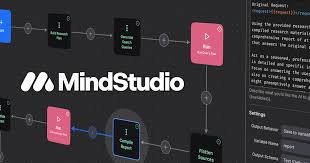

MindStudio is a visual, no‑code platform for building, deploying, and scaling AI agents and AI‑powered workflows for individuals, teams, and enterprises.[E1][16][17][21][28] It lets non‑developers design AI agents as end‑to‑end workflows where AI models act as the core processing engine rather than a minor add‑on , with access to 200+ text, image, audio, and video models via a unified Service Router and optional bring‑your‑own API keys.[E1][18][21][28][114] The platform targets use cases from custom internal tools to revenue‑generating agents, emphasizing enterprise readiness (SOC 2, training opt‑out, BYOK, self‑hosting options) along with low‑code extensibility and answer‑engine/search distribution strategy.[17][27][111][114]
Value Proposition & Features
Value proposition (2–3 sentences) MindStudio’s value proposition is to “rapidly build custom AI applications and automations with no coding” while mixing and matching models from OpenAI, Anthropic, Google, Mistral, Meta, and others through a single interface.[E1][21][30] It provides a visual agent builder that combines models, integrations, data sources, workflow logic, and custom code to ship production agents, APIs, apps, and automations without traditional backend development.[17][28][111] For enterprises, MindStudio adds governance features (SSO, audit logs, budgets, self‑hosting) so AI agents can be operated as controlled infrastructure rather than shadow IT.[27][80][111]
Core product features (2–3 sentences each)
- Visual AI Agent & App Builder MindStudio offers a drag‑and‑drop visual builder where users chain prompts, model calls, data blocks, logic, and integrations into agents and AI‑powered applications without writing code.[17][37][39][111] Agents can be deployed as shareable URLs, embeddable widgets, internal tools, or automations from the same workspace that also handles testing, versioning, publishing, and monitoring.[17][28][37]
- Multi‑model Service Router (200+ models) A built‑in Service Router gives instant access to 200+ AI models (LLMs, image, and vision models) with no provider accounts required, while still supporting bring‑your‑own keys and private models.[E1][18][21][114] This lets builders pick the best model per step and pass model costs through “at cost” without MindStudio markup, decoupling agent design from any single model vendor.[29][30][111][116]
- Triggers, Automations & Backend Agents Agents can be run via manual, scheduled, email, API, and webhook triggers , effectively functioning as backend automations that process inputs, call tools, and push outputs into other systems.[18][80][86][111] Individual and Business plans allow “unlimited agents and runs,” making it suitable for recurring workflows and multi‑agent backends, with model and media usage metered separately.[80][83][111]
- Integrations & Data Connectivity MindStudio provides integration blocks for APIs, data sources, file generation , and connectors to automation platforms like Zapier, Make, and n8n , plus a Chrome extension for browser‑based data capture.[18][80][111][114] Agents can read/write across SaaS tools, call external APIs, and generate structured outputs (documents, files) within the same workflow canvas.[39][111][114]
- Custom Code (JavaScript/Python) & Extensibility Workflows support custom JavaScript and Python blocks , allowing teams to embed proprietary logic, transformations, or bespoke integrations when visual blocks aren’t enough.[17][111] This positions MindStudio as low‑code rather than purely no‑code, giving developers a path to extend agent behavior while keeping orchestration in the visual builder.[17][28][111]
- Testing, Monitoring & Governance The same workspace is used to test, version, publish, and monitor agents , with enterprise features such as SOC 2 , training opt‑out, bring‑your‑own‑key, budget controls, SSO, and audit logs on Business plans.[17][27][59][80][89] Enterprise deployments can be self‑hosted with custom domains and model‑control options, so organizations can run MindStudio inside private clouds or networks.[80][86][111]
- Deployment Options (Apps, APIs, Assistants) Built agents can be deployed as apps, automations, APIs, embedded assistants , or monetized agents (e.g., AI coaching/twin products) using MindStudio’s monetization and subscription‑support capabilities.[21][81][87][111] The platform is used both for internal tools and external revenue‑generating agents, with zero platform revenue share reported in independent reviews.[82][87][113]
Prioritized feature list (5–8 bullets)
- Visual no‑code agent and app builder for chaining prompts, models, logic, and integrations.[17][37][39][111]
- Service Router with 200+ AI models , plus BYOK and private models support.[E1][18][21][114]
- Triggers and automations (manual, scheduled, email, API, webhook) for backend agents.[18][80][86][111]
- Integrations with Zapier, Make, n8n, APIs, data sources, and file generation. [18][114][111]
- Custom JavaScript/Python blocks for full‑code extensibility in workflows.[17][111]
- Governance features : SOC 2, training opt‑out, SSO, audit logs, budgets, self‑hosting for Business.[17][27][59][80][111]
- Freemium pricing with unlimited agents/runs on paid plans and pass‑through model usage. [78][80][81][83][85][111]
- Monetization support for selling AI agents and coaching twins without platform revenue cut.[82][87][113]
Screenshots
No reliable, stable public URLs for official MindStudio product UI screenshots were found in current sources; several blog posts reference UI and editor views but do not expose direct image URLs suitable for citation.[32][35][40]
Product Roadmap / Announcements
As of September 11, 2026,
- 2026‑09‑10 – Anthropic whistleblower controversy analysis – MindStudio published “The Anthropic Whistleblower Post: Genuine Warning or Funded …” , analyzing Jacob Kaczynski’s resignation post and funding links between AI policy nonprofits and Anthropic investor–linked grants, positioning MindStudio as a commentator on AI safety and governance.[11][48][94]
- 2026‑09‑09 – GPT‑6 Astra article hub – The blog’s GPT‑6 Astra tag lists 7 articles including “GPT‑6 Astra Hands‑On” and “GPT‑6 Astra Explained,” showing ongoing coverage of frontier autonomous agents and their implications for builders.[70]
- 2026‑09‑08 – Omarchy agentic Linux distro explainer – The post “What Is Omarchy? DHH’s Agentic Linux Distro Explained” describes a new agent‑centric Linux distribution and notes “BUILT BY MINDSTUDIO – Shipping agent infrastructure since 2021,” reinforcing MindStudio’s positioning as long‑running agent infrastructure.[63][117]
- 2026‑09‑03 – Gemini 3.8 Flash pricing deep dive – MindStudio published “Gemini 3.8 Flash Pricing: How Much Does It Cost to Use?”, detailing Google’s introductory pricing and token economics to help builders plan multi‑model costs.[67]
- 2026‑08‑26 – Granite 4.2 local reasoning model test – “IBM Granite 4.2 3B vs 8B: Local Reasoning Model Tested” benchmarks open‑weight Granite models and highlights Apache‑2.0 licensing for commercial local deployment, informing MindStudio’s agentic stacks.[68]
- 2026‑08‑25 – Stripe–OpenRouter acquisition analysis – “Why Did Stripe Pay $7.5 Billion for OpenRouter?” discusses Stripe’s reported $7.5B acquisition of OpenRouter and its implications for multi‑model routing ecosystems, relevant to MindStudio’s own Service Router strategy.[1][47][61]
Recent Developments (past 90 days)
- MindStudio has expanded coverage of frontier and open‑weight models (GPT‑6 Astra, GLM‑5.3 Flash, Gemini 3.8 Flash, IBM Granite 4.2), publishing pricing and benchmark articles that guide multi‑model agent design.[67][73][75][135]
- Blog content increasingly focuses on local and agentic computing (Omarchy, Apple’s Mac Studio local agents, M5 MacBook Air local AI), reflecting MindStudio’s interest in agents running on local hardware as well as in the cloud.[2][8][71][74]
- Multiple posts and independent reviews mention MindStudio’s subscription and monetization features for AI coaching and agent products, signaling an evolving creator‑economy angle alongside enterprise workflows.[51][82][87][113]
History and Origin Story
MindStudio’s canonical site states the company name as MindStudio , with metadata indicating it was founded in 2023 and reporting a workforce of 55 employees , though detailed founder biographies are not exposed on the public site.[E1] Blog footers and articles describing “Shipping agent infrastructure since 2021” suggest the team had experience building agent infrastructure before launching the current MindStudio platform brand.[117] External listings note that MindStudio is operated by GoMeta, Inc. , indicating a corporate parent behind the MindStudio product.[106][21]
Fundraising History
No direct public funding announcements specific to MindStudio (mindstudio.ai) were found; several blog posts discuss other companies’ rounds but not MindStudio’s own. Given that, fundraising details remain undisclosed.
| Round | Date | Amount | Lead investor |
| – | – | – | – |
| Total | – | – | – |
Investors (alphabetical) No reliable, source‑backed list of MindStudio investors is available from current public materials.
Notable Team Members
Public sources and the official site do not list named founders or C‑suite leaders for MindStudio; third‑party articles reference MindStudio in product contexts but do not attach specific individuals as executives or founders.[106][108][110][111] Without authoritative profiles or direct company disclosures, notable team members cannot be reliably identified.
Market Sizing
Category, Market Size, and Category Growth
MindStudio sits at the intersection of agentic AI development platforms , no‑code/low‑code AI agent builders , and AI workflow orchestration tools used by enterprises and creators.[17][28][30][114][135] Analyst and market‑research reports estimate the agentic AI market at about $19.33B in 2026 , projected to reach $205.88B by 2033 at a 40.2% CAGR , while AI workflow orchestration markets are projected from $10.9B in 2026 to $72.8B–$95.1B by 2035 with ~23–35% CAGR, and no‑code AI platform markets are estimated around $8.6–9B in 2026 .[124][128][129][126][134][135] Separate analyses of AI agents report 2026 market sizes in the $10.9–12.06B range with ~45–50% CAGR, reinforcing that MindStudio’s categories are in high‑growth segments.[121][133]
Pricing
MindStudio uses a freemium, subscription + usage model, with platform fees separated from AI model costs.[76][77][78][80][81][82][83][85][111]
| Tier | Price (base) | Key inclusions |
| Free | $0/month + model usage | 1 agent; 1,000 runs/month; access to 200+ models; Chrome extension; bring‑your‑own API keys; usage billed separately.[76][78][80][81][82][85][111][115] |
| Individual | $20/month (or $16/month billed annually ) + usage | Unlimited agents and runs; access to 200+ models and premium models; Chrome extension, APIs, automations, community/training; usage billed separately.[78][79][80][81][82][83][85][87][111][116] |
| Business | Custom pricing + usage | Team workspace, unlimited collaborators, granular permissions, SSO, audit logs, budgets and alerts, self‑hosting, custom domains, model‑control options.[80][82][83][85][86][89][111] |
(All figures are based on current public pricing pages and independent cross‑checks; users should confirm directly on mindstudio.ai for their region and date.[76][81][83])
Revenue Trajectory Estimates
No credible public estimates or disclosures of MindStudio’s revenue or ARR were located; independent reviews focus on pricing and monetization mechanics rather than financial performance.[81][82][87][113]
Competitive Landscape
Who it’s for, who it’s not for
MindStudio is suited for non‑technical or semi‑technical builders, small teams, and enterprises that want to design AI agents and workflows without building full custom stacks , including coaches, product teams, ops/RevOps, and internal‑tools builders who need multi‑model access and governance in a single canvas.[17][28][82][87][111][115] It is especially attractive where teams want AI‑native workflows (AI as core logic), unlimited agents/runs on a flat paid tier, and the ability to monetize agents without platform revenue share.[29][82][87][113]
It is less ideal for organizations that require open‑source, fully self‑auditable codebases , extremely deep control over training/inference infrastructure, or that already standardize on large enterprise iPaaS platforms like Workato or Microsoft Copilot Studio and only need light AI enrichment.[77][89][108][136][140][144] Teams that want purely on‑prem, open‑source frameworks such as LangGraph or CrewAI for maximum customization may also prefer those code‑first alternatives over a closed‑source SaaS like MindStudio.[135][140][150]
Viable Alternatives
- Microsoft Copilot Studio – Enterprise‑grade low‑code agent builder integrated with Microsoft 365 and Azure AI, suitable for large organizations standardized on Microsoft stacks.[123][127][133][140][150]
- Salesforce Agentforce – Agent platform built into Salesforce CRM, best where sales/service workflows and customer data live inside Salesforce.[123][125][133][136]
- Zapier + Zapier Agents – Broad app‑connector platform with AI agents for teams already using Zapier for automation and needing AI steps rather than full AI‑native workflows.[138][141][146][148][150]
- Make (with AI Agents) – Visual workflow automation tool with credits‑based pricing and bring‑your‑own LLM keys, good for mid‑market ops and marketing teams wanting visual orchestration.[138][141][144][150]
- n8n (self‑hosted) – Open‑source workflow automation with code nodes, ideal for teams wanting self‑hosting, privacy control, and developer‑friendly extensibility.[141][144][149][150]
Competitor Table
| Competitor | Description |
| Microsoft Copilot Studio | Enterprise low‑code agent builder and control plane integrated with Microsoft 365 and Azure AI, offering governed runtime and multi‑agent frameworks for large organizations.[123][133][140][150] |
| Salesforce Agentforce | CRM‑embedded agent platform that grounds reasoning in Salesforce records, with prebuilt sales and service agents and a low‑code builder.[123][125][133][136] |
| Zapier Agents | Agents layered on Zapier’s automation network, using 8,000+ app connectors to add AI‑powered steps and delegates into existing trigger‑action workflows.[138][141][146][148] |
| Make | Visual automation canvas with credits‑based AI agent features and bring‑your‑own‑LLM options, targeting mid‑market teams needing flexible SaaS orchestration.[138][141][144][150][85] |
| n8n | Open‑source workflow and agent framework that can be self‑hosted, offering code nodes and extensive integrations for teams prioritizing infrastructure control and privacy.[141][144][149][150] |
Sources
[1]: Why Did Stripe Pay $7.5 Billion for OpenRouter? - MindStudio
[2]: Apple's New Macs Bet You'll Own AI Instead of Renting It | MindStudio
[3]: MindStudio: wizualne agenty AI bez kodu
[4]: MindStudio · Free plan, then $20/mo · Pricing & Features (2026)
[5]: Is MindStudio Down? Live Status & Outage Tracker
[6]: Safe Superintelligence Articles | MindStudio Blog
[7]: Cryptographic Isolation for Multi-Model Swarms - LinkedIn
[8]: Mac Mini and Mac Studio 2026: Full Pricing and Specs Breakdown
[9]: MindStudio Review 2026: Build AI Agents Without Code
[10]: Claude Code's Big Update: Opus 5, Cross-Session Chat ...
[11]: The Anthropic Whistleblower Post: Genuine Warning or Funded ...
[12]: MindStudio Pricing in 2026: Plans, Revenue Share, and What ...
[13]: Gemini 3.7 Flash Benchmarks: How Much Better Is It Than ...
[14]: GLM-5.3-Flash: a ninth of the flagship's bill, and a tie on the work ...
[15]: MindStudio Blog · RSS Amplifier
[16]: MindStudio: training opt-out, BYOK and SOC 2 - The Agents Index
[17]: MindStudio: prices, plans and limits | Vergleich KI
[18]: What Is Grok Bot? xAI's Install-and-Go AI Agent Explained
[19]: MindStudio: 가격, 요금제, 한도 | Vergleich KI
[20]: Retell AI Pricing, Free Tier, and How It Builds Voice Agents
[21]: What Is Grokbot? xAI's New Agentic Assistant Explained
[22]: MindStudio Reviews 2026: Is the No-Code AI Agent ...
[23]: Blog
[24]: MindStudio for Enterprise: Guide [2026] (for enterprise ...
[25]: MindStudio Review 2026: AI Agents & Automation
[26]: Best Lindy Alternatives in 2026: 13 AI Agent Builders for ...
[27]: 11 best no-code AI agent builders in 2026
[28]: What Is Lovable? The AI App Builder Explained Simply
[29]: Turn Claude Code Into a One-Person Marketing Team | MindStudio
[30]: The Best AI Tools for Building Real Software With No Code
[31]: The AI App Builder IT Can Actually Bless (Without ...
[32]: What Does It Really Cost to Build an App With an AI ...
[33]: Building a Hardware Recommendation App With Replit's AI Agent
[34]: The Citizen Developer's Guide to an AI App Builder That ...
[35]: How to Build an AI Agent Simulation Game in Lovable (With MCP ...
[36]: Lovable vs Replit vs Codex vs Claude Code: Which One to ...
[37]: Seedance 2.5 Hits ArtList: 30-Second AI Video With Real ...
[38]: Legora: How a YC-Rejected Legal AI Startup Hit $100M ARR
[39]: Claude Fable 5.1: How It Handles Real Knowledge Work | MindStudio
[40]: MindStudio AI Coaching Subscription Monetization in 2026: Can ...
[41]: What Is Omarchy? DHH's Agentic Linux Distro Explained
[42]: MindStudio Review 2026: Is It Worth It for Coaches?
[43]: How OpenAI and Anthropic Turn Compute Into Profit - MindStudio
[44]: AI State Law Preemption Explained: Why It Matters for Startups
[45]: Blog — Page 2 | MindStudio
[46]: The Best AI Platforms for Building Internal Tools in 2026 | MindStudio
[47]: Gemini 3.8 Flash Pricing: How Much Does It Cost to Use? - MindStudio
[48]: IBM Granite 4.2 3B vs 8B: Local Reasoning Model Tested | MindStudio
[49]: GPT-6 Astra Articles | MindStudio Blog
[50]: M5 MacBook Air: How Much Faster Is Local AI, Really? | MindStudio