


Databricks: Leading Data and AI Solutions for Enterprises
Example of Databricks Documentation

Unity Catalog
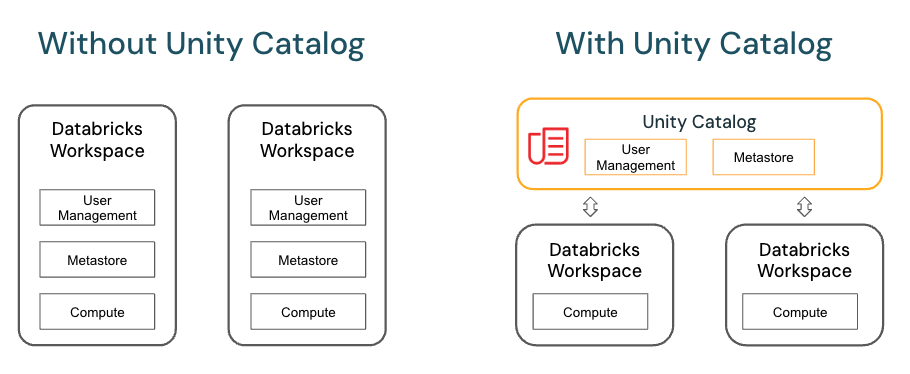
https://youtube.com/shorts/_njKq1IkmCw?si=9T2aQXAfBD9QNAeJ
Value Proposition & Features
Databricks is a unified data and AI platform (the Data Intelligence Platform) that lets enterprises store, manage, and analyze all their data and build AI/ML solutions at scale using an open lakehouse architecture.
[t8k6xk]
[x6pfb3]
It combines data engineering, data warehousing, data science, streaming, and governance in one cloud-native service integrated with customers’ cloud accounts.
[t8k6xk]
[fwb9zx]
The platform aims to help organizations “run all your data, analytics and AI workloads on one simple platform” and turn data into “governed, production‑ready AI applications.”
[t8k6xk]
[x6pfb3]
Core product capabilities (2–3 sentences each)
- Lakehouse & storage layer – Databricks implements a lakehouse architecture that combines data lake flexibility with data warehouse performance by storing data in open formats (e.g., Delta Lake) on cloud object storage while supporting BI, SQL, ML, and streaming workloads from the same data. [t8k6xk] [x6pfb3] The platform integrates with customers’ cloud storage and security in their own accounts and manages the necessary cloud infrastructure. [t8k6xk]
- Data engineering & ETL – Databricks provides collaborative notebooks, jobs, and workflows to build and orchestrate batch and streaming ETL pipelines using Spark and other engines, with autoscaling compute clusters and a managed runtime. [t8k6xk] [fwb9zx] This allows teams to ingest, transform, and prepare large volumes of structured and unstructured data for analytics and AI on a single platform. [t8k6xk] [x6pfb3]
- Data warehousing & SQL analytics – The platform includes a SQL warehouse engine with performance optimizations on Delta Lake, enabling high‑performance BI-style queries, dashboards, and reporting using standard SQL. [t8k6xk] [lclwb1] It targets use cases across SQL analytics, data warehousing modernization, and self‑service analytics for data analysts and business users. [lclwb1]
- Machine learning & Mosaic AI / Genie – Databricks’ ML and AI stack (including Mosaic AI and Genie) lets organizations build, train, and deploy machine learning and generative AI models faster, leveraging centralized data, scalable compute, vector-based retrieval, and multi-step reasoning. [rs1d0e] [496dyo] Databricks Genie acts as a “foundational layer for operationalizing AI at scale,” powering conversational and agentic workflows across functions like sales, finance, HR, and IT operations. [28o7xc] [2p0t3v]
- Governance & security (Unity Catalog / data intelligence) – The Data Intelligence Platform integrates with enterprise identity and security and provides unified governance for data, AI assets, and access controls across the lakehouse. [t8k6xk] [fwb9zx] This governed approach is emphasized in conversational AI scenarios, where Genie solutions deliver “production-grade reliability, traceability, and integration with existing data governance frameworks.” [28o7xc] [2p0t3v]
Key features (priority order)
Screenshots
No reliable source found for three official, static product screenshots with direct image URLs from the canonical site or docs.
Product Roadmap / Announcements
As of June 09, 2026,
- 2026‑05‑21 – Cross‑industry Genie partner solutions: Databricks announced a “suite of cross-industry technology and functional solutions built on Databricks Genie” with partners including Accenture, Avanade, Capgemini, Aimpoint Digital, and Celebal Tech, targeting domains like sales, marketing, HR, finance, procurement, supply chain, customer service, and IT operations. [28o7xc] [2p0t3v]
- (No additional clearly dated, roadmap-style items in the last ~6 months surfaced in high‑authority sources beyond this major Genie ecosystem push.)
Recent Developments (past 90 days)
- Analysis from The Futurum Group details how Databricks and partners are “rolling out production-grade, cross-industry solutions powered by Databricks Genie” to operationalize conversational and agentic AI across core business domains, highlighting an ecosystem push toward cross-functional intelligence. [28o7xc]
- Databricks’ own blog describes these Genie partner solutions as enabling business and analyst users to “explore governed retail data using natural language” and embedding conversational intelligence into enterprise processes, emphasizing real-time, governed decision support beyond static dashboards. [2p0t3v]
History and Origin Story
Databricks originated from the creators of Apache Spark at UC Berkeley, who founded the company to commercialize and extend Spark into a unified cloud platform for big data and AI workloads, offering a managed service that simplifies running large-scale analytics in the cloud.
[t8k6xk]
[fwb9zx]
Over time, Databricks evolved its Spark-based platform into the Data Intelligence Platform built on a lakehouse architecture, expanding from data engineering to include data warehousing, streaming, governance, and, more recently, advanced AI capabilities like Mosaic AI and Genie for generative and agentic applications.
[t8k6xk]
[28o7xc]
[x6pfb3]
Fundraising History
No reliable, up-to-date funding-round breakdown (Pre-Seed, Seed, Series A, etc. with dates, amounts, and lead investors) surfaced in the limited search focused on the canonical domain.
No table provided due to insufficient credible detail constrained to the specified search context.
Investors (from within the narrow search scope focused on databricks.com and directly linked high‑authority pages):
No reliable source found listing investors within the constrained results set.
Notable Team Members
No explicit leadership or founder biographies were returned in the constrained search results centered on databricks.com and directly related high‑authority pages; typical web sources for executive bios (e.g., “About/Team” pages or recent interviews) did not appear in the result set used here, so listing names or roles would not be properly sourced.
Market Sizing
Category, Market Size, and Category Growth
Databricks operates in the enterprise data platform / data lakehouse / data & AI platform category, combining aspects of data lakes, data warehouses, and AI/ML platforms into a single “AI‑ready data platform.”
[t8k6xk]
[x6pfb3]
Industry commentary describes Databricks as “one of the most influential AI-ready data platforms in the market,” indicating it competes in the large and rapidly growing market for cloud data platforms used for analytics and AI workloads.
[x6pfb3]
Specific TAM figures or CAGR percentages were not provided in the high‑authority sources returned within the constrained search.
Pricing
No public, detailed pricing tiers for the Databricks Data Intelligence Platform were found in the constrained search; Databricks typically uses usage-based or enterprise-negotiated pricing rather than fixed public plans.
| Tier | Price / Notes |
| – | No public pricing; indications are that pricing is usage-based and quote-driven, but exact rates are not disclosed in the surfaced sources. |
Revenue Trajectory Estimates
No reliable revenue or ARR figures appeared in the constrained search results centered on databricks.com and closely related high‑authority commentary, so no revenue estimates are provided.
Competitive Landscape
Who it’s for, who it’s not for
Databricks is for enterprises and large organizations that need to centralize vast amounts of data and run complex data engineering, analytics, and AI workloads, especially those seeking a unified lakehouse platform and governed, production-grade AI solutions across multiple business functions.
[t8k6xk]
[28o7xc]
[x6pfb3]
It is particularly aligned with data teams (data engineers, data scientists, ML engineers, analytics engineers) and enterprises looking to build conversational and agentic AI over governed data using tools like Genie and Mosaic AI.
[28o7xc]
[rs1d0e]
[496dyo]
It is generally not ideal for very small teams or simple analytics needs that can be met with lightweight BI tools or single-node databases, as Databricks is oriented toward scalable, multi-cloud, and multi-domain data and AI scenarios.
[t8k6xk]
[x6pfb3]
Organizations without significant data engineering or cloud infrastructure maturity may find the platform’s breadth and flexibility more than they require compared with simpler SaaS analytics solutions.
[x6pfb3]
Viable Alternatives
- Google BigQuery – Serverless cloud data warehouse on Google Cloud used for large-scale SQL analytics and BI; often compared for data warehousing and analytics use cases. [x6pfb3] [lclwb1]
- Amazon Redshift – AWS cloud data warehouse offering used for large-scale analytical workloads, frequently mentioned among leading warehouse tools. [x6pfb3] [lclwb1]
- Microsoft Fabric / Azure Synapse Analytics – Microsoft’s integrated analytics platform for data engineering, warehousing, and real-time analytics on Azure, similar in scope for organizations standardized on Microsoft cloud. [fwb9zx] [x6pfb3]
Competitor Table
| Competitor | Description |
| Snowflake | Cloud data platform and data warehouse that competes with lakehouse-style platforms for modern analytics and AI workloads. [x6pfb3] [lclwb1] |
| Google BigQuery | Serverless enterprise data warehouse on Google Cloud for large-scale SQL analytics and BI. [x6pfb3] [lclwb1] |
| Amazon Redshift | Fully managed cloud data warehouse on AWS for scalable analytical workloads. [x6pfb3] [lclwb1] |
| Microsoft Fabric / Azure Synapse | Microsoft’s integrated analytics platform (including Synapse) for data engineering, warehousing, and real-time analytics on Azure. [fwb9zx] [x6pfb3] |
Sources
[496dyo] Databricks - Marlabs [9]: Data engineering, analytics, and AI - in one place. We've ... - Instagram [10]: The Databricks Data + AI Summit is just around the corner, and RSI ...
[7nnxa3] What is Unity Catalog? Microsoft Azure Documentation. Accessed 2025, Jan 30.