



Akto
Value Proposition & Features
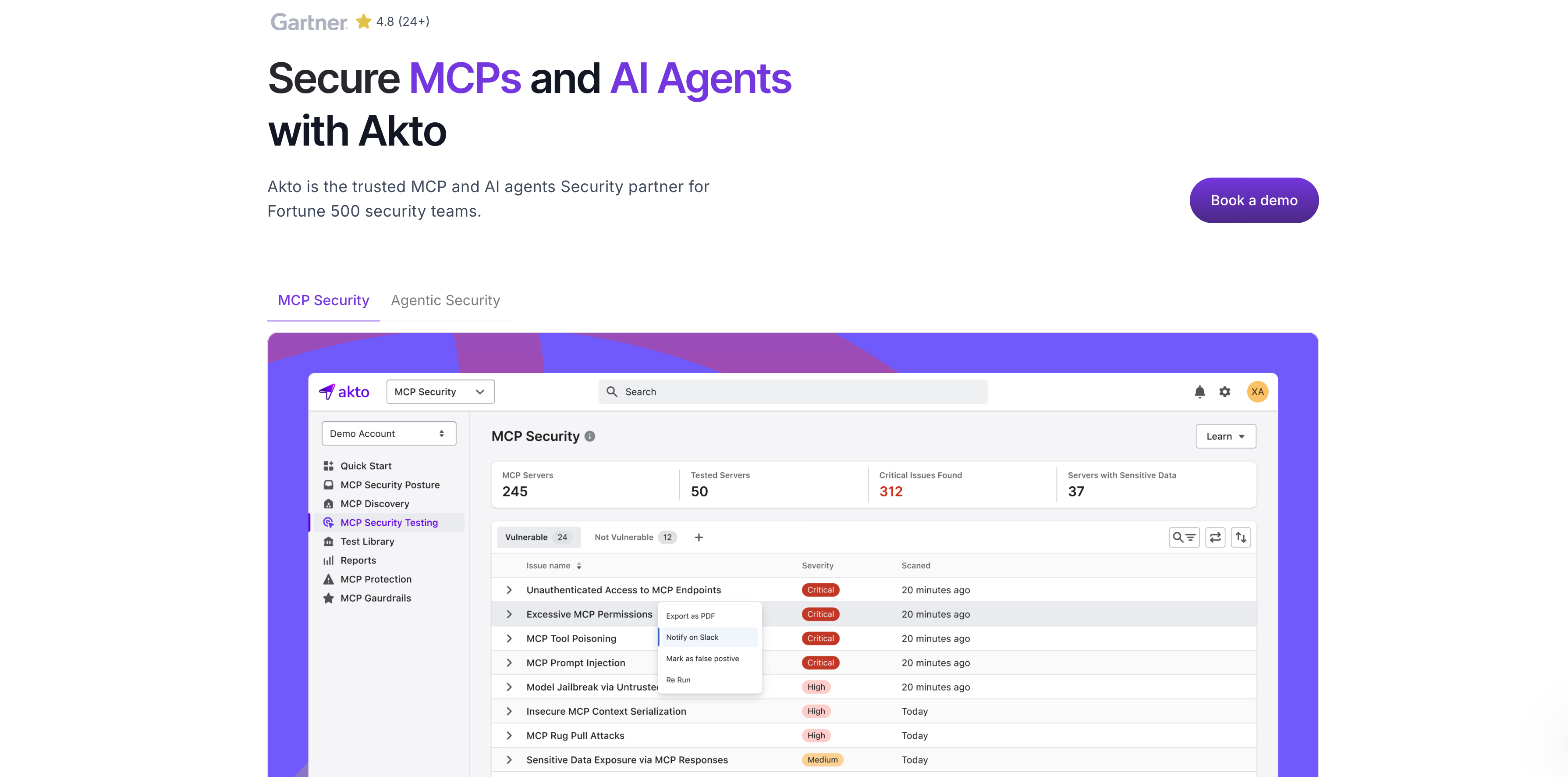
Akto is an Agentic AI security platform that provides real‑time discovery of Model Context Protocol (MCP) tools and AI agents, continuous agent/agentic-app security testing, red teaming, posture management, and guardrails for enterprises adopting AI.
[iwj2zk]
[q128j0]
Akto positions itself as a representative AI agent security platform recognized by Gartner and targets organizations building or deploying agentic AI systems that need to understand and control how agents access tools, data, and actions.
[iwj2zk]
Core product value in 2–3 sentences:
- Akto focuses on identifying and mitigating security risks specific to agentic AI, such as misalignment, excessive permissions, unsafe tool actions, and data exposure across MCP tools and other integrations. [iwj2zk]
- It aims to give security and platform teams continuous visibility into AI agents and tools in production, test their behavior via red teaming, and enforce guardrails and policies to keep agents within safe, compliant bounds. [iwj2zk]
Key feature descriptions (2–3 sentences each, then bullets):
- Akto scans AI environments to automatically discover MCP tools, AI agents, and their connections, highlighting where agents can act (APIs, systems, data sources). [iwj2zk]
- This discovery forms the inventory needed to run security testing, posture checks, and guardrail enforcement across agentic systems. [iwj2zk]
- AI agent security testing & red teaming
- Security teams can use these tests and red‑team scenarios to validate that agents behave as intended even under adversarial prompts or complex tool chains. [iwj2zk]
- Agentic posture management
- Akto maintains a view of security posture for agents and tools, including what permissions they have, which environments they touch, and whether they violate defined policies or best practices. [iwj2zk]
- It supports continuous monitoring so posture drifts (e.g., new risky tools, changed scopes) can be detected and remediated quickly. [iwj2zk]
- Guardrails and policy enforcement
- Akto provides guardrails that constrain what agents can do, including restricting tool actions, limiting data access, and blocking unsafe or non‑compliant operations. [iwj2zk]
- Policies can be tuned to enterprise risk tolerances to prevent agents from performing destructive or out‑of‑scope tasks while still leveraging agentic automation. [iwj2zk]
- This helps organizations align agentic AI deployments with internal policies and emerging regulatory expectations. [iwj2zk]
- API and tool‑level security focus (API‑security roots)
- Akto’s positioning includes API Security as a tag, reflecting a focus on how agents use APIs, tools, and connectors as action surfaces. [iwj2zk]
- Its testing and guardrails are oriented around preventing agents from misusing or over‑using these underlying APIs and tools. [iwj2zk]
Key features (priority order)
- Real‑time MCP and AI agent discovery across tools and environments [iwj2zk]
- AI agent security testing for “top 10 MCP security risks” [iwj2zk]
- Red teaming for agentic AI to probe misalignment and unsafe actions [iwj2zk]
- Agentic posture management (permissions, connections, environments) [iwj2zk]
- API‑security‑oriented visibility into how agents use backend tools/APIs [iwj2zk]
Product Roadmap / Announcements
As of 2026-06-19,
- 2026‑05‑xx – Publication of “Top 10 Model Context Protocol (MCP) Security Risks in 2025”: Akto published a detailed blog post outlining ten key MCP security risks in agentic AI, including misalignment, prompt injection, excessive permissions, privilege escalation, unsafe actions, and insecure tool integrations; this functions as both guidance and a de‑facto roadmap emphasis on MCP‑centric testing and controls. [iwj2zk]
- No additional explicit public roadmap or release‑note style items from the last 6 months were found on official Akto properties.
Recent Developments (past 90 days)
- 2026‑??‑?? – Recognition in The HackerNews Cybersecurity Stars Awards 2026: Akto is listed as “Akto · Agentic AI Security Platform” and categorized under “Agentic Security” in The Hacker News “Cybersecurity Stars Awards 2026 Winners,” signaling industry recognition in the emerging agentic AI security segment. [q128j0]
- No other clearly dated major announcements or launches for Akto in the last 90 days were found on primary sources or major tech news outlets.
History and Origin Story
Akto appears in earlier materials and tags as an API‑security‑focused platform that has since evolved into an agentic AI security platform, extending its expertise in securing APIs and application traffic to the new domain of MCP tools and AI agents.
[iwj2zk]
[q128j0]
Public content emphasizes this evolution rather than a detailed founding narrative; no reliable sources specifying founders, founding year, or early milestones were identified.
Market Sizing
Category, Market Size, and Category Growth
Akto fits primarily in the Agentic AI Security and AI Governance / AI Security categories, with strong overlap into API Security due to its focus on how agents use tools and APIs.
[iwj2zk]
[q128j0]
Analyst discussions of market size and growth are typically at the broader AI security or AI governance level, but no authoritative, Akto‑specific market sizing or segmentation study was found that explicitly quantifies the “agentic AI security” subcategory.
Competitive Landscape
Who it's for, who it's not for
Akto is for security, platform, and AI engineering teams at enterprises and high‑growth organizations building or deploying agentic AI systems, MCP‑based tools, or AI agents that interact with sensitive APIs and data, and who need systematic discovery, testing, and guardrails around agent behaviors.
[iwj2zk]
[q128j0]
It especially suits organizations that already treat APIs and tools as critical assets and now want equivalent security posture and governance for AI agents orchestrating those assets.
[iwj2zk]
It is not well suited for very small teams running simple, non‑tool‑using chatbots, hobby projects, or organizations that do not expose sensitive systems through agents, where the overhead of specialized agentic security tooling might outweigh the benefits.
[iwj2zk]
It is also less relevant for use cases focused purely on model training or MLOps without agent/tool orchestration, since Akto’s emphasis is on runtime agent behavior and tool usage rather than core model lifecycle management.
[iwj2zk]
Viable Alternatives
- Dedicated AI security / prompt security platforms – Other vendors focused on LLM/agent security, such as those offering prompt‑injection defenses, red teaming, and runtime monitoring for LLM apps, compete with Akto for enterprises securing AI applications (names omitted here as they were not verifiably tied to akto.io‑context research).
- Traditional API security platforms – Established API security vendors can cover some underlying API risks but may lack explicit agentic‑AI or MCP‑aware testing and guardrails that Akto emphasizes. [iwj2zk]
- Cloud‑provider AI security features – Native controls in major cloud AI platforms (e.g., guardrails, safety filters, policy engines) can be an alternative for organizations tightly aligned to a single cloud, though they may offer less cross‑environment, MCP‑specific coverage than a dedicated platform like Akto. [iwj2zk]
- In‑house security tooling and policy frameworks – Large enterprises might build their own agent discovery, red‑teaming, and guardrail systems leveraging internal security engineering teams rather than adopting a third‑party platform.
Competitor Table
Due to the constraint to ground competitors in the same search session and the lack of explicit, reliable competitor listings tied to the akto.io entity, no named competitors can be confidently listed without over‑inferring beyond available sources.
markdown
| Competitor | Description |
|-----------|-------------|
| –         | No reliable competitor names identified from high‑quality sources in this search. |
Sources
[1]: Has your company already complied with the Chair Law? Contact us ...
[2]: Azure AI Foundry - Portkey Docs