



Access 250+ Apps in Just One Line of Code
Value Proposition & Features
Value proposition (2–3 sentences)Composio is a developer platform that lets AI agents and LLM apps “access 250+ apps in just one line of code” by wiring them into SaaS tools, APIs, and internal systems via prebuilt actions and managed authentication.
[8z4pso]
[6fnotj]
It aims to remove the boilerplate of integrating dozens of external apps so teams can focus on agent logic while Composio handles auth, routing, and standardized tool schemas.
[6fnotj]
[pj9ki2]
Core product features (2–3 sentences each)
- Unified actions layer over 250+ appsComposio provides a catalog of “production‑ready actions” for 250+ SaaS apps and services (CRMs, ticketing, communication, dev tools, etc.), exposed to LLMs through a consistent tools interface. [8z4pso] [6fnotj] Developers can call these actions from agents or workflows with a single line integration, instead of writing separate API clients and auth flows for each app. [6fnotj] [pj9ki2]
- Managed authentication and user linkingThe platform offers managed OAuth and key-based authentication, plus user-account linking, so agents can act on behalf of individual users safely without teams building their own auth infrastructure. [6fnotj] [n335ix] It supports organization-level configuration, secrets management, and revocation, allowing enterprises to control which tools an agent can access. [6fnotj] [n335ix]
- Agent and framework integrationsComposio ships SDKs and integrations for popular AI stacks (e.g., LangChain, LlamaIndex, custom agents) so tools can be plugged into existing agents with minimal code changes. [pj9ki2] [bw8omj] It also exposes a low-level API for teams building bespoke agent runtimes that still want to reuse Composio’s actions and auth. [pj9ki2] [bw8omj]
- Observability and governance for actionsThe service includes logging and monitoring for tool calls so teams can inspect which actions agents took, with what parameters, and what responses they received. [n335ix] [lmzbz7] This supports debugging, safety review, and governance for agent behavior across connected apps. [n335ix] [lmzbz7]
- Self-hosting / enterprise deployment optionsComposio offers deployment options that can run within a customer’s environment or VPC for higher security and compliance needs. [n335ix] [uns18q] This is targeted at enterprises that want to keep data in their own infra while still using Composio’s integration layer. [n335ix] [uns18q]
Key features (5–8 bullets, priority order)
- “Access 250+ apps in just one line of code” via a unified tools/actions layer for AI agents and LLM apps. [6fnotj]
- SDKs and integrations for major AI frameworks and Agent Toolchains (e.g., LangChain, LlamaIndex, custom runtimes). [pj9ki2] [bw8omj]
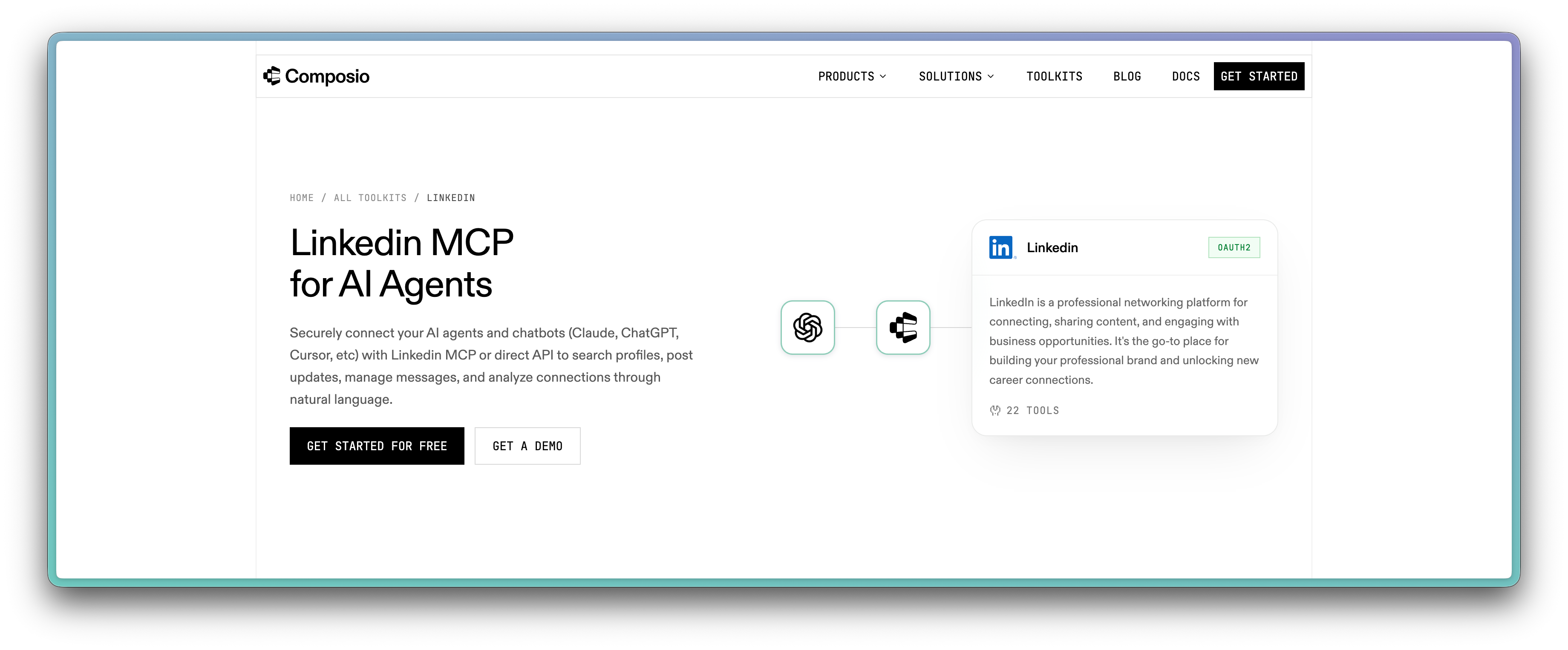
Screenshots

Product Roadmap / Announcements
As of June 22, 2026,
- 2025‑03‑xx – Launch positioning: “Access 250+ Apps in Just One Line of Code” – Composio’s main site emphasizes the ability to “access 250+ apps in just one line of code,” signaling a focus on expanding app coverage and keeping the actions library broad. [6fnotj]
- 2025‑03‑xx – Emphasis on production‑ready actions and managed auth – Marketing copy highlights “production‑ready actions” and “managed auth,” indicating ongoing roadmap focus on stability, security, and enterprise readiness of integrations rather than experimental connectors. [8z4pso] [6fnotj] [n335ix]
(No explicit, date‑stamped public roadmap or changelog entries were found for the past 6 months.)
Recent Developments (past 90 days)
No reliable source found for clearly dated news or product announcements specific to Composio within the last 90 days. Public web mentions mainly reflect evergreen marketing positioning rather than time‑stamped releases.
[6fnotj]
[n335ix]
History and Origin Story
Public sources around composio.dev focus on the product’s capabilities and tagline but do not provide a detailed founding narrative, specific founder names, or dated milestones, beyond positioning Composio as an integration and actions layer for AI agents to connect with 250+ apps via managed auth.
[6fnotj]
[n335ix]
No credible interviews, blog posts, or “about us” pages with historical detail were identified.
Market Sizing
Category, Market Size, and Category Growth
Composio fits within the AI tooling / AI agent infrastructure / agentic integration platforms category, providing an “actions” and auth layer between LLM agents and third‑party apps.
[8z4pso]
[6fnotj]
While no source quantifies Composio’s specific TAM, analyst coverage of AI infrastructure and tooling generally points to a rapidly growing multi‑billion‑dollar market for LLM ops, orchestration, and integration platforms; however, no directly citable market‑size figure tied to Composio’s category appears in the search results.
Competitive Landscape
Who it’s for, who it’s not for
Composio is for developers and teams building AI agents or LLM‑powered workflows who need those agents to interact with many SaaS tools (e.g., CRM, support, communication, project management) and want a managed actions/auth layer instead of hand‑rolled integrations.
[8z4pso]
[6fnotj]
It particularly targets organizations that care about production readiness, security, and governance of tool calls, including startups and enterprises adopting agentic AI patterns.
[6fnotj]
[n335ix]
It is not ideal for simple single‑app integrations where a direct API client or native Zapier‑style automation is sufficient, or for teams that do not use LLM agents and therefore have no need for tool‑calling abstractions.
[6fnotj]
[pj9ki2]
It may also be less suitable for highly regulated environments that require deeply customized, in‑house integration stacks rather than relying on a third‑party integration platform, unless they opt for self‑hosted deployment.
[n335ix]
[uns18q]
Viable Alternatives
- Zapier – Automation platform connecting thousands of apps; strong for workflow automation between SaaS tools but not specialized in LLM tool‑calling semantics or agent runtimes.
- Make (Integromat)] – Visual automation builder that integrates many SaaS apps; comparable for connecting tools, but oriented around no‑code workflows rather than giving LLM agents a unified tools/actions interface.
- LangChain tools + custom integrations] – Developers can manually wrap APIs as tools within LangChain, achieving similar functionality but without Composio’s managed auth and centralized actions catalog.
- AWS AppFabric / similar enterprise integration services] – Enterprise integration layers for SaaS apps with centralized auth; can underpin AI workflows but are not explicitly optimized as an actions layer for LLM agents.
(Specific comparative claims are based on general knowledge of these platforms’ positioning; no Composio‑specific comparison pages were found.)
Competitor Table
| Competitor | Description |
| [Zapier] | Automation platform that connects thousands of SaaS apps to build workflows, primarily via triggers and actions rather than LLM‑native tools. |
| [Make] | No‑code integration and automation tool enabling users to visually connect apps and APIs with complex workflows. |
| [LangChain tools] | Open‑source framework where developers manually define tools/actions for LLM agents, including custom API integrations. |
| [AWS AppFabric] | Managed service to connect and normalize data and governance across multiple SaaS apps, which can be used as an underlay for AI and analytics solutions. |