Support Vector Machines
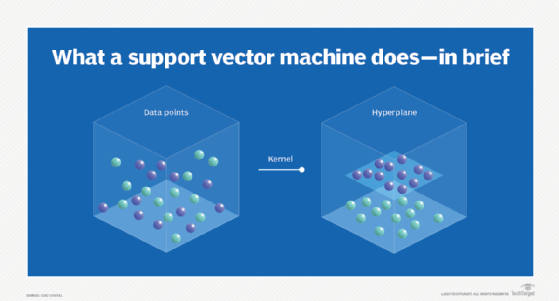
- Hyperplane : The core function of an SVM is to find a hyperplane in the feature space that best separates classes. For two-dimensional data, this appears as a line; for higher dimensions, it becomes a plane or higher-dimensional space. [3lp9q7] [gb1ju5]
 Imagine two groups of data points (e.g., circles and squares) on a plane—the SVM determines the line (hyperplane) that best separates these groups.
- The dataset is moderately sized; SVMs can be less efficient with extremely large datasets.
- Data classes are clearly distinguishable, or separable with non-linear kernels.
- Robustness to outliers is needed, as SVMs tend to ignore non-critical outliers. [3lp9q7]
| Algorithm | Best Use Cases |
| Logistic Regression | Linearly separable data, probabilistic output |
| Decision Trees | Interpretable models, non-linear relationships |
| Random Forests | Large, complex datasets with mixed data types |
| Neural Networks | Very large datasets, complex feature interactions |
| k-Nearest Neighbors | Simple, non-parametric, proximity-based analysis |
| Naive Bayes | High-dimensional, independent feature assumptions |
 |
- Handling Complex Relationships : Kernels enable SVMs to model complex, non-linear boundaries, allowing companies to extract value from unstructured or non-linearly separable data types (e.g., images, text).
- Data-Driven Insights : When properly tuned, SVMs enable more actionable business intelligence, making sense of data patterns that might be missed by simpler models.
Citations
[3lp9q7] 2025, Nov 11. Support Vector Machine (SVM) Algorithm - GeeksforGeeks . Published: 2025-10-24 | Updated: 2025-11-11
[gb1ju5] 2025, Nov 11. What Is a Support Vector Machine? - MATLAB & Simulink - MathWorks . Published: 2025-10-22 | Updated: 2025-11-11
[1rfn6v] 2025, Nov 09. Support vector machine - Wikipedia . Published: 2002-07-27 | Updated: 2025-11-09
[10wu6s] 2025, Nov 10. Support Vector Machines: A Simple Explanation - KDnuggets . Published: 2016-07-07 | Updated: 2025-11-10
[4zeqh9] 2025, Nov 11. 1.4. Support Vector Machines - Scikit-learn . Updated: 2025-11-11