


Financial Times
Financial Times
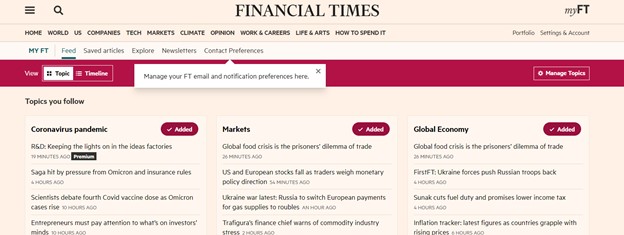
Financial Times is the pink‑paper, globally oriented business newspaper and digital outlet strategy teams read when they want a fast, high-signal view of markets, companies, and policy without getting lost in noise.[1]
The Financial Times (FT) is a British daily newspaper and digital publication focused on business and economic current affairs.[1] It was first published in 1888 and is based in London, with core editorial offices across the UK, US, and continental Europe.[1] Since 2015 it has been owned by Japanese media group Nikkei, Inc. after being sold by Pearson.[1] Consultants and innovators return to it for its combination of global macro coverage, corporate insight, and opinion pieces that frame how policy, technology, and capital flows shape competitive strategy.[1]
Type and Format
- Type: This source is a magazine / newspaper / website (a daily business newspaper with a major digital presence).[1]
- Format details
- The Financial Times is published in print (broadsheet) and also digitally.[1]
- It operates on a subscription model with a paywall, offering metered access and paid digital and print subscriptions.[1]
- It was founded in 1888, originally as the London Financial Guide, and took the name Financial Times shortly thereafter.[1]
- The FT is currently owned by Nikkei, Inc., a Japanese media group that acquired it from Pearson in 2015.[1]
- Where it lives:
- Homepage[1]
The People Behind It
- The Financial Times was founded in 1888 by James Sheridan and Horatio Bottomley under the original title London Financial Guide before becoming the Financial Times.[1]
- The paper is currently owned by Nikkei, Inc., a major Japanese financial media group that also owns the Nikkei newspaper.[1]
- As of the mid‑2020s, the FT’s editor is Roula Khalaf, who became editor in 2020 and is the first woman to hold the role.[1]
- The FT is headquartered at Bracken House, 1 Friday Street, London, near the City’s financial district, which houses its publishing, corporate, and main editorial offices.[1]
Signature writers / columnists
- Martin Wolf – the FT’s chief economics commentator, known for his columns on global macroeconomics, financial crises, and economic policy; he is widely regarded as one of the most influential economic commentators.[1]
- Gillian Tett – an FT columnist and journalist focusing on financial markets, behavioral finance, and the sociology of money and risk.[1]
- Martin Sandbu – writer of the FT’s Free Lunch economics newsletter, offering analytical takes on policy, inequality, and globalization.[1]
- FT Alphaville team – a group blog and newsletter offering deeply reported, often irreverent analysis of markets, finance, and economic oddities.[1]
(Specific columnist roles and status may evolve; these names represent long-running “signature” voices frequently associated with the brand.[1])
Catalog of Notable Works
For a publication like the FT, “works” are its regular sections, columns, and features rather than standalone books.
- FT Big Read — long‑form, in‑depth feature series — deep dives into major business, geopolitical, and technological themes that go beyond daily news.[1]
- Lex — written by the Lex column team — long‑running column providing concise, opinionated analysis of companies, sectors, and deals, often used by investors to stress‑test views.[1]
- Martin Wolf columns — written by Martin Wolf — agenda‑setting commentary on global macro, crises, and policy, useful for framing systemic risks and opportunities.[1]
- Unhedged — written by FT markets writers — newsletter and column focusing on markets, valuation, and how macro narratives translate into asset prices.[1]
- FT Alphaville — written by the Alphaville team — blog‑style coverage of finance, market structure, esoteric trades, and “weird finance,” useful for understanding the plumbing behind headlines.[1]
- Moral Money — written by FT sustainability and ESG journalists — covers sustainable finance, ESG regulation, and how climate and social issues reshape capital allocation.[1]
- Tech Tonic — FT’s technology podcast and associated coverage — explores how frontier technologies, from AI to geopolitics of chips, intersect with business models and regulation.[1]
Why It Matters to Innovators
- Signals on capital allocation and market structure: The FT continuously tracks how investors, boards, and regulators respond to new technologies, giving innovators live insight into how markets are pricing risk and opportunity around themes like AI, decarbonization, and fintech.[1]
- Macro context for Platform Strategy and global scaling: Coverage of trade policy, competition law, and cross‑border M&A helps innovators understand how geopolitics and regulation constrain or enable global platform plays and expansion bets.[1]
- Frameworks for understanding financialized innovation: Columns like Lex and Martin Wolf’s commentary help situate product and technology bets within balance-sheet constraints, interest-rate regimes, and credit cycles—crucial for innovation that depends on venture capital, project finance, or leveraged rollouts.[1]
- ESG and climate as design constraints: The Moral Money franchise tracks how sustainability regulation and investor expectations are evolving, giving innovators a moving map of constraints and opportunities for climate tech, green infrastructure, and socially responsible products.[1]
- Competitive intelligence and case material: FT corporate coverage and Big Read investigations provide real‑world case studies of corporate transformation, failed pivots, and successful strategic shifts, useful when designing Innovation Portfolios or stress‑testing a Business Model Canvas.[1]
Best Starting Points
- FT Big Read — accessible long‑form features that quickly convey the FT’s analytical depth on a single complex theme (e.g., AI, supply chains, climate finance).[1]
- Lex — bite‑sized, opinionated corporate and markets analysis that shows how the FT “thinks” about companies and deals; good for learning its evaluative lens.[1]
- Moral Money — the best entry point if you care about ESG, climate, and sustainability‑driven innovation and regulation.[1]
- FT Alphaville — for innovators whose work intersects with financial markets infrastructure, crypto, or complex instruments; offers a more experimental, insider tone.[1]
- Martin Wolf columns — for a deeper, more macro‑intellectual entry point into the FT’s perspective on global economic systems and policy regimes.[1]
Adjacent Sources
- The Economist — another global weekly publication providing macro, business, and policy analysis, often read alongside the FT.
- Wall Street Journal — US‑based business and financial newspaper, a useful contrast in editorial stance and corporate coverage.
- Nikkei Asian Review — Nikkei’s own English‑language Asian business publication, complementary for Asia‑focused innovation and investment themes.
- HBR — more management‑ and framework‑oriented, helpful to pair with FT reporting when translating signals into corporate action.
- Disruptive Innovation — often discussed or illustrated through FT corporate and sector coverage.