


Why Nations Fail
[xwng6w] 2022, Sep 20. " Schwartz%20Lecture.pdf | Economics ". Daron Acemoglu and James A. Robinson. Economics
-
- A foundational political-economy book arguing that inclusive institutions—not geography, culture, or luck—largely determine whether nations prosper.
- Why Nations Fail is a book by economists Daron Acemoglu and James A. Robinson, first published in 2012. The book draws on fifteen years of research and explains national prosperity through the design of political and economic institutions.[1][3] Innovation consultants return to it because it offers a durable diagnostic for how power structures either enable or suppress broad-based experimentation and growth.
Type and Format
- Type: This source is a book .
- Format details: The Crown edition was published in 2012 and runs to 544 pages; a Profile illustrated reprint was also published in 2012 at 320 pages.[2][3]
The People Behind It
- Daron Acemoglu is an Institute Professor at MIT and co-director of the Stone Center on Inequality and the Shaping of the Future of Work.[9]
- Acemoglu’s related work includes Introduction to Modern Economic Growth , The Narrow Corridor , and Power and Progress .[9]
- James A. Robinson is Acemoglu’s coauthor on Why Nations Fail and The Narrow Corridor ; together, they developed the book’s framework contrasting inclusive and extractive institutions.[1][6]
- Their broader contribution connects political institutions, economic development, inequality, and long-run prosperity.[9][10]
Catalog of Notable Works
- “So Close and Yet So Different” — contrasts neighboring regions whose divergent institutions produced sharply different outcomes.
- “Theories That Don’t Work” — challenges explanations based primarily on geography, culture, or ignorance.
- “The Making of Prosperity and Poverty” — introduces the distinction between inclusive and extractive political and economic institutions.[1][10]
- “Small Differences and Critical Junctures” — explains how modest institutional differences can compound during moments of crisis or transition.
- “Drifting Apart” — shows how countries can move onto divergent paths even after sharing similar starting conditions.
- “The Virtuous Circle” — describes how inclusive institutions reinforce participation, innovation, and accountable governance.
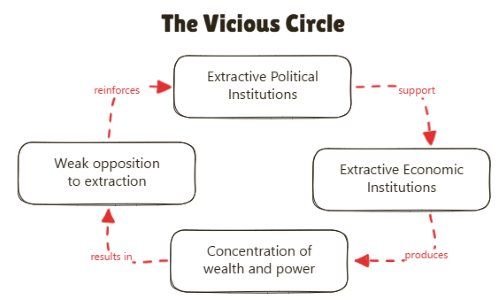
- “The Vicious Circle” — explains how extractive institutions reproduce concentrated power and resist reform.
Why It Matters to Innovators
- Institutions shape the innovation frontier. Inclusive institutions distribute opportunity and protect participation, while extractive institutions concentrate gains and decision-making in a narrow elite.[1][10] This is a macro-level version of Permissionless Innovation .
- Political power and economic incentives are inseparable. The book helps diagnose why technically sound reforms fail when incumbent groups benefit from the status quo.[1][10]
- Critical junctures create openings for change. Wars, crises, technological shifts, and political transitions can redirect institutional trajectories; innovators can treat these moments as windows for Systems Change .
- Prosperity depends on broad participation, not merely invention. A society may possess talent and technology yet underperform when institutions prevent experimentation, investment, or fair access.[1][3]
- The framework distinguishes capability problems from power problems. “Bad policy” may reflect not ignorance but institutions designed to preserve extraction—an essential lens for Innovation Governance .
Best Starting Points
- Why Nations Fail — Google Books — the complete book record and central thesis.[3]
- MIT Economics: Daron Acemoglu — concise context on Acemoglu’s role and related body of work.[9]
- The Narrow Corridor — a follow-on framework about how state capacity and societal power jointly sustain liberty.[6]
- Britannica overview of Daron Acemoglu — a compact summary of the inclusive-versus-extractive institutional argument.[10]
Adjacent Sources
Sources
[1]: 2013, Sep 17. books.google.com . Why Nations Fail . Updated: 2025, Jun 21. Generated: 2026, Nov 06. Perplexity API response.
[2]: books.google.com . Why Nations Fail: FROM THE WINNERS OF THE NOBEL PRIZE IN ... . Updated: 2026, Oct 27. Generated: 2026, Nov 06. Perplexity API response.
[3]: 2012, Mar 20. books.google.com . Why Nations Fail: The Origins of Power, Prosperity, and ... . Updated: 2026, Oct 20. Generated: 2026, Nov 06. Perplexity API response.
[4]: books.google.com . Why Nations Fail - Google Books . Updated: 2026, Oct 20. Generated: 2026, Nov 06. Perplexity API response.
[5]: books.google.co.ug . My library . Updated: 2026, Nov 04. Generated: 2026, Nov 06. Perplexity API response.
[6]: 2025, Mar 04. books.google.com . The Narrow Corridor . Updated: 2025, Mar 29. Generated: 2026, Nov 06. Perplexity API response.
[7]: 2025, Aug 03. books.google.com . Kenapa Negara Gagal: Ringkasan Dan Tinjauan - Daron Acemoglu ... . Updated: 2025, Sep 04. Generated: 2026, Nov 06. Perplexity API response.
[8]: books.google.com . Our Thousand-Year Struggle Over Technology and Prosperity . Updated: 2026, Oct 09. Generated: 2026, Nov 06. Perplexity API response.
[9]: economics.mit.edu . Daron Acemoglu | MIT Economics . Updated: 2026, Oct 03. Generated: 2026, Nov 06. Perplexity API response.
[10]: 2026, Sep 27. britannica.com . Daron Acemoglu | Nobel Prize, Education, Career, ... . Updated: 2026, Oct 27. Generated: 2026, Nov 06. Perplexity API response.