


The Long Boom
The Long Boom
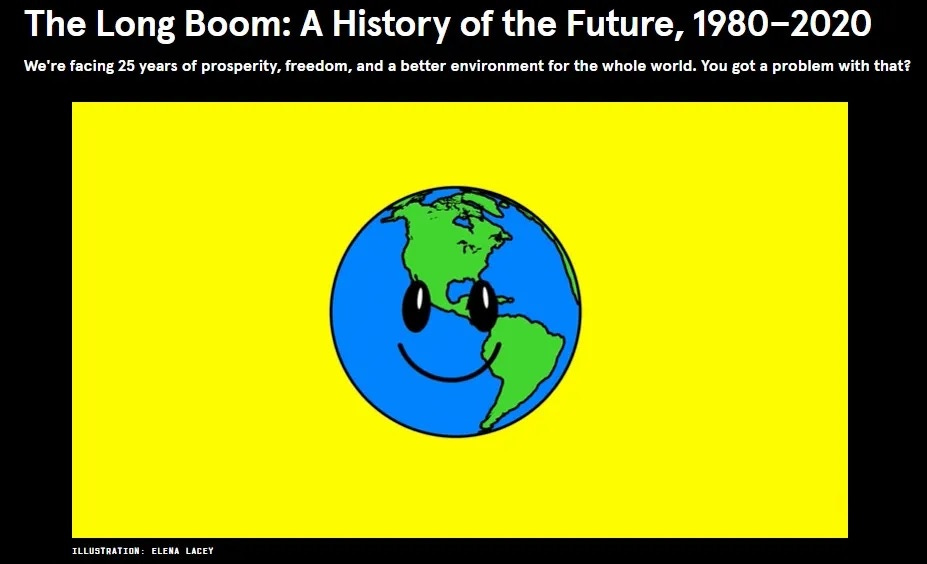
The Long Boom is a late‑1990s futurist thesis from Wired that argued the world was on the verge of a 25‑year run of unprecedented economic growth driven by technology, globalization, and cultural change.[4]
This source is best understood as a visionary essay / manifesto, originally published as the cover story of Wired magazine in July 1997, titled “The Long Boom: A history of the future, 1980‑2020,” written by Peter Schwartz and Peter Leyden.[4] It projected that “a 25-year boom” would transform the world into a “more peaceful, open and prosperous” place if certain political and social conditions were met.[4] Innovation consultants return to it because it is a canonical example of techno‑optimistic scenario planning—useful both as a model of bold long‑range visioning and as a cautionary tale about blind spots in forecasting.[4]
Type and Format
- Type: This source is a magazine essay / manifesto within a technology magazine (Wired), often treated as a stand‑alone futurist work.[4]
- Format details
- It appeared as the cover story in Wired (US edition) in July 1997 under the headline “The Long Boom: A history of the future, 1980‑2020.”[4]
- The essay takes the form of a scenario narrative, laying out conditions under which a prolonged global boom could occur and a list of “Ten things that could derail the Long Boom.”[4]
- It was influential enough that later critics describe it as a definitive expression of late‑1990s “smug neoliberal fantasy” about open markets, free trade and technological innovation delivering peace, affluence and equality.[4]
- Where it lives
- The original essay lives on Wired’s site: Homepage — this New Statesman piece extensively quotes and summarizes the Wired manifesto and links back to it.[4]
- There is no standalone book titled The Long Boom by Schwartz and Leyden; the primary artifact is the Wired article itself, occasionally republished or archived by third parties.[4]
The People Behind It
- Peter Schwartz
- Peter Schwartz is a futurist and cofounder of the scenario planning consultancy Global Business Network (GBN), known for advising corporations and governments on long‑range strategy.[4]
- Before GBN, Schwartz worked at Royal Dutch/Shell, where he helped pioneer the use of scenario planning in corporate strategy.[4]
- He later served as Senior Vice President for Strategic Planning at Salesforce, continuing his work on future‑oriented corporate strategy.[4]
- Peter Leyden
- Peter Leyden is a journalist and futurist who worked at Wired magazine in the 1990s and co‑authored “The Long Boom” cover story.[4]
- He has since built a career as a speaker and consultant on the future of technology, politics, and the economy, often revisiting and updating themes from “The Long Boom.”[4]
- Wired magazine
- Wired is a technology and culture magazine founded in 1993 that became a key voice of 1990s digital optimism, blending coverage of the internet, innovation, and futurism.[4]
- Its editorial stance in that era strongly favored globalization, deregulated markets, and technological progress as drivers of social transformation—values that shaped the framing of “The Long Boom.”[4]
Catalog of Notable Works
Because “The Long Boom” is a single seminal essay rather than a book series or recurring column, the “catalog” here focuses on the major arguments and features within the manifesto as it was presented in Wired.
- A 25‑year global boom thesis — The core argument is that from approximately 1995 to 2020 the world could experience “a 25-year boom” characterized by strong economic growth, technological progress, and spreading prosperity, contingent on maintaining open markets and political stability.[4]
- “A history of the future, 1980‑2020” narrative — The essay is structured as a retrospective from the year 2020 looking back to 1980, telling a story of how deregulation, the end of the Cold War, and the rise of information technology created a new global order.[4]
- Ten conditions that enable the boom — Schwartz and Leyden lay out enabling conditions such as continued technological innovation, an open global trading system, political reform in key regions, and successful management of environmental issues.[4]
- “Ten things that could derail the Long Boom” — The article lists specific downside risks—including global financial crises, environmental catastrophes, political backlash, or war—that could disrupt the optimistic scenario, explicitly acknowledging uncertainty and fragility.[4]
- Framing of technology as a universal solvent — The manifesto repeatedly presents the internet, biotech, and other emerging technologies as primary levers for solving problems of productivity, resource scarcity, and even geopolitical conflict.[4]
- Universalizing neoliberal optimism — Critics have highlighted how the essay assumes that open markets, free trade and technological innovation would “bring peace, affluence, equality and happiness to the world,” a set of claims later labeled “a smug neoliberal fantasy.”[4]
Why It Matters to Innovators
- Case study in Techno Optimism and its blind spots“The Long Boom” shows how intelligent, well‑informed futurists in 1997 extrapolated a narrative of “inevitable” prosperity from the conjunction of the internet, globalization and post‑Cold War politics.[4] For innovators, it is a vivid example of how compelling narratives can underweight tail risks like political backlash, inequality, and environmental shocks.
- Template for Scenario Planning and long‑range storytellingSchwartz and Leyden’s “history of the future, 1980‑2020” is a canonical format: write from the future looking back to make strategic implications concrete.[4] Product and strategy teams can borrow this narrative device when building long‑range roadmaps or speculative visions.
- Reminder to incorporate socio‑political variables, not just tech curvesThe piece’s critics note that it over‑relied on market liberalization and tech innovation, underestimating how populism, geopolitical conflict, and climate disruption could derail growth.[4] For innovators, this is a warning to integrate political economy and social legitimacy into any growth thesis, not just Exponential Technologies.
- Framework for conditional optimism (“if–then” futures)The essay is explicit that the boom depends on meeting certain conditions and avoiding “ten things that could derail” it.[4] That structure—clear drivers, enabling conditions, and explicit failure modes—is a useful mental model for articulating when a bold innovation thesis holds and when it breaks.
- Historical benchmark for evaluating innovation narrativesBecause it spans 1980–2020, “The Long Boom” gives innovators a concrete artifact against which to test hindsight: which bets (internet, computing, Asia’s rise) were directionally right, and where did it misread distributional impacts, governance, or resilience? This makes it a powerful teaching tool in strategy, Innovation Foresight, and policy‑tech conversations.[4]
Best Starting Points
- Wired cover story “The Long Boom: A history of the future, 1980‑2020” — This is the primary text; it lays out the 25‑year boom scenario, the enabling conditions, and the derailers in an accessible magazine feature format.[4]
- New Statesman essay “The Long Boom: a smug neoliberal fantasy” — This critique summarizes the original manifesto’s claims and systematically contrasts them with how globalization, inequality, and politics unfolded, giving innovators a ready‑made debrief on what the 1990s vision missed.[4]
- Talks and later reflections by Peter Schwartz — Schwartz’s subsequent scenario work for corporations and institutions builds on lessons from optimistic 1990s futures, providing a more tempered view of uncertainty and risk.[4]
- Talks and essays by Peter Leyden revisiting 21st‑century prospects — Leyden has periodically revisited how the world progressed relative to “The Long Boom,” offering a practitioner’s view on how long‑range optimism needs to be updated post‑financial crisis and in light of climate and political shocks.[4]
Adjacent Sources
- Wired Magazine — for the broader editorial environment that produced “The Long Boom,” including other 1990s techno‑optimist pieces.
- Peter Schwartz — for Schwartz’s other scenario planning work and books on corporate futures.
- Promoters of Globalization — for contemporaneous arguments that open markets and technology would converge on global prosperity.
- Critics of Globalization — for counter‑arguments that highlight inequality, ecological limits, and political backlash.
Sources
[1]: In New Mexico, a way out of the boom-bust cycle?
[2]: The Longest Economic Boom Ever? - A Wealth of Common Sense
[3]: The Case for a U.S. Productivity Boom | InsuranceAUM.com
[4]: The Long Boom: a smug neoliberal fantasy - New Statesman
[5]: Chris Harman: Zombie Capitalism (7. The Long Boom)
[6]: Publication: Falling Long-Term Growth Prospects
[7]: The Case for a U.S. Productivity Boom