


The Death Of Expertise
The Death of Expertise
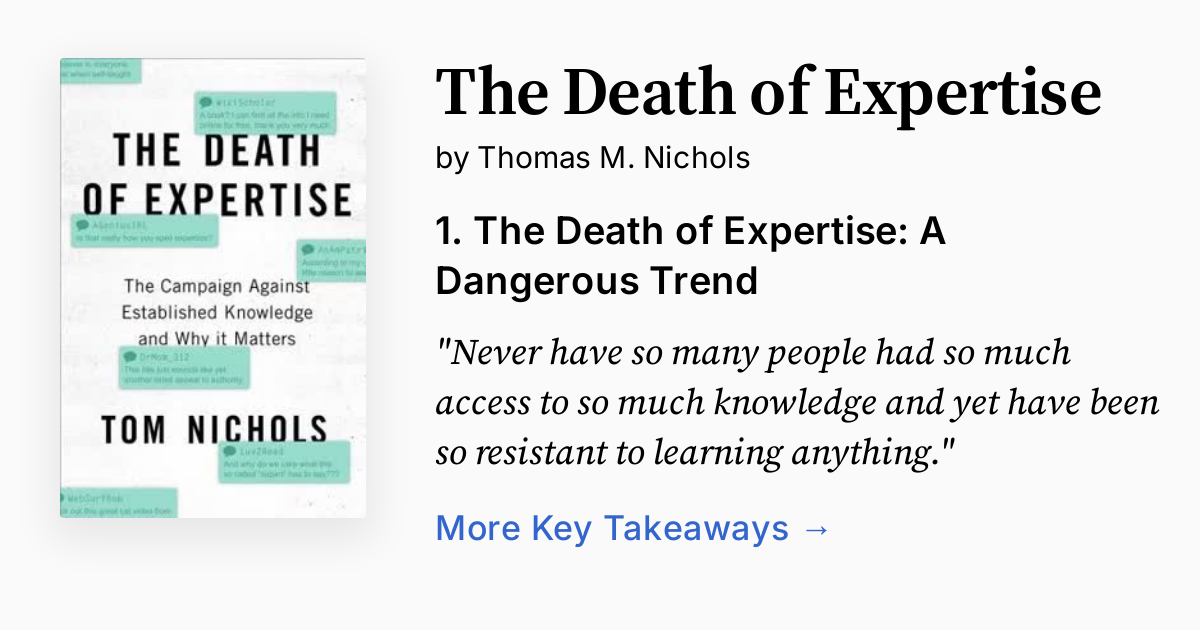
The Death of Expertise is a sharp, accessible diagnosis of why modern publics increasingly reject expert knowledge, and what that does to democratic decision-making and institutional trust.[1][2]
This source is a nonfiction book by Tom Nichols, first published in 2017 by Oxford University Press.[1][2] It expands on a 2014 article Nichols wrote in The Federalist and argues that a mix of higher education trends, the internet, and fragmented media has produced a culture where uninformed opinions are treated as equivalent to expert judgment.[1] Consultants and innovators return to it because it crisply explains the systemic forces behind misinformation, “everyone’s-an-expert” dynamics, and the operational risks of working in anti-expert environments.[1][3]
Type and Format
- Type: This source is a book.[1]
- Format details
- Publisher: Oxford University Press.[2][5]
- Year of first publication: 2017.[1][2]
- Length: about 252 pages in the Oxford University Press edition.[2]
- Notable editions: 2017 hardcover and e-book; identifiers include LCCN 2016037219 and ISBN 9780190469412.[5]
- Where it lives
- Homepage (Oxford University Press) — catalog page and purchasing options.[2]
- Google Books — preview and bibliographic data.[1]
The People Behind It
- Tom Nichols is a professor of national security affairs at the U.S. Naval War College; he is described as "professor of national security at US Naval War College" in discussions of the book.[3]
- He is an American academic and writer who has also worked with the Harvard Extension School and is known for commentary on foreign policy and civic culture (noted in his broader biographical discussions in reviews and profiles).[3][7]
- The Death of Expertise grew out of his 2014 article of the same name in The Federalist, which he expanded into the 2017 book.[1]
Catalog of Notable Works
(For a single book, “catalog” = its core arguments / chapter themes. Chapter titles vary slightly by edition; bullets below synthesize the book’s widely described structure and major arguments.)
- The campaign against established knowledge — Nichols frames “the death of expertise” as a “campaign against established knowledge” and laments the erosion of respect for “facts, logical analysis, and critical thinking,” where “uninformed opinions carry the same weight as expert opinions.”[1][3]
- Why experts still matter even when they fail — He acknowledges that “experts do sometimes fail,” but argues the right response is “the self-correcting presence of other experts to recognize and rectify systemic failures,” not the wholesale rejection of expertise.[1]
- Higher education and the customer-student — Nichols criticizes the transformation of higher education into a consumer product in which “students become valued clients instead of learners,” gaining “a great deal of self-esteem, but precious little knowledge,” and where diploma mills conflate “education” and “training.”[6]
- The internet and the illusion of knowledge — He argues that the internet produces an “illusory intelligence,” changing “the way we read, the way we reason, even the way we think, and all for the worse,” by putting dubious and credible sources on an apparently equal footing.[6]
- Media fragmentation and echo chambers — The book highlights “the explosion of media options” as a driver of anti-expertise, feeding hoaxes, conspiracy theories, fake news, propaganda, and “all manner of bullshit” by eliminating shared factual baselines.[1][3]
- Civic consequences: apathy and ‘I can’t change anything’ — Nichols links widespread ignorance and incompetence to an “I don’t care, I can’t change anything” attitude that is “slowly eroding our personal, political, and economic norms.”[4]
- Restoring a functional relationship between experts and citizens — Across the book, he presses both experts and laypeople to rebuild a healthier relationship: experts must be more transparent and humble, and citizens must relearn how to distinguish evidence-based authority from mere opinion.[1][4]
Why It Matters to Innovators
- It explains why users, customers, and even internal stakeholders often distrust expert recommendations or data, helping innovators diagnose resistance to evidence-based decisions in product, policy, or strategy contexts.[1][3]
- Nichols’ critique of higher education as a “consumer good” and of “faux universities” that act as diploma mills illuminates how credential inflation and weak Critical Thinking skills distort hiring, training, and talent pipelines in innovation-driven organizations.[6]
- The discussion of the internet’s impact on “the way we read, the way we reason, even the way we think” gives a grounded lens for evaluating how digital products either combat or amplify misinformation and cognitive overload—key for anyone designing information-rich services.[6]
- His analysis of media fragmentation and echo chambers is directly relevant to innovators working on platforms, recommendation systems, or community tools, highlighting the risks of architectures that flatten expert and non-expert content into the same perceived reliability.[1][3]
- For corporate and public-sector innovators, the book provides a vocabulary to talk about expertise, authority, and legitimacy—useful when designing governance models, advisory boards, and decision rights in complex Innovation Systems.
Best Starting Points
- Google Books preview of — skim the introduction and early chapters to grasp the core thesis and tone.[1]
- Oxford University Press page for — publisher overview, endorsements, and table of contents.[2]
- Tom Nichols’ original article “The Death of Expertise” (PDF) — the 2014 essay that seeded the book, useful as a concise, shareable version of the argument.[5]
- Wise Words summary — “The Death of Expertise Book Summary” — a practitioner-friendly synopsis that distills key arguments about education, equality of perspectives, and the internet’s role.[6]
- — short video summary, useful as an on-ramp for teams before discussing the book’s implications.[8]
Adjacent Sources
- Tom Nichols other works (if tracked separately in the vault)
- Thinking, Fast and Slow — on cognitive biases and reasoning flaws that intersect with Nichols’ concerns about how people process information.
- The Wisdom of Crowds — a counterpoint on when non-expert aggregation outperforms experts, which Nichols explicitly critiques.[6]
- Amusing Ourselves to Death — explores media’s impact on public discourse, complementary to Nichols’ media-fragmentation argument.
Sources
[1]: The Death of Expertise - Wikipedia
[2]: Book Review: The Death of Expertise - Dr. Richard Blackaby
[3]: The Death of Expertise - The Key Point
[4]: The Death of Expertise: The Campaign Against Established ...
[5]: [PDF] The-Death-of-Expertise.pdf
[6]: The Death of Expertise Book Summary - Tom Nichols - Wise Words
[7]: Book Review: "The Death of Expertise" by Tom Nichols
[8]: