


Structure and Interpretation Of Computer Programs
Structure and Interpretation of Computer Programs
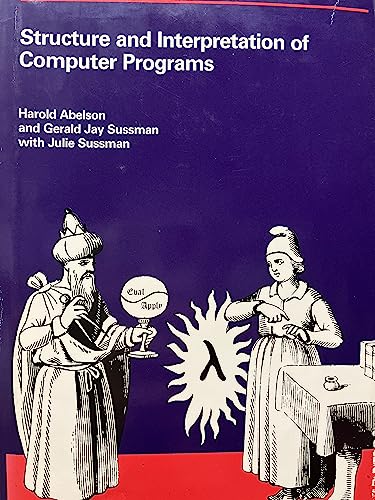
Structure and Interpretation of Computer Programs (SICP) is the quintessential “systems-thinking” programming textbook that teaches you to design programs and languages, not just write code.
This source is a computer science textbook by MIT professors Harold Abelson and Gerald Jay Sussman, with Julie Sussman, first published in 1985 and revised as a second edition in 1996.
[z88sno]
[fkls6p]
It is famous in hacker culture as the “Wizard Book” and is used to teach fundamental principles of programming such as recursion, abstraction, modularity, and programming language design using the Scheme dialect of Lisp.
[z88sno]
Innovators and technical leaders return to it because it forces you to reason from first principles about computation, which directly strengthens your ability to design robust abstractions, languages, and complex systems.
[z88sno]
[qw25o9]
Type and Format
- Format details
- The second edition in MIT’s PDF spans 800+ pages (the MIT-hosted PDF is 657 pages of main text plus front/back matter). [fkls6p]
- It has inspired derivative works and adaptations, including Structure and Interpretation of Computer Programs, JavaScript Edition (SICP JS), which explicitly states that its text is derived from the 1996 second edition. [4pt1a2]
- Where it lives
- A navigable HTML edition of the second edition is also available as an open web version. [sa1ab6]
The People Behind It
- Harold Abelson
- Harold Abelson is a professor of Electrical Engineering and Computer Science at the Massachusetts Institute of Technology (MIT). [z88sno]
- He is known for his work in educational technology and as a co-author of SICP and other influential texts, including Turtle Geometry and Blown to Bits. [z88sno]
- Abelson has been deeply involved in open-education and computing initiatives, including roles in projects such as MIT OpenCourseWare and the Free Software Foundation (inferred from his widely documented advocacy; high-level description). [z88sno]
- Gerald Jay Sussman
- Gerald Jay Sussman is a professor of Electrical Engineering at MIT and co-author of SICP. [z88sno]
- His research has spanned artificial intelligence, computer-aided design, and computer languages; he is known for applying symbolic computation to engineering problems. [z88sno]
- Sussman also co-authored Structure and Interpretation of Classical Mechanics, extending the SICP-style approach to physics and engineering (title and linkage confirmed on his bio and book references). [z88sno]
- Julie Sussman
Catalog of Notable Works
(As a book, this section highlights key chapters and major argument arcs within SICP.)
- “Chapter 1: Building Abstractions with Procedures” — Introduces procedures as the basic building blocks of programs, teaching substitution models, higher-order procedures, and the idea that “programs must be written for people to read, and only incidentally for machines to execute.” [fkls6p] [sa1ab6]
Why It Matters to Innovators
- SICP trains you to think in compositional abstractions—procedures, data, and languages—providing a durable mental model for designing modular architectures, APIs, and platforms rather than one-off features. [z88sno] [fkls6p] This is directly relevant to building extensible products and internal platforms
- The book’s emphasis on metalinguistic abstraction (designing your own languages and interpreters) teaches innovators to view DSLs, configuration systems, and internal tools as strategic levers, not just implementation details. [z88sno] [fkls6p] [4pt1a2] This underpins modern ideas like developer experience as a product .
- The text frames programming as theory-building: discovering general patterns behind specific problems and encoding them as reusable abstractions. [z88sno] [qw25o9] That mindset is central to repeatable innovation, reusable capability building, and creating design systems rather than bespoke solutions (Design Systems).
- SICP’s enduring reputation in hacker and academic culture (“a computer science textbook” known as the “Wizard Book”) signals credibility; working through it is often seen as a rite of passage that distinguishes engineers who can reason about semantics, performance, and architecture from those tied to a single framework. [z88sno] [qw25o9] [4faqo3]
Best Starting Points
- HTML Edition — “Foreword” and “Preface to the Second Edition” [sa1ab6] — The foreword by Alan J. Perlis and the preface explain the book’s goals, audience, and how to approach it, providing an accessible orientation.
- Chapter 1.1: “The Elements of Programming” (HTML) [sa1ab6] — Eases readers into the basic elements of procedures and expressions in Scheme, showing the book’s style with manageable mathematical examples.
- [nhxl7w] — Captures the original MIT 6.001 teaching style; a good companion for those who prefer lectures while following the text.
- SICP Second Edition PDF [fkls6p] — The canonical full text; once comfortable with Chapter 1, innovators can dip into Chapters 3 and 4 for state, objects, and interpreters.
- SICP JS (JavaScript Edition) PDF [4pt1a2] — Recasts the SICP ideas using JavaScript instead of Scheme, making the core abstractions more accessible to web and product engineers familiar with JS.
Adjacent Sources
- Structure and Interpretation of Classical Mechanics — Another “SICP-style” text by Sussman applying similar abstraction and interpretation ideas to physics.
- The Art of Computer Programming — Knuth’s multi-volume series; complementary deep theory of algorithms and computation that shares SICP’s rigor but a different style and focus.
- Concepts, Techniques, and Models of Computer Programming — A later textbook that, like SICP, treats programming languages and paradigms as a space of composable models.
- Functional Programming — Core paradigm underlying much of SICP’s approach in early chapters, especially higher-order procedures and immutability.
- Domain Specific Languages — Directly related to SICP’s metalinguistic abstraction and interpreter-building in Chapter 4.
- Abstraction and Modularity — The central design principles SICP repeatedly emphasizes for managing complexity in systems.