


Redesigning Work
2022, May 03.
Lynda Gratton
Redesigning Work
An evidence-based management book by Lynda Gratton that gives leaders a practical blueprint for how to rethink jobs, teams, and workplaces in the post‑pandemic, hybrid era.
"Redesigning Work" is a book by London Business School professor Lynda Gratton, first published in 2022, that tackles how organizations should reconfigure work after COVID-19 and the rise of hybrid arrangements. It builds on Gratton’s long-standing research on the future of work and draws on company case studies to offer a step-by-step process for leaders. Innovation consultants return to it because it combines rigorous people research with a very usable design framework for reshaping work, not just talking about flexibility in the abstract.
Type and Format
- Type: This source is a book.
- Format details:
- Published by Penguin Business (an imprint of Penguin Random House).
- First published in 2022.
- Typical retail listings describe it as approximately 240–270 pages in length (exact page count varies slightly by edition and format).
- Available in hardcover, ebook, and audiobook editions.
- Where it lives:
The People Behind It
- Lynda Gratton is a professor of management practice at London Business School, where she has focused on the future of work, organizational behavior, and human resource strategy.
- She is the founder of the research consultancy HSM Advisory, which works with companies on “future of work” and people strategy issues and provides many of the cases and data in the book.
- Gratton has written several influential books on work and organizations, including The Shift and The 100-Year Life, which similarly explore how demographics, technology, and social change are reshaping work and careers.
- She is recognized globally as a thought leader on work design and has been listed among the top management thinkers by Thinkers50.
Catalog of Notable Works
Key chapters / arguments in Redesigning Work (chapter titles and structure summarized from publisher and catalog descriptions):
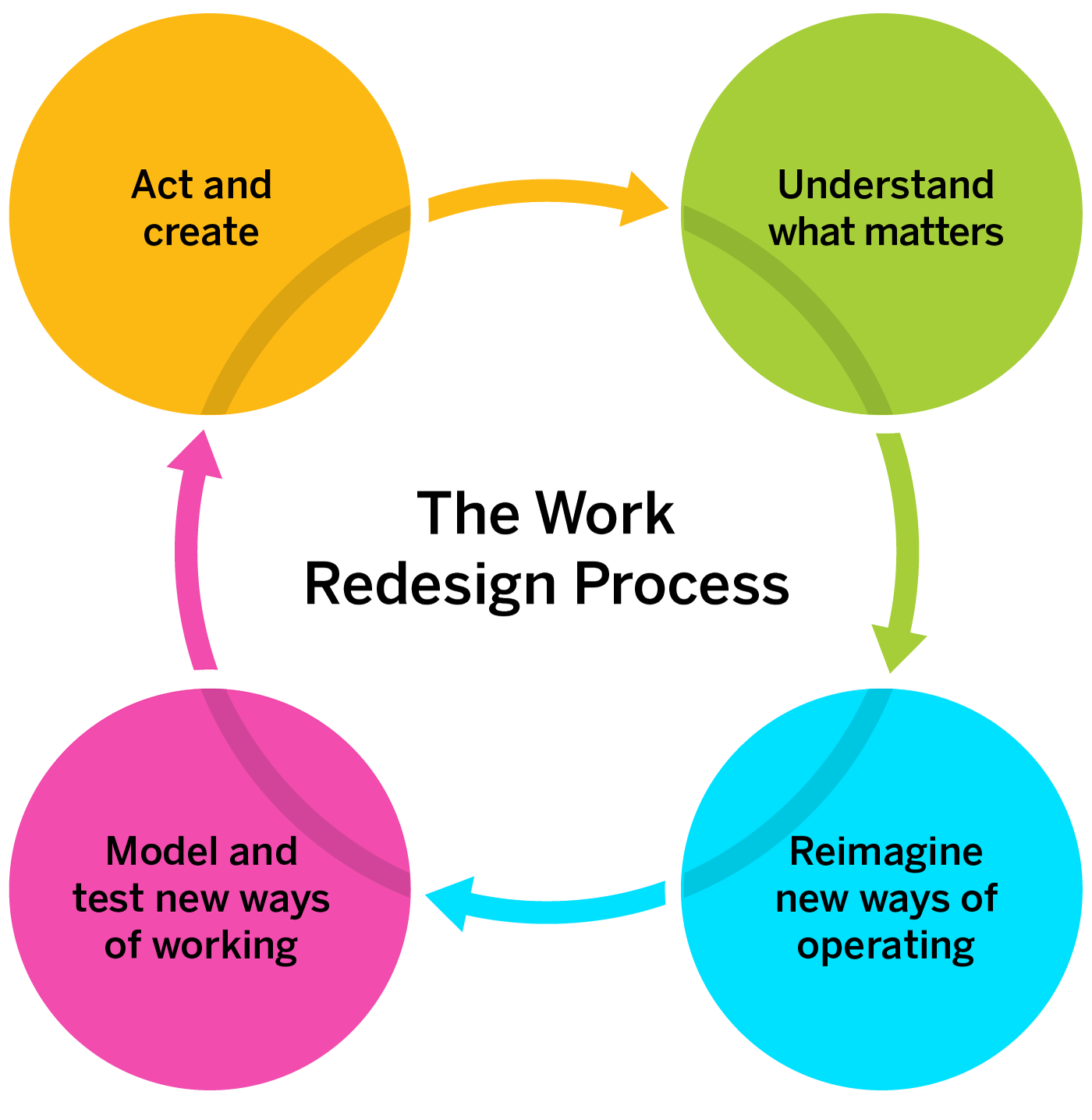
- "Understand" — Lays out how leaders should rigorously gather data on how work is currently done, what employees value, and how networks and knowledge flows operate before changing anything.
- "Reimagine" — Encourages leaders to creatively envision future work arrangements, including hybrid models, by experimenting with time (when work happens) and place (where it happens), grounded in business strategy.
- "Model and Test" — Advocates building and simulating alternative work designs, pressure-testing them against core principles such as fairness, productivity, and inclusion before broad rollout. [pvvf8d]
- "Act and Create" — Focuses on implementation: how leaders role‑model new behaviors, co-create with employees, adjust HR systems, and ensure new ways of working become embedded rather than fads. [pvvf8d]
- "The Four-Step Process for Redesigning Work" — An integrative framework Gratton popularized (and later outlined in MIT Sloan Management Review) that runs through understanding people and jobs, reimagining work, modeling and testing, and acting so the redesign sticks. [pvvf8d]
- Case study chapters (various firms) — Interspersed throughout the book are case-based chapters showing how specific organizations applied hybrid and flexible work redesigns in different industries, offering concrete examples for practitioners.
- "The Great Redesign" — Connects the book’s ideas to the broader shift toward skills-based organizations and new talent models, arguing this redesign transforms how companies plan, deploy, and develop people. [2poiyc]
Why It Matters to Innovators
- It provides a four-step design framework (Understand → Reimagine → Model & Test → Act & Create) that innovators can treat like a playbook for redesigning jobs, workflows, and collaboration patterns, not just office layouts. [pvvf8d]
- Gratton insists leaders start with data on how work really happens—mapping networks, flows of knowledge, and what people value—before making changes, which aligns with evidence-based Organization Design and reduces the risk of shallow “flexibility theater.” [pvvf8d]
- The book reframes hybrid work as an opportunity to experiment with time and place as design variables, enabling new combinations of synchronous/asynchronous and on-site/remote work that can unlock productivity and autonomy. [pvvf8d]
- It highlights how skills and capabilities, rather than fixed roles, should drive work design—connecting closely to skills-based talent models and internal talent marketplaces that support continuous Business Model Innovation. [ktv4qx] [2poiyc]
Best Starting Points
- Redesigning Work — Penguin Business page — Best overview of the book’s promise and audience, with a concise description you can use to decide if it fits your current project.
- Redesigning Work — Google Books — Provides a searchable preview of key sections so you can skim the framework and case studies before buying.
- The Four-Step Process for Redesigning Work (MIT Sloan Management Review article) — Gratton’s article that distills the core methodology from the book into a short, practitioner-friendly summary. [pvvf8d]
- The Great Redesign: Redesigning work and how talent connects to it (Thinkers50 / HSM Advisory piece) — A complementary article that situates the book’s ideas in the broader move to skills-powered organizations. [2poiyc]
Adjacent Sources
- Lynda Gratton — Profile of the author and her wider body of work on the future of work and organizations.
- The 100 Year Life — Another Gratton co‑authored book on longevity and careers, which complements Redesigning Work’s perspective on work design.
- The Shift — Gratton’s earlier exploration of long-term trends reshaping work, useful background for the assumptions built into Redesigning Work.
- Future of Work Reports — Research series on structural shifts in work and labor that provide macro context for Gratton’s firm-level design focus.
- Hybrid Work Design — Concept entry unpacking hybrid models of time and place in organizational design.
- Organization Design — Core conceptual toolkit that underpins Gratton’s practical four-step methodology.