


Only The Paranoid Survive (andy Grove)
Only the Paranoid Survive (Andy Grove)
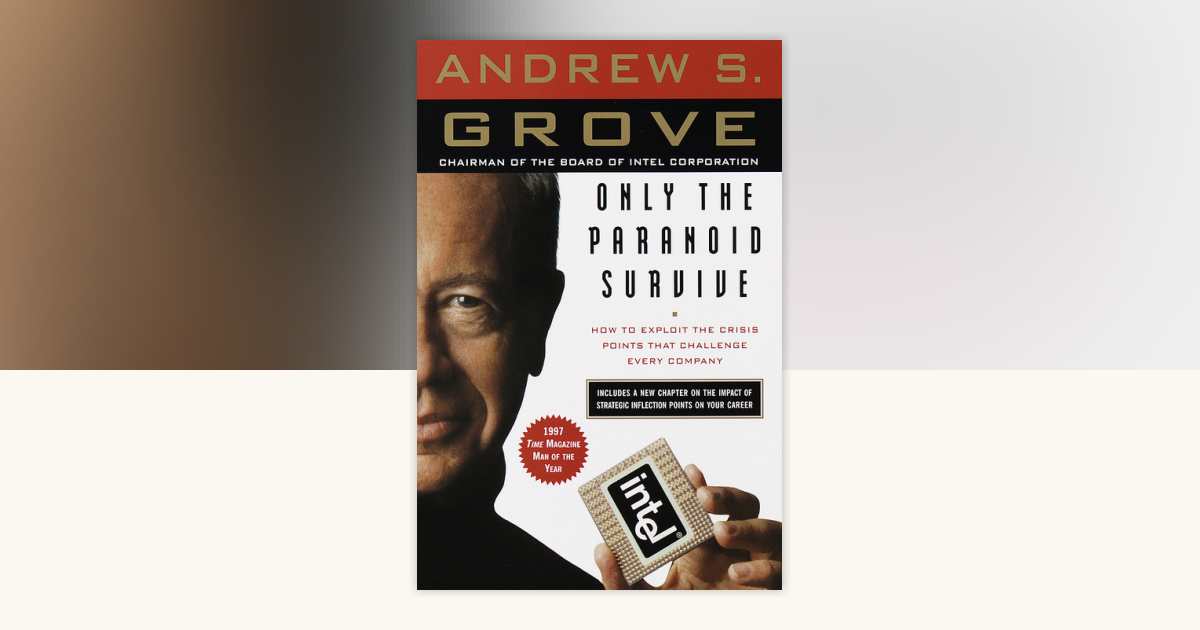
Only the Paranoid Survive is Andy Grove’s classic playbook on how leaders recognize and navigate “when everything changes” moments in a business before those moments kill the company.[2][4]
This is a business and management book written by Andrew S. (Andy) Grove, co‑founder and former CEO of Intel, first published in the late 1990s.[2][5] It blends Intel war stories with a practical framework for handling what Grove calls “strategic inflection points,” those times when fundamental forces in your market shift and old playbooks stop working.[1][2] Innovation consultants keep returning to it because it is one of the clearest field-tested guides to diagnosing existential threats early and then leading an organization through high‑stakes strategic change.[1][2][5]
Type and Format
- Type: This source is a book.[2][4]
- Format details
- Publisher and year: The book is published by Crown Business / Currency (an imprint of Penguin Random House); the Penguin Random House catalog presents it as a classic management title originally released in the 1990s (often cited as 1996/1997 in secondary commentary).[2][5]
- Length: The Penguin Random House edition describes it as a business book in the standard management-book length (roughly a few hundred pages; exact page counts vary by edition).[2]
- Notable editions: There are multiple formats, including paperback and an unabridged audiobook (narrated version on Audible), signaling ongoing demand and status as an enduring management classic.[2][4]
- Where it lives:
- Homepage (Penguin Random House)[2] — primary publisher page with description and purchasing options.
- Google Books[1] — canonical Google Books entry listing bibliographic details and previews.
The People Behind It
- Andrew S. (Andy) Grove — author
- Andy Grove was co‑founder and later CEO of Intel, the semiconductor company that became the world’s leading producer of microprocessors.[2][5]
- He is widely regarded as one of Silicon Valley’s most influential operators; his leadership helped guide Intel through shifting from memory chips to microprocessors, one of the most famous strategic pivots in tech history.[2][5]
- Beyond Only the Paranoid Survive, Grove authored other management and technology books and was known for his rigorous approach to management, which has influenced generations of founders and executives.[5][7]
Catalog of Notable Works
(Book → key chapters / major arguments)
The exact chapter list varies slightly by edition; below are the core ideas and named concepts the book is known for:
- “Strategic Inflection Points” — Grove introduces the central idea: a strategic inflection point is when “the balance of forces shifts from the old structure, from the old ways of doing business and the old ways of competing, to the new” (paraphrasing), requiring leaders to rethink strategy rather than optimize the status quo.[1][2]
- “The 10X Change Test” — He argues that inflection points are often detectable when some dimension of your environment changes by an order of magnitude (a 10X change in technology, competition, or customer expectations), which should trigger deep strategic questioning instead of incremental adjustments.[1][2]
- “Let Chaos Reign, Then Rein It In” — Grove advises that during transformation leaders should first “let [chaos] reign” to encourage experimentation and learning, and then “rein it in” once the new direction emerges to focus and execute.[1]
- “The Inertia of Success” — He warns that the very practices that made you successful create inertia that blinds you to change; past stars are often “the last one to adapt to change” at an inflection point.[1][6]
- “Only the Paranoid Survive” (the mantra) — The core argument is that constant, constructive paranoia—persistently questioning assumptions, scanning for threats, and listening for weak signals from customers and the frontline—is essential for long‑term survival in dynamic markets.[1][2][5]
- Intel Case Studies (e.g., memory to microprocessors) — Grove dissects Intel’s own shift from memory chips to microprocessors as a canonical inflection point, illustrating how internal debates, customer feedback, and competitive pressure converged to force a radical change in strategy.[2][5]
- Middle Management as Early Warning System — He emphasizes that middle managers and frontline people are often the first to feel the new reality, and that senior leaders must actively listen to them to detect inflection points early.[1][2]
Why It Matters to Innovators
- Gives a language for existential shifts: The concept of a strategic inflection point gives innovators precise words and diagnostic cues for those moments when a market, technology, or regulatory shift threatens to obsolete your current business model, going beyond generic “disruption” talk.[1][2][5]
- Operationalizes paranoia into practice: Grove turns “paranoia” into a systematic leadership discipline—scanning for 10X changes, interrogating comforting data, and using internal dissent as signal—which maps well to continuous discovery and Innovation Accounting practices.[1][2]
- Framework for leading through chaos: The “let chaos reign, then rein it in” principle gives founders a concrete playbook for balancing experimentation with alignment, a critical tension in scaling product organizations and navigating Pivot or Persevere decisions.[1][2]
- Exposes the danger of success inertia: The book explains how past success blinds incumbents, showing why high‑performing teams often miss or dismiss new threats—useful for corporate innovators trying to shift legacy organizations or avoid being disrupted themselves.[1][5][6]
- Bridges strategy and execution with real cases: Because the ideas are anchored in Intel’s own high‑stakes bets, they resonate with operators; the book helps translate abstract strategic concepts into meeting‑room decisions about product focus, org design, and capital allocation.[2][5]
Best Starting Points
- Publisher description — Only the Paranoid Survive (Penguin Random House) — concise overview of the book’s premise and why Grove’s Intel experience matters.[2]
- Google Books — Only the Paranoid Survive — skim the table of contents and preview to see how the book structures strategic inflection points and the Intel case studies.[1]
- Audible — Only the Paranoid Survive (Audiobook) — for audio‑first learners, this version presents the full text as a “tech CEO’s guide to recognizing and navigating the moments when everything shifts.”[4]
- Battery Ventures blog — “Only the Paranoid Survive: Lessons from Intel and Andy Grove for Today’s AI Startups” — modern interpretation applying Grove’s principles directly to AI startups, helpful for connecting the book to current innovation themes.[5]
- Marc Abraham review — “Only the Paranoid Survive” — practitioner review highlighting key takeaways like strategic inflection as a long struggle and the “let chaos reign / rein it in” advice.[1]
Adjacent Sources
- High Output Management (Andy Grove) — Grove’s other management classic, focused more on day‑to‑day management systems than on inflection points.
- The Innovator’s Dilemma (Clayton Christensen) — complementary theory on how incumbent success leads to vulnerability to disruptive technologies.
- Measure What Matters (John Doerr) — extends Grove‑inspired OKR practices for focus and execution during growth and change.
- Only the Paranoid Survive (Battery Ventures AI lessons) — applied take on Grove’s ideas for contemporary AI startups, echoing his paranoia and customer‑focus themes.[5]
- Strategic Inflection Points — core concept drawn directly from this book.
- Disruptive Innovation — broader theoretical frame within which many readers place Grove’s work.

Sources
[1]: “Only the Paranoid Survive” (Book Review) - Marc Abraham
[2]: Only the Paranoid Survive by Andrew S. Grove
[3]: Andy Grove: Only The Paranoid Survive [Outliers] - Apple Podcasts
[4]: Only the Paranoid Survive Audiobook by Andrew S. Grove
[5]: Only the Paranoid Survive: Lessons from Intel and Andy Grove for ...
[6]: Only the Paranoid Survive Quotes by Andrew S. Grove - Goodreads
[7]: [[Outliers] Andy Grove: Only the Paranoid Survive The Knowledge ...