


Experience Economy
Experience Economy
The Experience Economy is a management book that argues companies must move beyond goods and services to designing staged customer experiences as their core economic offering.
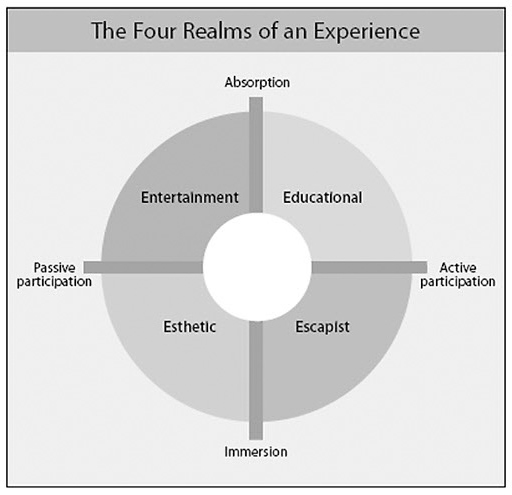
First published as a Harvard Business Review article in 1998 and then as a full-length book in 1999 by B. Joseph Pine II and James H. Gilmore, The Experience Economy became a foundational text in service design and customer experience strategy. The book was updated in an expanded edition in 2011 (often marketed as the “Updated Edition”) to reflect the rise of digital experiences and mass customization. Innovation consultants return to it because it provides a clear economic framework—commodities → goods → services → experiences (→ transformations)—and practical tools like the “4Es” realms of experience that help teams design differentiated offerings.
[lts1dp]
Type and Format
- Type: This source is a book.
- Format details
- Publisher: Originally published by Harvard Business School Press (now Harvard Business Review Press).
- Year of first publication: 1999 as a full-length book following the 1998 HBR article “Welcome to the Experience Economy.”
- Length: The updated edition runs roughly 400+ pages (often cited as around 416–432 pages depending on edition).
- Notable editions:
- Original 1999 hardcover edition.
- 2011 Updated Edition (sometimes subtitled Updated Edition or Updated and Revised) adding new examples, especially digital and mass-customization cases.
- Where it lives
- Google Books — canonical Google Books entry for the updated edition by B. Joseph Pine II and James H. Gilmore.
The People Behind It
- B. Joseph Pine II
- Pine is a management advisor, speaker, and author focused on mass customization, customer experience, and authenticity in business.
- Before The Experience Economy, he wrote Mass Customization: The New Frontier in Business Competition, which explored how companies can efficiently tailor offerings to individual customers.
- He co-founded the consulting firm Strategic Horizons LLP with James Gilmore, advising organizations on competing through experiences.
- James H. Gilmore
- Gilmore is a business author, speaker, and consultant whose work centers on customer experience, innovation, and market differentiation.
- Along with Pine, he co-authored the original Harvard Business Review article “Welcome to the Experience Economy” (1998) that introduced the term and framework.
- He is also known for co-developing concepts like “staging experiences” and exploring how businesses create value beyond services.
(Specific institutional bios vary by edition and publisher materials; Pine and Gilmore are consistently credited as co-authors and co-founders of Strategic Horizons LLP.)
Catalog of Notable Works
Below are key ideas and chapter-level arguments commonly associated with The Experience Economy (exact chapter titles and structure may vary slightly by edition, but these reflect the canonical arguments as described in publisher summaries and secondary analyses).
[8rcdpj]
[lts1dp]
[4yr0dl]
- Work Is Theatre & Every Business a Stage — Frames employees as performers and workplaces as stages, emphasizing scripting, roles, and staging to deliver consistent, intentional experiences. [4yr0dl]
- Experience Design for Transformation — Extends the progression to transformations, where companies guide customers through personal change (health, learning, identity), positioning transformations as the next economic offering beyond experiences.
- Charging Admission & Pricing Experiences — Argues that firms must charge explicitly for experiences, not just embed them in services or goods, and explores models for admission, membership, and subscription pricing. [4yr0dl]
Since Google Books only offers limited preview, detailed subchapter titles are often summarized in reviews and academic analyses rather than fully listed publicly.
[lts1dp]
[4yr0dl]
Why It Matters to Innovators
- Clarifies pricing and business model implications by arguing that experiences must be explicitly charged for—critical when designing new revenue models, memberships, and premium tiers around Customer Experience and Service Blueprinting. [4yr0dl]
- Anticipates the shift toward personalization and mass customization, giving innovators a conceptual bridge between Mass Customization, digital product configuration, and experience-led differentiation. [lts1dp]
- Extends into “transformations” as the next economic offering, which is highly relevant for ventures in health, education, coaching, and behavior change aiming to deliver measurable personal outcomes, not just moments of delight.
Best Starting Points
- Google Books — — Best single entry point: includes publisher description and limited preview that outline the core progression of economic value and the 4Es framework.
Adjacent Sources
- Mass Customization — Pine’s earlier work that underpins the personalization logic feeding into the Experience Economy.
- Welcome to the Experience Economy (HBR) — The seminal article where Pine and Gilmore first introduced the concept.
- Customer Experience — Practical discipline that operationalizes many of the book’s ideas in journeys, touchpoints, and service blueprints. [8rcdpj] [4yr0dl]
- Service Dominant Logic — Theoretical lens that complements the Experience Economy by emphasizing value co-creation in services and experiences.
- Blue Ocean Strategy — Another strategy book focused on crafting uncontested market space, often used alongside the Experience Economy to frame differentiation choices.
Sources
[8rcdpj] The rise of the experience economy | Onsight [2]: The experience – economy revisited: an interdisciplinary ...