


Effectuation Elements Of Entrepreneurial Expertise
Effectuation - Elements of Entrepreneurial Expertise
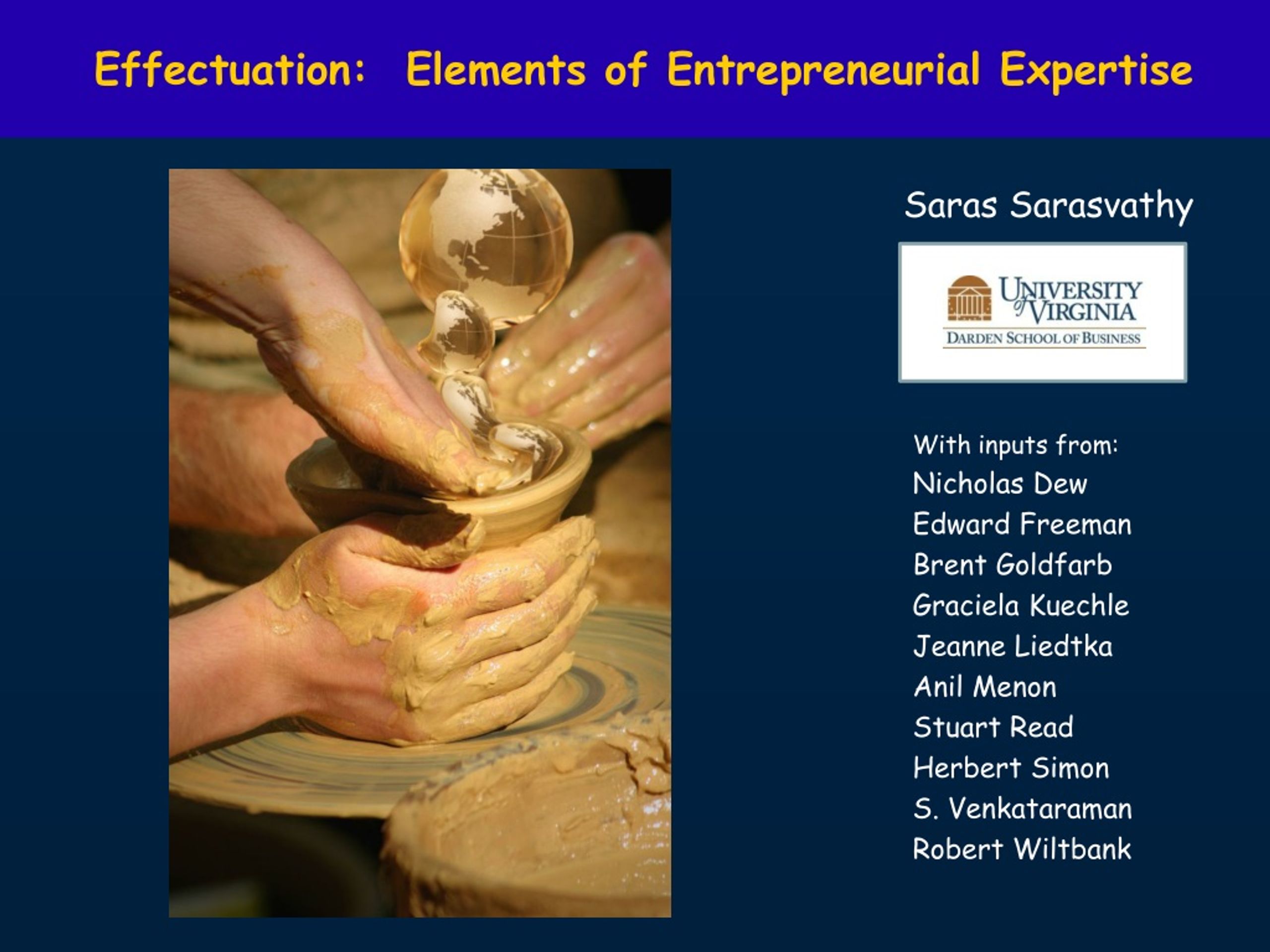
Effectuation: Elements of Entrepreneurial Expertise is the core academic book that codifies Saras Sarasvathy’s research on how expert entrepreneurs actually think and act under uncertainty, turning that into a teachable decision-making logic for venture creation.[4][5][6]
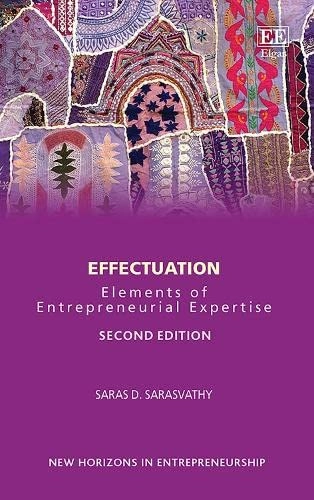
This is a book by Saras D. Sarasvathy, originally published by Edward Elgar Publishing and currently available in a new and updated edition released in 2022.[4][6] It synthesizes empirical research on expert entrepreneurs into the theory of effectuation, a form of “non-predictive control” for creating new firms, markets and economic opportunities when the future is unknowable.[4][5][6] Innovation consultants return to this source because it provides a rigorous, research-grounded alternative to classic prediction- and planning-driven approaches to entrepreneurship and corporate innovation.[2][3][4]
Type and Format
- Type: This source is a book.[4][5][6]
- Format details
- Publisher: Edward Elgar Publishing.[4][6]
- Year of (latest) edition: The new and updated edition is dated January 28, 2022.[6]
- Length: The 2022 edition is listed as 328 pages.[6]
- Notable editions: Edward Elgar describes this as a “new and updated edition of the bestselling Effectuation.”[4][6] Earlier editions under the same title established the book as a key reference in entrepreneurship research.[4][5]
- Where it lives:
- Homepage (publisher) — Edward Elgar book page.[4]
- Google Books — canonical Google Books entry for the 2022 edition.[6]
The People Behind It
- Author: Saras D. Sarasvathy
- Saras D. Sarasvathy is a professor at the University of Virginia Darden School of Business, where she is closely associated with the development and dissemination of effectuation theory.[3]
- The Darden School notes that “Effectuation was created by Darden’s Professor Saras Sarasvathy to help entrepreneurs navigate the uncertainty and risk that comes with starting a business.”[3]
- Her work empirically examined the decision-making of expert entrepreneurs and led to the articulation of effectual logic as distinct from predictive, causal approaches to entrepreneurship.[1][3][4]
Because this is a single‑author book, there is no broader editorial team beyond the author and the publisher’s standard editorial process.
Catalog of Notable Works
For a book, this section focuses on key arguments and building blocks rather than a full chapter list. Chapter titles and detailed structure are not fully exposed in the short online previews, so this list highlights the book’s major conceptual pillars, based on publisher and related effectuation materials.
- Effectuation as non-predictive control — The book defines effectuation as a theory and set of techniques of “non-predictive control for creating new firms, markets and economic opportunities” when the future is truly unknowable.[4][5][6]
- Effectual vs. causal logic — A central argument distinguishes effectual reasoning (controlling an unpredictable future through available means) from causal reasoning (starting with a goal and working backwards via prediction and planning), showing how expert entrepreneurs favor the former under uncertainty.[1][3][4]
- Foundational empirical study of expert entrepreneurs — The work builds on Sarasvathy’s empirical research comparing the decision-making patterns of expert entrepreneurs to those of managers or novices, documenting the existence and bounds of “effectual entrepreneurial expertise.”[1][4]
- Five principles of effectuation — While the named principles (Bird-in-Hand, Affordable Loss, Crazy Quilt, Lemonade, Pilot-in-the-Plane) are described in more practitioner-friendly form on effectuation.org, the book provides the deeper theoretical and empirical basis for these principles.[2][3][4]
- Applications to firm and market creation — The book demonstrates how effectual logic can be used to create new firms and markets rather than only optimize within existing ones, emphasizing entrepreneurial action where human agency shapes the future rather than predicting it.[4][5][6]
Because the full chapter list is not visible in the public previews, specific chapter titles cannot be reliably quoted without over-speculation.
Why It Matters to Innovators
- Reframes entrepreneurship as a controllable process under extreme uncertainty. Effectuation argues that entrepreneurial success is not about superior prediction or innate traits but about using a learnable process focused on control rather than prediction.[2][3][4] For innovators, this directly supports operating in ambiguous spaces where market data and forecasts are thin.
- Provides a decision logic for “unknowable” futures, not just risky ones. Edward Elgar emphasizes that effectuation is especially important “for situations where the future is truly unknowable or human agency is of primary importance.”[4][6] This maps to innovation contexts where there is no historical data and aligns with vault ideas around uncertainty, exploration vs exploitation, and emergent strategy.
- Installs actionable principles (Bird-in-Hand, Affordable Loss, Crazy Quilt, Lemonade, Pilot-in-the-Plane). Effectuation.org summarizes how expert entrepreneurs start with who they are, what they know, and whom they know; focus on affordable loss; build early partnerships; turn surprises into opportunities; and focus on what they can control.[2][3] These principles give innovators concrete heuristics for Minimum Viable Product, early customer development, and partnership-driven experimentation.
- Challenges business-plan-first, forecast-heavy corporate innovation processes. The research shows expert entrepreneurs “know better than trying to predict the future” and instead use non-predictive control.[3][4] This provides a strong, research-based counter-narrative to over-engineered business cases and detailed 5‑year forecasts for genuinely novel initiatives.
- Bridges rigorous academic research and practitioner tooling. The book is the theoretical backbone behind the Effectuation 101 resources and tools used in entrepreneurship education and training worldwide.[2][3][4] For consultants, it’s a credible anchor to justify using effectuation-inspired workshops, curricula, and venture design methods.
Best Starting Points
- Effectuation: Elements of Entrepreneurial Expertise — Google Books — Quick way to browse the latest edition’s front matter and sample pages; good for evaluating whether to buy or assign.[6]
- Effectuation — Edward Elgar Publishing page — Publisher’s overview with positioning language on non-predictive control and the importance of effectuation under unknowable futures.[4]
- What is Effectuation? Effectuation 101 — Practitioner-friendly explanation of the five core principles (Bird in Hand, Affordable Loss, Lemonade, Crazy Quilt, Pilot in the Plane) that operationalize the book’s theory for startups and innovation teams.[2]
- Effectuation – Overview | UVA Darden School of Business — Institutional framing from Darden, emphasizing how expert entrepreneurs manage uncertainty via non-predictive control and linking the work to Sarasvathy’s research.[3]
Adjacent Sources
- Effectuation — The main practitioner hub translating the book’s ideas into simple language, examples, and teaching tools.[2]
- Academic institutional framing tying effectuation to entrepreneurial expertise research and pedagogy.[3]
- Effectual Entrepreneurial Expertise: Existence and Bounds (research paper) — Empirical paper underpinning the book’s claims about effectual reasoning in entrepreneurial decision-making.[1]
- The Lean Startup — Another influential framework for building startups under uncertainty, complementary but more focused on iterative product experimentation than on decision logic.
- Discovery Driven Planning — Planning approach that, like effectuation, pushes back against traditional forecast-driven planning in uncertain contexts.
- Affordable Loss and Non Predictive Control — Vault concept capturing the book’s key mental model: focusing on controllable means and acceptable downside rather than optimizing expected value.
Sources
[1]: [PDF] effectual entrepreneurial expertise: existence and bounds
[2]: What is Effectuation? Effectuation 101
[3]: Effectuation - Overview | UVA Darden School of Business
[4]: Effectuation - Edward Elgar Publishing
[5]: Effectuation: Elements of Entrepreneurial Expertise - Goodreads
[6]: Effectuation: Elements of Entrepreneurial Expertise - Google Books