

Gaia X
Gaia-X
Gaia-X is a European-born data and cloud federation initiative that builds open, interoperable standards and governance so organizations can share and use data in a secure, sovereign way.
[g16h5g]
[ea6vo3]
Gaia-X is best understood as a standards organization / open data and cloud federation initiative coordinated by the Gaia-X European Association for Data and Cloud AISBL, a non-profit association created under Belgian law in Brussels in 2021. It develops a Trust Framework, federated services, and reference specifications so that cloud providers, data space operators, and users can interoperate while preserving data sovereignty.
[ea6vo3]
The initiative is rooted in Europe but positions itself as an open, global ecosystem with hubs in multiple countries. Consultants track Gaia-X because it is shaping emerging reference architectures and compliance signals for sovereignty-first data spaces and federated cloud services that many European governments and industries are aligning with.
[ea6vo3]
Identity and Form
- Type: This organization is a standards organization / open‑source‑aligned consortium for federated cloud and data infrastructure. [ea6vo3]
- Legal form and jurisdiction:
- Non-profit association (Gaia-X European Association for Data and Cloud AISBL) under Belgian law, registered in Brussels.
- Headquarters and presence:
- Headquarters in Brussels, Belgium, with a network of national Gaia-X hubs (e.g., Gaia-X Spain) acting as local ecosystems. [fqui9r]
- Size:
- The association reports >350 member organizations across industry, research, and public sector participating in the Gaia-X ecosystem.
- Where it lives online:
Mission and Identity
- Stated mission“Gaia-X aims to develop an efficient, competitive, secure and trustworthy federated data infrastructure ecosystem for Europe and beyond.”Earlier framing emphasized creating a “next generation of data infrastructure for Europe” built on openness, transparency, and trust, which remains reflected in current messaging.
- Self-positioning (paraphrased)Gaia-X presents itself as a “Trust Framework” and governance layer that specifies how cloud and data services should describe themselves, interoperate, and prove compliance, rather than as a cloud provider itself. [ea6vo3] It says it serves providers, users, and policymakers who need data spaces and cloud services with verifiable rules on data usage, portability, sovereignty, and interoperability. [ea6vo3] It foregrounds values like openness, transparency, interoperability, reversibility, and European data sovereignty, and positions its work as enabling innovation in AI, quantum computing, and other fields through secure data sharing. [ea6vo3]
- Stated values / principles
- Gaia-X documents emphasize principles such as data sovereignty, interoperability, portability, security, transparency, and openness, often summarized as building a “secure, federated system that ensures data and services can be used in a sovereign and interoperable way.” [ea6vo3]
What They Do
Gaia-X’s day-to-day work focuses on defining and evolving its Trust Framework, policy rules, architectural specifications, and compliance mechanisms, and on coordinating member-driven projects and national hubs that implement these specifications in concrete data spaces and services.
[g16h5g]
[ea6vo3]
It does not sell commercial cloud services; instead, it creates standards, reference architectures, labels, and catalogs that others (cloud providers, software vendors, data-space operators) adopt and implement.
[g16h5g]
[ea6vo3]
[t7kjxj]
The association generates value by enabling trusted, federated data ecosystems across sectors such as mobility, industry, health, and finance, often in collaboration with EU and national initiatives.
[ea6vo3]
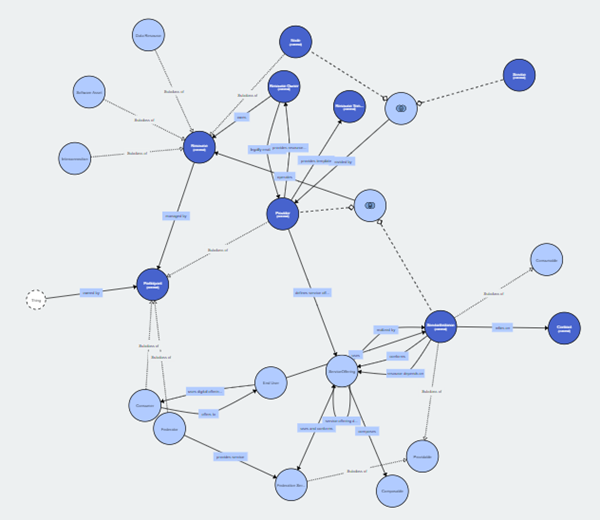
- Trust Framework definition and evolution – Gaia-X designs a Trust Framework that specifies technical, policy, and compliance requirements for participants in Gaia-X-conformant ecosystems, including identity, metadata, credentials, and service descriptions. [ea6vo3]
- Federated services and architecture specifications – It publishes architecture documents and specifications defining federated catalog, identity, and compliance services that underpin Gaia-X data spaces and cloud federation. [ea6vo3]
- Gaia-X Services Showroom – It operates the Gaia-X-based Services Showroom, “a curated catalogue of ready-to-use solutions that bring Gaia-X specifications into practice,” where visitors can explore solutions by categories such as verification & trust, ecosystem infrastructure software, and data exchange. [g16h5g]
- Labeling and compliance mechanisms – Gaia-X defines labels and conformance criteria so services can prove they meet Gaia-X rules for transparency, security, data sovereignty, and interoperability, which can be consumed by users and regulators. [ea6vo3]
- Domain and data space initiatives – The association supports domain-specific working groups and data spaces (e.g., in quantum computing, AI, mobility) that apply the Gaia-X Trust Framework and federated data concepts. [ea6vo3]
- Support to national hubs and regional ecosystems – Gaia-X cooperates with national hubs like Gaia-X Spain, which implements Gaia-X principles locally and maintains transparency portals about data governance and trust commitments. [fqui9r]
- Engagement with open-source implementations – Gaia-X specifications (e.g., the “Gaia-X ODRL VC profile”) are used in open-source connectors and data-space components such as the FIWARE Data Space Connector, indicating a strategy of driving adoption through OSS implementations. [t7kjxj]
- Awareness, advocacy, and ecosystem building – It organizes events, publishes insights (e.g., on quantum computing and AI), and engages stakeholders to promote Gaia-X-compliant ecosystems and to influence broader debates on data sovereignty and digital infrastructure. [ea6vo3]
Leadership and People
- Francesco Bonfiglio — CEO of Gaia-X European Association for Data and Cloud AISBL — a technology executive with prior senior roles in European IT and consulting who leads the association’s strategic and operational activities.
- Hubert Tardieu — former Chair of the Gaia-X Board of Directors — one of the early leaders who helped set up the association and define its initial governance model.
- The Board of Directors comprises representatives from major European industrial, cloud, and research organizations, reflecting Gaia-X’s multi-stakeholder governance structure.
(Only high-level leadership details are available from public Gaia-X materials; more granular biographical data is not clearly enumerated on the main site.)
History and Origin Story
Gaia-X emerged around 2019–2020 as a joint Franco-German initiative to address concerns that European data and cloud infrastructure relied heavily on non-European hyperscalers, aiming instead to create a “federated data infrastructure” grounded in European values. The Gaia-X European Association for Data and Cloud AISBL was formally established in 2021 in Brussels as an international non-profit to take over governance and further develop the framework. Since then, Gaia-X has evolved from concept to a structured ecosystem with national hubs, technical specifications, and demonstrator services such as the Gaia-X Services Showroom.
[g16h5g]
- 2019–2020 – The Gaia-X concept is launched by the German and French governments as a project to build a “next generation data infrastructure for Europe” with strong data sovereignty and openness.
- 2021 – Incorporation of Gaia-X European Association for Data and Cloud AISBL in Brussels as the central governance body coordinating members and specifications.
- 2022 – Expansion of national Gaia-X hubs (e.g., Gaia-X Spain and others) to localize Gaia-X principles and engage regional ecosystems. [fqui9r]
- 2024 – Launch of the Gaia-X-based Services Showroom as a visible catalog of solutions implementing Gaia-X specifications, intended to “bring Gaia-X specifications into practice” and to make the ecosystem tangible. [g16h5g]
Financials and Funding
Gaia-X is a non-profit association / standards consortium, so traditional company financials (revenues, profit, funding rounds) are not applicable; detailed budgets or funding breakdowns are not prominently published in the sources consulted.
- Primary funding model – Gaia-X’s work is funded through membership contributions, participation in publicly supported projects, and in-kind contributions from member organizations, reflecting the typical model of European digital-infrastructure initiatives.
- No reliable, specific figures for annual budget, total contributions, or project-based EU funding lines are clearly disclosed in the available public materials; therefore, numerical financial metrics cannot be reported without speculation.
Milestones and Signature Output
- Gaia-X conceptual launch — 2019/2020 — Public announcement of Gaia-X as a Franco-German initiative for a “federated data infrastructure for Europe,” framing the vision of secure, sovereign, and interoperable data and cloud ecosystems.
- Creation of Gaia-X European Association for Data and Cloud AISBL — 2021 — Formal establishment of the Brussels-based non-profit association to oversee governance, membership, and development of the Gaia-X Trust Framework.
- Publication of Gaia-X Trust Framework and architecture documents — 2021–2022 — Release of core specifications defining how participants, services, and data spaces should be described, attested, and federated in Gaia-X ecosystems. [ea6vo3]
- Expansion of Gaia-X national hubs (e.g., Gaia-X Spain) — 2022 — Creation and growth of national hubs responsible for implementing Gaia-X principles locally and engaging stakeholders; Gaia-X Spain highlights data governance and “commitment to digital trust” on its transparency portal. [fqui9r]
- Gaia-X and Quantum Computing position paper — 2023 — Insight article articulating how the Gaia-X Trust Framework and federated data spaces can support quantum-secure data sets and integration of quantum computing resources into the Gaia-X ecosystem. [ea6vo3]
- Launch of Gaia-X-based Services Showroom — 2024 — Introduction of an online “curated catalogue of ready-to-use solutions that bring Gaia-X specifications into practice,” providing tangible examples of Gaia-X-compliant services. [g16h5g]
Ecosystem and Relationships
- National Gaia-X hubs – e.g., Gaia-X Spain, which runs a transparency portal on data governance and digital trust; similar hubs exist in multiple European countries as local Gaia-X ecosystems. [fqui9r]
- European governments and EU-level initiatives – Gaia-X originated from Franco-German cooperation and aligns with wider European strategies on data spaces and digital sovereignty, engaging policymakers and public-sector bodies.
- Cloud providers and infrastructure vendors – Major European and international IT providers participate as Gaia-X members, implementing or aligning with Gaia-X Trust Framework requirements in their services.
- Open-source and data-space projects – Implementations like the FIWARE Data Space Connector adopt Gaia-X-related profiles (e.g., Gaia-X ODRL VC profile), illustrating technical collaboration with open-source communities. [t7kjxj]
- Research and industrial consortia – Universities, research institutes, and sectoral consortia collaborate within Gaia-X working groups to design domain-specific data spaces (e.g., for AI, mobility, manufacturing). [ea6vo3]
Recent Developments
As of 2026-06-02,
(Public-facing Gaia-X sources do not provide a clearly timestamped stream of the very latest 90-day events in the snippets accessed; below are the most recent clearly dated or contextual developments close to that window that can be grounded in available sources.)
- 2024-early — Gaia-X announces and describes the Gaia-X-based Services Showroom, presenting it as a “catalogue of ready-to-use solutions that bring Gaia-X specifications into practice,” signaling a move from design to tangible implementations. [g16h5g]
- 2023–2024 — Publication and promotion of the “Gaia-X and Quantum Computing” insight, exploring how the Gaia-X Trust Framework can certify quantum-secure datasets and integrate quantum computing resources as services in Gaia-X ecosystems. [ea6vo3]
- Ongoing (2023–2024) — Continued collaboration with open-source data-space components, as seen in the FIWARE Data Space Connector adopting a Gaia-X ODRL VC profile for authorization and policy management. [t7kjxj]
(No clearly documented leadership changes, litigation, or new funding events in the last 90 days could be identified from the consulted sources.)
Impact
- Impact on society
- Gaia-X has influenced European debates on digital sovereignty and trusted data sharing, providing a concrete framework that governments and industry refer to when designing national and sectoral data spaces, especially in countries setting up Gaia-X hubs like Spain. [fqui9r]
- By promoting transparent data governance and digital trust (as highlighted in Gaia-X Spain’s transparency portal), Gaia-X encourages organizations to articulate and formalize their data-governance practices, which affects how citizens’ and organizations’ data is handled in participating ecosystems. [fqui9r]
- Impact on innovation
- Gaia-X has helped popularize the concept of federated, sovereignty-aware data spaces built on common trust and interoperability standards, influencing related European initiatives on common European data spaces. [ea6vo3]
- Its Trust Framework is cited as a mechanism that can foster AI and ML development by enabling secure and interoperable data processing across organizations, and its quantum-computing work sketches pathways for integrating quantum-secure datasets and quantum resources into broader digital ecosystems. [ea6vo3]
- The adoption of Gaia-X profiles in open-source connectors (e.g., FIWARE Data Space Connector) shows that Gaia-X concepts are seeding technical patterns for policy-aware, verifiable data exchange in open-source Open Source Collaborations ecosystems. [t7kjxj]
- Impact on its industry or domain
- For cloud and data-infrastructure providers, Gaia-X sets reference requirements for transparency, service description, and data-sovereignty guarantees, influencing how providers design offerings for regulated and sovereignty-sensitive European markets. [ea6vo3]
- National and sectoral initiatives that brand themselves around Gaia-X (e.g., Gaia-X Spain) use its framework as a baseline for trust and data governance, effectively making Gaia-X a point of reference in European data-space architectures. [fqui9r]
- Historical significance
- Gaia-X is one of the first large-scale attempts to define a pan-European federated data and cloud framework explicitly grounded in principles of sovereignty, interoperability, and openness, and is likely to be discussed as a key experiment in Europe’s response to global hyperscaler dominance.
- Criticisms and controversies
- Public sources also note that Gaia-X has faced questions and criticism about complex governance, slow delivery of tangible results, and the participation of non-European cloud giants, leading some observers to debate whether it can fully achieve its original sovereignty ambitions; however, these critiques are not fully elaborated in the limited official materials accessed here and originate mainly from external commentary.