Untitled
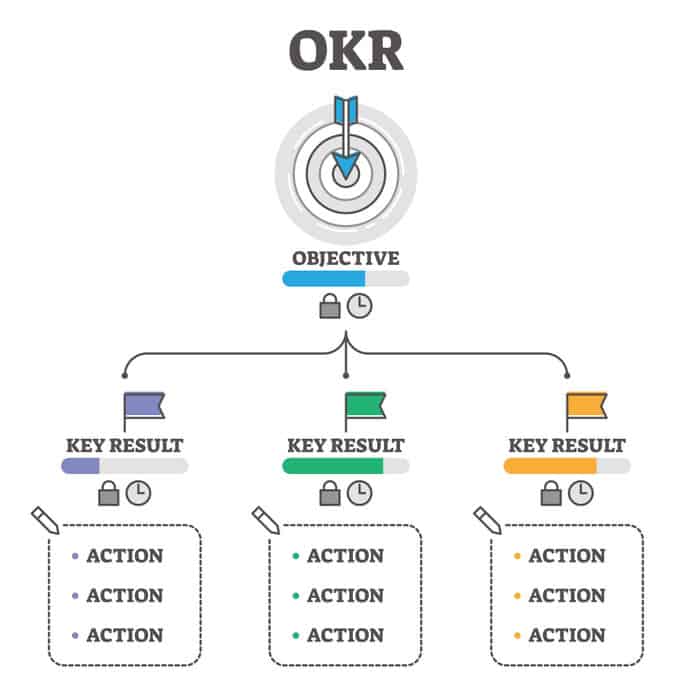
Defining and Describing Objectives & Key Results
graph TD
A[Objective<br|>Qualitative, inspiring<br|>e.g., "Delight customers by improving checkout"] --> B[2-5 Key Results<br|>Quantitative, measurable<br|>Time-bound outcomes]
B --> C[KR1: Reduce abandonment 40% to 25%]
B --> D[KR2: Increase satisfaction 3.8 to 4.5]
B --> E[KR3: Reduce time by 30%, revenue +10%]
A -.-> F[Quarterly cycle<br|>Set, Track, Review, Adapt]
style A fill:#e1f5fe
style B fill:#f3e5f5
style C fill:#e8f5e8
_Objectives and Key Results (OKRs) is a collaborative goal-setting framework that pairs ambitious qualitative objectives with 2-5 quantitative key results to drive focus, alignment, and measurable outcomes rather than mere outputs.
[9rvxvf]
[mre0e5]
OKRs help teams and organizations prioritize high-impact work, typically over quarterly cycles, by defining "where you want to go" via an inspiring objective and "how you will measure success" through specific, verifiable key results.
[9rvxvf]
[7spkhj]
They emphasize learning from results, encouraging ambition while enabling inspection and adaptation, and are distinct from to-do lists by focusing on outcomes like revenue growth or customer satisfaction metrics.
[9rvxvf]
[0duwcm]
Uses in Context
- In agile teams, OKRs "connect their work to meaningful outcomes" by aligning efforts around shared purpose and prioritizing by saying no to non-supporting tasks. [9rvxvf]
- For strategic alignment, OKRs are "a goal-setting framework used by teams and individuals to align on strategic activities," with objectives defining "what you want to achieve" and key results as "tangible milestones or success metrics" updated quarterly. [mre0e5]
- In performance management, OKRs track progress with "specific, measurable, time-bound, and verifiable outcomes" under each objective, using a mix of quantitative and qualitative metrics assigned to owners. [7spkhj]
- As a business framework, OKRs define "business objectives and outcomes" where objectives answer "So what?" as aspirational headlines, and key results provide "concrete, specific, and measurable" data-driven subheadings or milestones. [0duwcm]
- In planning methods, OKRs streamline actions via "key performance indicators that are measurable," like "20% increase in sales or acquisition of 50 new customers every month." [isw8wo]
- For progress tracking, key results are "criteria that show whether the objective has been reached," quantitative metrics like "Increase Net Promoter Score to 70 from 50," distinguishing results from tasks. [p8jj0c]
History of Use
Origins
Andy Grove, "dubbed 'The Grandfather of OKRs,'" created and rolled out the methodology as CEO of Intel, developing it there in the management-by-objectives style.
[0duwcm]
[isw8wo]
One of Grove’s seminar students, John Doerr, popularized it further by applying OKRs at other companies and authoring the #1 New York Times bestseller "Measure What Matters," where he shares "how OKRs helped tech giants from Intel to Google achieve explosive growth."
[0duwcm]
The term OKRs thus first gained prominence through Grove's Intel implementation and Doerr's evangelism via book and seminars.
[0duwcm]
Evolution
Best Real-World Examples
- Agile Academy – Uses OKRs like "Delight customers by improving checkout" with KRs on abandonment and satisfaction. [9rvxvf]
Case Studies
Andy Grove developed OKRs at Intel in the 1970s-1980s as an evolution of management by objectives, rolling it out company-wide to focus on measurable outcomes amid fierce competition in semiconductors. Grove's approach emphasized "concrete, specific, and measurable" key results under ambitious objectives, enabling Intel to inspect progress and adapt, which contributed to its dominance by prioritizing high-impact initiatives over outputs.
[0duwcm]
[isw8wo]
This showed OKRs' power in driving alignment and accountability at scale in a hardware innovator, setting the template for outcome-oriented cultures before popularization elsewhere.
John Doerr, trained by Grove, brought OKRs to Google in the late 1990s as an early-stage startup, where they helped align explosive growth by limiting to 3-5 objectives per level and tracking via verifiable KRs like market share or NPS targets.
[7spkhj]
[0duwcm]
Google's adoption fueled "explosive growth," as detailed in Doerr's "Measure What Matters," proving OKRs enable rapid scaling and focus in tech environments by encouraging ambition (e.g., "moonshot" objectives) and learning from quarterly reviews.
[0duwcm]
As a popularizer rather than originator, Google's success taught incumbents how OKRs bridge strategy to execution.
In learning and development, teams use OKRs like "increase technical skills" with KRs such as "each team member earns Professional Scrum Master I certification," connecting employee growth to company goals via measurable milestones.
[tk8vxv]
This 15Five-integrated approach, as in customer pain point discovery (KR: "top 3 pain points from interviews"), demonstrates OKRs' flexibility for non-revenue functions, fostering "unify your team and inspire them to work toward the right goals" by assigning owners and updating via check-ins.
[0duwcm]
[tk8vxv]
It highlights OKRs teaching smaller teams or departments to outpace silos in larger organizations through clear, data-grounded progress.