


WebSockets
Defining and Describing WebSockets
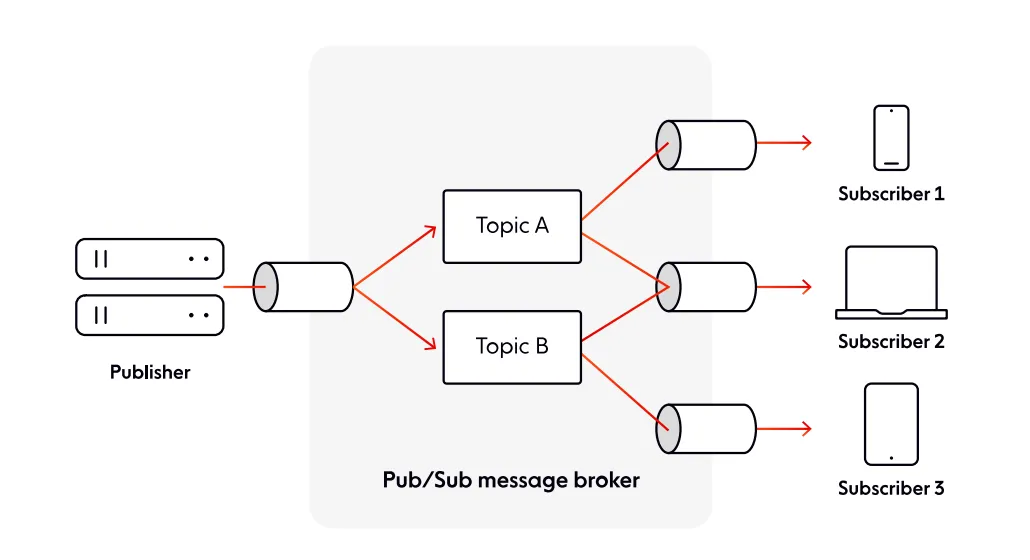
WebSockets apply when a product needs live, event-driven interaction—such as telemetry, notifications, chat, trading, or voice streams—and do not describe ordinary request/response HTTP calls or one-off API fetches.
[7hezdn]
[pmmw2c]
[gz85l2]
[z518hl]
An innovation consultant would care because WebSockets change product architecture, latency, infrastructure cost, and user experience: they let teams push data instantly, but also require connection management, authentication, and infrastructure that can handle long-lived sessions.
[7hezdn]
[gz85l2]
[5bftii]
[z518hl]
Disambiguation
Primary sense — the innovation-consulting sense
WebSockets are a web protocol that keeps a connection open so a client and server can exchange messages in both directions in real time.
[pmmw2c]
[z518hl]
Other senses
1. WebSocket APIs / vendor-specific WebSocket endpoints
A WebSocket API is a product-specific interface exposed over the WebSocket protocol for streaming or bidirectional integration.
[7hezdn]
[2d92vj]
[gz85l2]
- ThingsBoard describes a “WebSocket API” that lets clients subscribe to telemetry, entity data changes, alarm events, and notifications, with updates pushed instantly. [7hezdn]
- LSEG describes a “Websocket API” as a server-side interface for direct WebSocket access to market-content streams using JSON and WebSocket protocols. [2d92vj]
- Palantir’s “WebSocket listeners” route incoming data to compute modules and are designed for bidirectional workflows, especially real-time audio and telephony. [gz85l2]
Etymology and Origin
- The term WebSocket appears as a standardized protocol term in RFC 6455, which Microsoft summarizes as “WebSocket (RFC 6455) is a protocol that enables two-way persistent communication.” [z518hl]
- Google Cloud’s documentation says “The WebSockets spec and protocol is maintained by the W3C,” indicating that the term migrated into formal web-standards vocabulary rather than remaining a vendor coinage. [pmmw2c]
Adjacent Vocabulary
- Synonyms: persistent connection — emphasizes the long-lived nature; bidirectional streaming — emphasizes message flow in both directions; real-time messaging — broader product term that may or may not imply the WebSocket protocol; socket connection — looser technical shorthand, but less precise than WebSocket. [7hezdn] [pmmw2c] [z518hl]
Usage in Practice
- “The WebSocket API provides real-time, bidirectional communication between client applications and the platform.” [7hezdn]
- “Use it to subscribe to telemetry updates, entity data changes, alarm events, and notifications — all pushed instantly without polling.” [7hezdn]
- “WebSocket is a protocol that provides a full-duplex communications channel between a web client and web server over a single TCP connection.” [pmmw2c]
- “The WebSocket protocol uses the HTTP protocol to establish the connection between the client and server.” [pmmw2c]
- “WebSocket (RFC 6455) is a protocol that enables two-way persistent communication.” [z518hl]
- “WebSocket listeners route incoming data to a compute module for processing.” [gz85l2]