


User Authentication
_
Defining and Describing User Authentication
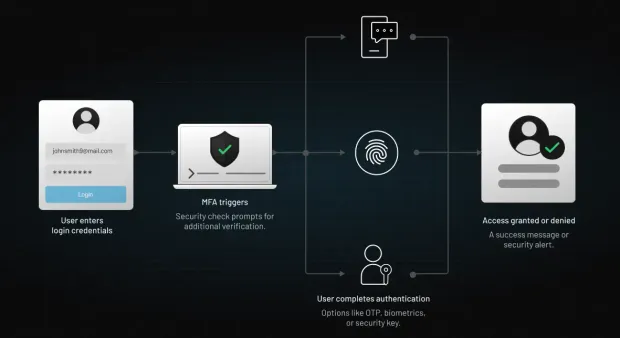
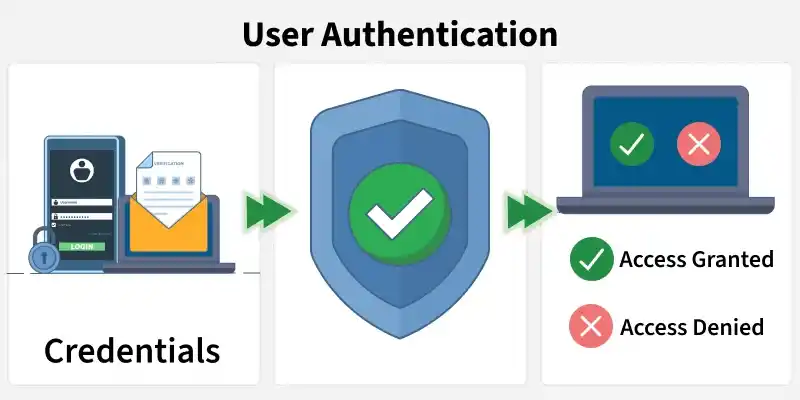
User authentication is the security process by which a product or platform verifies that a user is really who they claim to be before granting access to applications, APIs, or data, typically via passwords, tokens, or biometrics.[1][2][3][12][13]
In innovation and startup contexts, user authentication refers to the design and implementation of the “front door” that controls how customers sign up, log in, and prove identity across web apps, mobile apps, and APIs.[1][3][9][14] It applies whenever a system must decide whether to trust an access attempt—consumer apps, B2B SaaS dashboards, developer portals, or internal admin tools—but not to downstream authorization (what a user can do after being authenticated) or purely anonymous usage.[1][3][9] Innovation consultants care because choices around authentication (password policy, MFA, social login, passkeys, auth providers) strongly influence conversion, security risk, compliance posture, and engineering velocity in early-stage products.[1][3][8][9][14]
Disambiguation
Primary sense — the innovation-consulting sense
User authentication (digital product / startup sense): The end‑to‑end mechanism that verifies a user’s identity before granting access to a system, application, device, API, or resource, typically using credentials and authentication factors governed by security policies.[1][2][3][9][13]
- User authentication in this sense is “the process of confirming a user's identity before they gain any access to your application,” answering the question ‘Are you really who you claim to be?’[1][2][3][12][13] It is the first control that stands between a person and the systems, data, and apps they want to use.[3][9]
- It relies on credentials and authentication factors (something you know like a password, something you have like a token or device, something you are like biometrics) plus policies to decide whether a login attempt should be trusted.[3][9][12][13] For startups, this includes email/password sign‑in, social login (OAuth), magic links, MFA, and increasingly WebAuthn/passkeys.[1][8][9][13][14]
- This sense is not authorization: roles and permissions “control what authenticated users can do,” whereas authentication only verifies identity.[1][3] Consultants often separate “authN” (authentication) from “authZ” (authorization and roles) when advising founders on product architecture.[1][3][8]
- This sense excludes broader identity governance (lifecycle of accounts, access certifications) and generic “user verification” in non-digital contexts; it is specifically about digital access control, login flows, and token issuance in software systems.[3][8][9][11][13]
Other senses
1. User authentication in cybersecurity / identity-protection literature
Definition: In security vendor and cybersecurity‑operations writing, user authentication is the “critical control point that verifies the identity of users to protect confidential data against unauthorized access,” emphasizing attack models, MFA strength, and phishing resistance.[3][8][11][12][13]
- CrowdStrike and similar vendors describe user authentication as the gate that “guarantees that users are who they say they are through credentials such as passwords, tokens or biometric data” to protect sensitive data.[12][13] This framing emphasizes breach prevention and identity‑based attacks (phishing, credential stuffing, AiTM).
- Security fundamentals material explains user authentication as “the first line of defense, allowing only legitimate users to access sensitive resources,” and ties it to secure password storage (Argon2/bcrypt/scrypt), MFA, HTTPS, secure cookies, and robust logging and monitoring.[3][9][11]
- For innovation consulting, this sense matters because investors and CISOs evaluate startups on whether their authentication controls meet modern standards (NIST SP 800‑63B, OWASP, FIDO2/WebAuthn, phishing‑resistant MFA, token protection), impacting enterprise sales and due diligence.[4][7][8][9][11][15]
- Also used in generic IT and networking to mean any mechanism that identifies a user before granting access to a network or device; this broad infra sense is rarely important in strategy or product‑innovation work and is typically folded into the primary sense above.[2][3][5][13]
Adjacent Vocabulary
- Synonyms
- Login / sign‑in flow: Common product term for the user‑facing part of authentication; narrower, as it focuses on UX (screens, buttons) rather than back‑end verification and policies.[1][3][9][13][14]
- Digital identity verification: Often used when authentication must meet regulatory or high‑assurance standards (KYC, strong MFA); emphasizes assurance level more than everyday app login.[3][8][11][13]
- Access control (narrow sense): In some materials, user authentication is described as part of “access control,” but strictly speaking access control also includes authorization and policy enforcement.[3][8][9]
- Antonyms
- Anonymous access: Allowing use of a system without any identity verification (e.g., public content, unauthenticated APIs), the opposite of requiring user authentication.[3][9][13]
- Unauthenticated session: A state where actions are performed without having verified the user’s identity (or after token/session failure), in contrast to an authenticated session.[3][9][10][11]
- Adjacent terms
- Authorization (AuthZ) and User Roles — deciding what an authenticated user may do; closely coupled in product architecture but conceptually distinct.[1][3][8]
- OpenID Connect — external services that perform authentication and issue identity tokens to apps.[8][9][11][14]
- Multi‑Factor Authentication (MFA) and Phishing‑Resistant MFA — adding factors beyond passwords to strengthen authentication; now a baseline enterprise expectation.[4][6][8][9][15]
- Password Policy and NIST SP 800‑63B — guidelines that shape how passwords are created, checked, stored, and rotated in authentication systems.[4][5][6][7][9][15]
- WebAuthn, Passkeys, and FIDO2 — modern, device‑bound or synced cryptographic methods for passwordless or strong authentication in browsers and apps.[8][9][11]
- JWT and Session Token Management — mechanisms by which authentication state is represented and validated at API boundaries after login.[8][9][10][11]
Usage in Practice
- Shipkit, a founder‑oriented guide to building MVPs, explains: “Authentication verifies who your users are (through passwords, emails, or social login), while roles control what authenticated users can do within your application… Authentication answers a single question: ‘Are you really who you claim to be?’”[1]
- A startup‑focused explainer notes: “User authentication is a security process that verifies a user’s identity before allowing them to access a system, application, or network.”[2] This frames authentication as a prerequisite to any meaningful use of the product.
- Rapid7’s security fundamentals describe user authentication as “the process of verifying a person’s identity before allowing access to a system, application, device, or resource,” and emphasize that it “usually relies on credentials, authentication factors, and policies that decide whether the login attempt should be trusted.”[3]
- A trade‑press guide for consumers and small businesses says: “User authentication is what happens whenever you do something like log into your bank account, access your laptop, or sign into a social media account… It’s the process of verifying that a user is who they claim to be, which helps keep data and information protected from unauthorized access.”[13]
- A Spanish‑language cybersecurity overview similarly defines: “La autenticación de usuarios es el punto de control crítico que verifica la identidad de los usuarios para proteger los datos confidenciales contra accesos no autorizados… garantiza que los usuarios sean quienes dicen ser mediante credenciales como contraseñas, tokens o datos biométricos.”[12]
- A startup‑oriented article on Auth0’s use cases explains that an auth platform “sits in the authentication layer of a startup’s product stack and helps teams manage how users sign up, log in, verify identity, and access applications or APIs.”[14]
- A web‑app security guide underscores practice: “Authentication is a crucial process for verifying the identity of users or systems in web applications. It serves as the first line of defense, allowing only legitimate users to access sensitive resources.”[9]
Common Misuses
- Confusing authentication with authorization/roles. Teams often talk about “user authentication” when they mean “who can access which features or data.” The more precise term is authorization or role‑based access control (RBAC), with authentication reserved for identity verification.[1][3][9]
- Equating password creation UX with full authentication posture. Marketing copy may claim “strong user authentication” when all that has changed is a visually pleasing signup form; the better terms here are signup UX or onboarding flow, while true authentication posture includes storage, MFA, and token handling.[3][4][6][7][9]
- Using ‘user authentication’ to describe KYC or regulatory identity checks. In fintech and regulated markets, verifying legal identity for compliance (KYC/AML) goes beyond basic login; digital identity verification or customer due diligence are more accurate.[3][8][11][13]
- Labeling any login as ‘secure user authentication’ without meeting modern standards. Some products advertise “secure authentication” while storing passwords improperly, omitting MFA, or using long‑lived, poorly validated tokens; the better phrase for what they have is basic password login, whereas secure, modern authentication implies conformance with guidelines like NIST SP 800‑63B, strong MFA, and robust token protection.[4][7][8][9][11][15]
Sources
[1]: Authentication and User Roles for Your Startup MVP | Shipkit
[2]: What is User Authentication, and Why is it Important?
[3]: Examples And Use Cases
[4]: Auditing Password Policies with NIST SP 800–63B
[5]: Standards and Guidance for Authentication of External Users
[6]: NIST password guidelines
[7]: Meeting NIST 800-63B Password Requirements with ASP.NET Core ...
[8]: Comprehensive Authentication Guide
[9]: Authentication Methods for Web Applications: A Beginner's ...
[10]: How should security teams implement JWT authentication safely in ...
[11]: IR 8587, Protecting Tokens and Assertions from Forgery, Theft, and ...
[12]: ¿Qué es la autenticación de usuarios?
[13]: Master user authentication: Key practices for online safety
[14]: Auth0 Use Cases: How Startups Secure User Authentication
[15]: NIST recommendations on...