


Unmanned Aerial Systems
(2025-12-02T11:48.465Z)
Perplexity Query
(2025-12-02T11:48
.465Z)
Question:
Write a comprehensive one-page article about "Unmanned Aerial Systems".
Model: sonar-pro
Introduction to Unmanned Aerial Systems
Unmanned Aerial Systems (UAS), commonly known as drones, are aircraft with no human pilot, crew, or passengers on board that are controlled remotely by operators on the ground.
[oj8y7p]
These sophisticated systems consist of an unmanned aircraft, an autonomous or human-operated control system, and a command and control system that links all components together.
[ds940d]
UAS have become increasingly significant across multiple sectors because they enable operations that would otherwise be too dangerous, costly, or impractical for traditional manned aircraft, revolutionizing industries from agriculture to emergency response and infrastructure inspection.

Understanding UAS Technology and Capabilities
Unmanned Aerial Systems represent a paradigm shift in how we gather data and conduct critical operations. The appeal of using UAS stems from their ability to be controlled remotely without an on-board pilot, enter environments that would otherwise prove too dangerous for human life, remain airborne for extended periods of time, and effectively provide remote operators with precise and accurate information while scanning large geographic areas in short periods of time.
[zv791m]
Unlike traditional manned aircraft, UAS offer cost-effectiveness by requiring fewer personnel to operate and maintain, enhanced safety since pilots remain on the ground sometimes thousands of miles away, and versatility in sizes and configurations that can be tailored to specific mission needs.
[t6ulev]
The technological advantages of UAS extend to their persistent surveillance capabilities, allowing continuous monitoring and data collection in ways that manned aircraft cannot sustain.
[t6ulev]
Advanced sensors, including infrared cameras, can be mounted to UAS to capture high-resolution imagery and collect critical real-time data.
[zv791m]
This combination of remote operation, extended flight duration, and sophisticated sensor integration makes UAS exceptionally valuable for tasks requiring detailed information gathering in challenging or hazardous environments.
Diverse Applications Across Industries
The practical applications of UAS span nearly every sector of the economy. In precision agriculture, UAS reduce the time and manpower needed to perform essential tasks while enhancing producers' ability to monitor crops and livestock, alert farmers to insect threats, analyze pesticide and fertilizer levels, and detect plant diseases before they become detrimental to crop growth.
[zv791m]
According to industry projections, nearly 80% of commercial UAS use will eventually occur in the agricultural sector.
[zv791m]
Disaster and emergency response represents another critical application area. UAS allow for monitoring and prediction of floods, tornadoes, and forest fires, while assisting in search-and-rescue situations by deploying advanced thermal imaging to locate survivors in debris and rubble.
[zv791m]
In infrastructure inspection, UAS can examine bridges, pipelines, power lines, and railway tracks, preventing costly downtime while ensuring public safety.
[t6ulev]
Additional applications include critical infrastructure security, environmental monitoring, wildlife conservation, border and maritime security, and highway transportation, where UAS provide eyes-in-the-sky during incident response for roadway disturbances and damage assessment following natural disasters.
[w8keem]

Current State and Market Development
The UAS market has experienced rapid growth as control technologies have improved and costs have fallen. Government agencies like NASA utilize UAS technology to conduct hurricane, atmospheric, weather, and climate studies in dangerous or high-altitude settings, while military applications continue to advance through systems like the RQ-4 Global Hawk used for worldwide intelligence, surveillance, and reconnaissance.
[zv791m]
Private companies have begun integrating UAS into commercial operations, with notable examples including Amazon Prime Air for package delivery and various commercial drone services for aerial photography, surveying, and inspection work.
[oj8y7p]
The transition toward autonomous operations represents a significant trend, with autonomous drones increasingly conducting operations beyond visual line of sight (BVLOS) while maximizing production, reducing costs and risks, and ensuring site safety and regulatory compliance.
[oj8y7p]
State departments of transportation have begun deploying UAS for highway system design, construction, and operation, demonstrating the technology's practical value in modern infrastructure management.
[w8keem]
Future Outlook
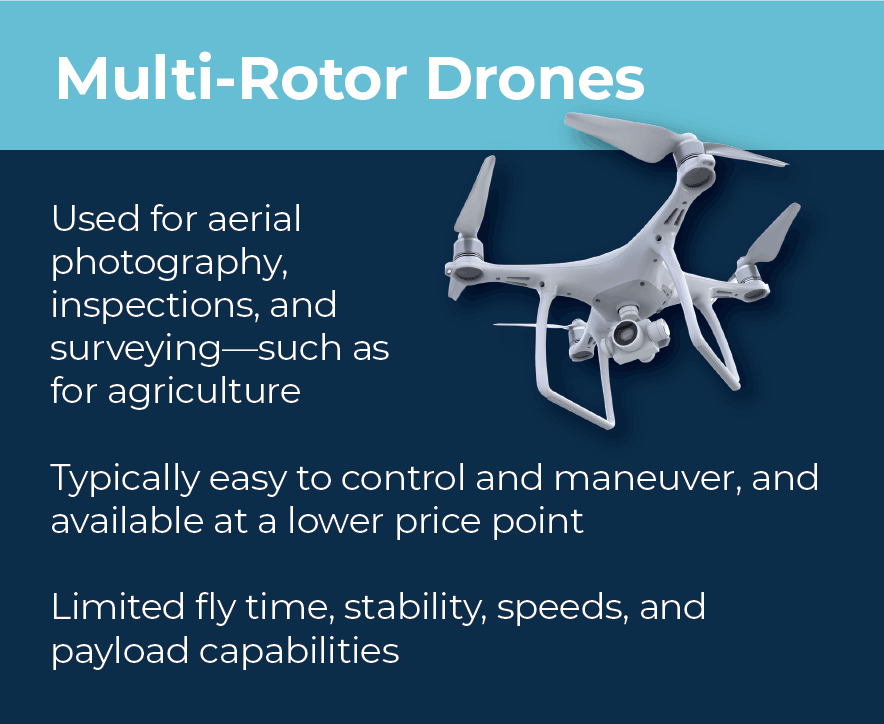
The future of UAS technology promises even greater integration into national airspace systems and expanded commercial applications. As regulatory frameworks continue to develop and autonomous capabilities advance, UAS will likely become standard tools across agriculture, emergency response, infrastructure management, and environmental monitoring. The convergence of improved battery technology, artificial intelligence, and sensor capabilities suggests that UAS will increasingly handle complex missions with minimal human intervention, fundamentally transforming how societies monitor environments, respond to emergencies, and manage critical infrastructure.
Conclusion
Unmanned Aerial Systems have evolved from specialized military tools into versatile platforms that address challenges across civilian, commercial, and scientific domains. As technology continues to advance and integration into national airspace systems progresses, UAS will undoubtedly play an increasingly central role in shaping how we approach safety, efficiency, and data collection across industries for decades to come.
Citations
[ds940d] 2025, Nov 23. Unmanned Aerial Systems (UAS) | SKYbrary Aviation Safety. Published: 2025-11-21 | Updated: 2025-11-23
[zv791m] 2025, Dec 01. UAS Uses and Benefits - North Dakota Department of Commerce. Published: 2004-02-01 | Updated: 2025-12-01
[t6ulev] 2025, Apr 06. UAS vs UAV: Exploring the World of Unmanned Aircraft Systems. Published: 2024-11-15 | Updated: 2025-04-06
[w8keem] 2025, Nov 25. [PDF] Unmanned Aerial Systems (UAS) - Federal Highway Administration. Updated: 2025-11-25
[oj8y7p] 2025, Dec 01. Unmanned aerial vehicle - Wikipedia. Published: 2002-06-22 | Updated: 2025-12-01
[6]: 2025, Jun 08. A Guide to Unmanned Aerial Systems (UAS) | DroneBox. Published: 2025-06-02 | Updated: 2025-06-08
[7]: 2025, Dec 02. Unmanned Aircraft Systems (UAS) - Federal Aviation Administration. Updated: 2025-12-02
[8]: 2025, Sep 15. Drones (UAS) - Washington State Department of Ecology - | WA.gov. Published: 2023-01-01 | Updated: 2025-09-15