


Strategic Alignment
Defining and Describing Strategic Alignment
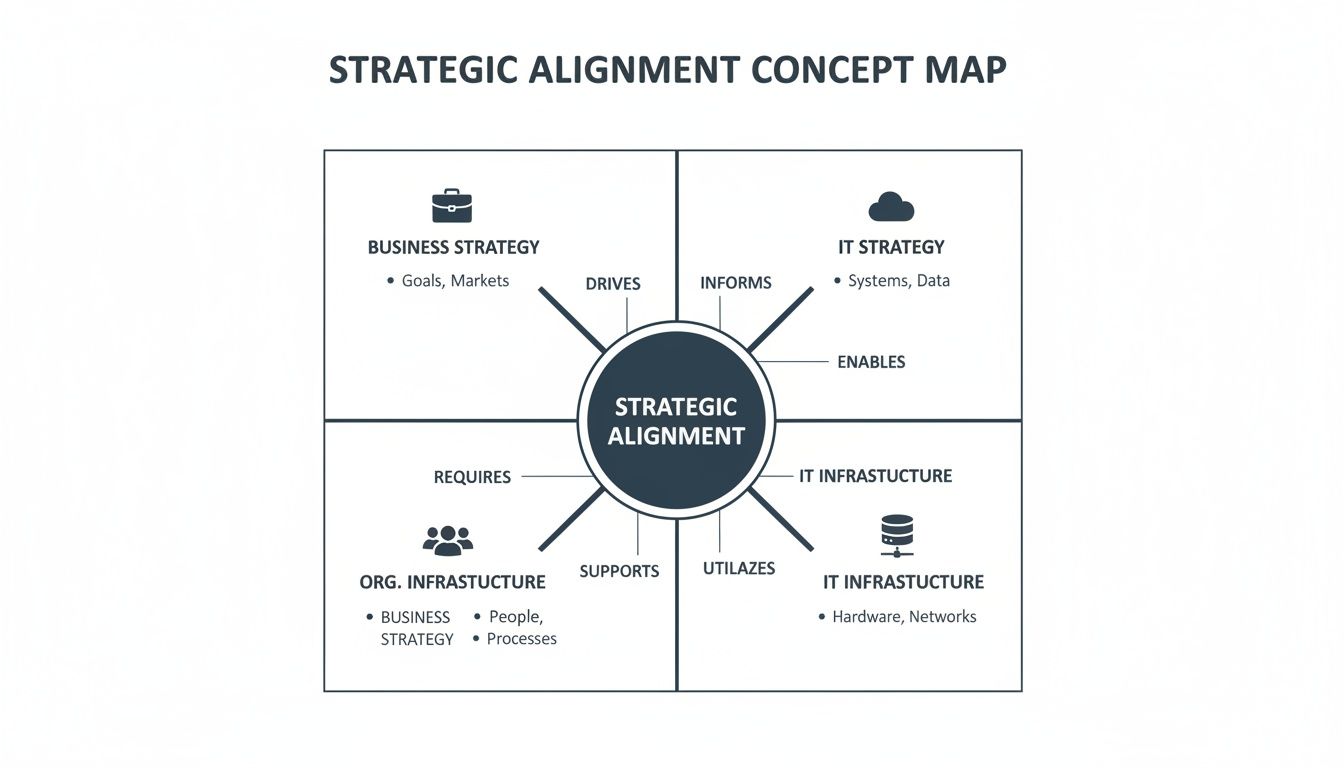
Uses in Context
- In IT and enterprise planning, strategic alignment means “synchronize IT investments with enterprise objectives” so technology spending supports business value. [6j5kuc]
- In project and organizational management, the term is used to say that “all organizational activities directly support overarching business goals and vision.” [1o54im]
- In business architecture, it describes the role of architecture in “ensuring that all business initiatives align with organizational goals.” [5p8p55]
- In strategy execution, it is paired with outcome-driven execution as a driver of enterprise performance in volatile conditions. [8m5o9a]
- In merger and acquisition planning, it can mean a “shared vision, compatible business strategies, aligned market positioning, and complementary strengths.” [x4j83p]
- In general business advisory writing, it is invoked when a company revisits structure so that its setup better fits its goals and constraints. [x3f9dw]
History of Use
Origins
Evolution
- 1990s–2000s: The concept broadened from general business planning into a formal business-and-IT alignment problem, with later frameworks emphasizing fit between business strategy, IT strategy, and infrastructure. [ae12sc]
Best Real-World Examples
- Monday.com — Monday — a project-management framing that defines business alignment as organizational activity directly supporting business goals. [1o54im]
- Orbus Software — a business-architecture explanation of how initiatives align with organizational goals. [5p8p55]
- Transworld Business Advisors — a merger-oriented example using strategic alignment to describe shared vision and compatible strategies. [x4j83p]
Case Studies
KPMG’s 2025 CIO guidance shows strategic alignment in an enterprise-technology setting.
[6j5kuc]
The guide explicitly recommends synchronizing IT investments with enterprise objectives, translating strategic goals into measurable tech outcomes, and using business-facing metrics so funding decisions reflect business impact rather than budget convenience.
[6j5kuc]
What changed here is the framing of IT from a support function into a value-driving part of strategy execution.
[6j5kuc]
This case shows that strategic alignment is not only about agreement in principle; it is about creating a decision system where technology choices are traceable to business outcomes.
[6j5kuc]
A merger-planning article from Transworld Business Advisors uses strategic alignment as part of leadership alignment before finalizing a deal.
[x4j83p]
In that context, the term includes shared vision, compatible business strategies, aligned market positioning, and complementary strengths.
[x4j83p]
This changes the meaning from internal coordination to inter-organizational fit, where two companies must evaluate whether their strategic logics can be reconciled before integration.
[x4j83p]
The case shows that strategic alignment can function as a due-diligence concept, not just an operational one.
[x4j83p]
Monday.com’s business-alignment explainer presents the concept as a practical coordination principle for day-to-day work.
[1o54im]
It states that strategic alignment ensures all organizational activities directly support overarching business goals and vision.
[1o54im]
In that framing, the concept is not abstract governance; it is a way to evaluate whether projects, processes, and priorities are connected to the strategy they are supposed to serve.
[1o54im]
This shows how the term has migrated into mainstream management language as a simple test of whether work is tied to purpose.
[1o54im]