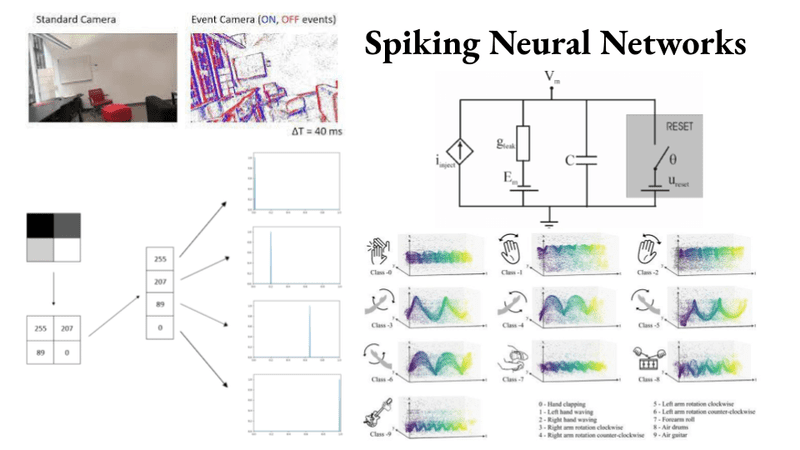
Spiking Neural Networks
Defining and Describing Spiking Neural Networks
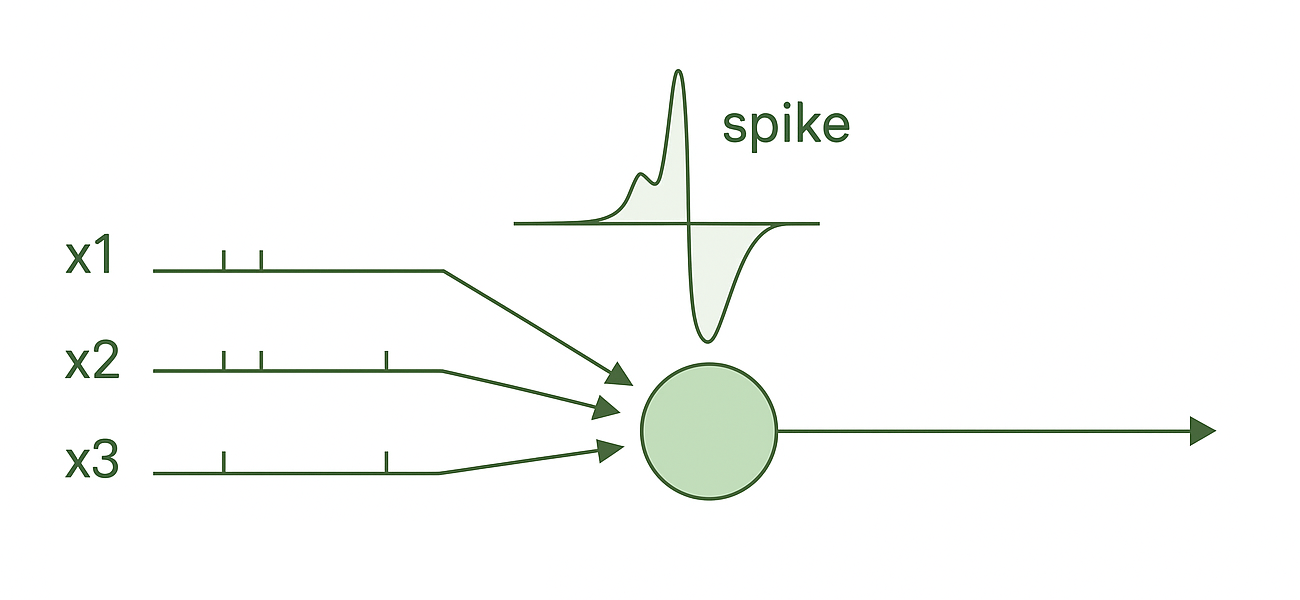
Spiking neural networks are neural nets that compute with time-stamped spikes, mimicking how real biological neurons fire rather than using continuous activations.
Spiking Neural Networks ( SNNs ) are brain-inspired neural networks that process information using discrete signals called spikes instead of continuous values like traditional neural networks .
[6rxmvi]
[h5yqgz]
In SNNs, each neuron integrates incoming spikes over time into a membrane potential and emits a spike when this potential crosses a threshold, after which it typically resets.
[6rxmvi]
[h5yqgz]
This event-driven, temporal behavior makes SNNs inherently more energy-efficient and temporally dynamic than conventional Artificial Neural Networks (ANNs), especially on neuromorphic hardware.
[6rxmvi]
[i98nnz]
They matter because they bridge computational neuroscience and machine learning, enabling models that are closer to biological neural computation and attractive for low-power, real-time applications such as edge AI, robotics, and neuromorphic vision.
[i98nnz]
[9pcp7h]
[85hfzq]
flowchart LR
A["Input spikes<br|>(event streams)"] --> B["Spiking neurons<br|>(e.g., LIF)"]
B --> C["Output spikes<br|>(temporal spike patterns)"]
subgraph Spiking_neuron_dynamics ["Spiking neuron dynamics"]
B1["Membrane potential<br|>integrates weighted spikes"] --> B2{"Threshold reached?"}
B2 -- No --> B1
B2 -- Yes --> B3["Emit spike<br|>reset potential"]
B3 --> B1
end
style B fill:#f8f8ff,stroke:#555
style B1 fill:#ffffff,stroke:#777,stroke-dasharray: 5 5
style B2 fill:#ffffff,stroke:#777
style B3 fill:#ffffff,stroke:#777
Key characteristics often cited include: use of spikes for communication between neurons , generation of spikes when membrane potential crosses a threshold , and higher energy efficiency than traditional neural networks .
[6rxmvi]
[h5yqgz]
[i98nnz]
Common neuron models include leaky integrate-and-fire (LIF) neurons, where the membrane potential “leaks” toward a baseline unless driven by spikes.
[6rxmvi]
[h5yqgz]
Learning in SNNs can use mechanisms such as spike-timing-dependent plasticity (STDP) , where synaptic weights are adjusted based on the precise timing difference between pre- and post-synaptic spikes, or surrogate gradient methods that make SNNs trainable with backpropagation-like algorithms.
[6rxmvi]
[i98nnz]
Uses in Context
- In Neuromorphic Computing , SNNs are described as “ the latest generation of neural computation, offering a brain-inspired alternative to conventional Artificial Neural Networks (ANNs) ,” particularly suited to energy-constrained and latency-sensitive applications. [i98nnz]
- In low-power AI discussions, SNNs are invoked as architectures that “ fire only when something meaningful happens, enabling AI that’s faster, more efficient, and inherently private ” on edge devices. [9pcp7h]
- In deep learning tutorials and educational material, SNNs are framed as networks that “ mimic the behavior of biological neurons ” and “ use spikes for communication between neurons ,” offering “more energy-efficient” computation for tasks like pattern recognition. [6rxmvi]
- In neuroscience modeling, SNNs are referred to as the “ go-to neural architecture for modelling and simulating actual brain circuits, given the relative closeness of spiking neurons to biological neurons .” [h5yqgz]
- In imaging and computer vision, SNNs are discussed as promising tools for “ enabling energy-efficient, event-driven computation in imaging ,” especially when paired with event-based sensors. [85hfzq]
- In optimization and training research, SNNs appear in contexts like “ activity pruning for efficient spiking neural networks ,” where researchers propose algorithms that reduce spiking activity while preserving accuracy. [01vdu0]
History of Use
Origins
- As a distinct term in neural computation, “spiking neural networks” emerged in the 1990s in the computational neuroscience community to distinguish these time- and spike-based models from earlier rate-based neural networks, reflecting an explicit focus on spike timing and event-driven dynamics. [h5yqgz] [i98nnz]
(Note: Most contemporary sources describe origins and positioning retrospectively; detailed historical credit typically points to early computational neuroscience work on integrate-and-fire neurons and spike-based coding, rather than to today’s large tech adopters.)
Evolution
- 1990s–2000s – From theory to detailed brain models: SNNs were primarily used to model real neural circuits, benefiting from increasing computational power and detailed neuron models, and they became “the go-to neural architecture for modelling and simulating actual brain circuits.” [h5yqgz]
- 2010s – Emergence of neuromorphic hardware and STDP learning: Dedicated neuromorphic platforms and renewed interest in spike-timing-dependent plasticity positioned SNNs as promising for low-power, event-driven computation, with STDP-based SNNs offering “the lowest spike counts and energy consumption… optimal for unsupervised and low-power tasks.” [i98nnz]
- Late 2010s–2020s – Surrogate gradients and ANN-to-SNN conversion: Researchers developed surrogate gradient techniques and ANN-to-SNN conversion methods that allow SNNs to “closely approximate ANN accuracy (within 1–2%)” while leveraging temporal dynamics and energy savings, pushing SNNs into mainstream machine learning benchmarks and edge AI applications. [i98nnz] [01vdu0]
- 2020s – Application to imaging and sensing: SNNs began to be systematically reviewed and applied to imaging, with surveys noting that they “hold significant promise for enabling energy-efficient, event-driven computation in imaging, but the field is still at an early stage.” [85hfzq]
Best Real-World Examples
- Loihi neuromorphic research using SNNs – A neuromorphic chip project that uses SNNs to demonstrate ultra–low-power, event-driven computation and real-time learning, showcasing SNN advantages on specialized hardware. [i98nnz] [9pcp7h] [85hfzq]
- Event-based vision SNNs for neuromorphic cameras – Research systems that pair SNNs with event-based image sensors to perform high-speed recognition and tracking with very low energy consumption. [i98nnz] [85hfzq]
- Surrogate-gradient-trained SNNs on benchmark datasets – Academic models that use surrogate gradient training to reach “within 1–2%” of ANN accuracy on tasks like image classification while exploiting temporal dynamics. [i98nnz]
- STDP-based unsupervised SNNs for pattern detection – Experimental networks using spike-timing-dependent plasticity, such as tutorials that detect specific spike patterns (e.g.,
[1, 0, 1, 0, 1]), illustrating unsupervised learning from spike timing. [6rxmvi] [i98nnz] - Energy-efficient SNNs with activity pruning (AT-LIF) – The “Activity Pruning for Efficient Spiking Neural Networks” work proposing the AT-LIF algorithm to “reduce spiking activity using [a] sparse regularizer” while maintaining performance. [01vdu0]
- Brain-circuit simulation SNN projects – Large-scale simulations that use SNNs as the main architecture to model biological brain circuits due to the close match between spiking neurons and real neuron behavior. [h5yqgz] [i98nnz]
- Edge sensing SNN demos for always-on devices – Edge AI prototypes where SNNs “fire only when something meaningful happens,” enabling ultra–low-power always-on sensing and classification directly on sensors without cloud connectivity. [9pcp7h]
Case Studies
Case Study 1: STDP-Based Pattern Detection with LIF Neurons
A widely cited educational example demonstrates how an SNN can learn to recognize a temporal spike pattern using leaky integrate-and-fire (LIF) neurons and spike-timing-dependent plasticity (STDP) .
[6rxmvi]
In this setup, developers define a
LIFNeuron class that models membrane potential integration and threshold-based spiking, and a Synapse class that carries weighted spikes between neurons.
[6rxmvi]
They initialize a small network with input, hidden, and output layers, specify a target spike train such as pattern = [1, 0, 1, 0, 1] , and then run a simulation over discrete time steps.
[6rxmvi]
During the simulation, neurons update their membrane potentials at each time step, generate spikes when thresholds are crossed, and apply an stdp function that adjusts synaptic weights based on the timing difference between pre- and post-synaptic spikes .
[6rxmvi]
Over time, the network becomes more responsive to the specified spike pattern, demonstrating how timing-based plasticity alone can enable unsupervised pattern learning in SNNs.
[6rxmvi]
[i98nnz]
This case illustrates the core conceptual difference from standard ANNs: learning and representation depend on when spikes occur, not just on average firing rates. Case Study 2: Efficient SNN Training via Activity Pruning (AT-LIF)
Recent research on activity pruning for efficient spiking neural networks proposes an algorithm called AT-LIF that directly targets one of SNNs’ practical challenges: balancing accuracy with low spike activity.
[01vdu0]
The work focuses on LIF-based SNNs and introduces a sparse regularizer that penalizes excessive spiking during training, effectively encouraging the network to use fewer spikes while retaining predictive performance.
[01vdu0]
According to the paper, the goal is “to improve efficiency of SNN learning while conserving effectiveness,” and the proposed method reduces spiking activity compared to baseline SNN training approaches.
[01vdu0]
Experiments show that AT-LIF-trained networks maintain competitive accuracy while generating fewer spikes, which translates into lower energy consumption on neuromorphic or event-driven hardware.
[i98nnz]
[01vdu0]
This case study highlights how SNN research is evolving from purely biological inspiration toward engineering optimizations that exploit spike sparsity for real-world efficiency gains, especially in edge and embedded systems where energy budgets are tight.
[i98nnz]
[01vdu0]
Case Study 3: SNNs for Energy-Efficient Imaging and Edge Sensing
A recent review of spiking neural networks in imaging analyzes how SNNs can be combined with imaging sensors to achieve event-driven, low-power computation.
[85hfzq]
The authors note that SNNs “hold significant promise for enabling energy-efficient, event-driven computation in imaging” but emphasize that the field is “still at an early stage.”
[85hfzq]
In many of the surveyed systems, event-based cameras produce asynchronous streams of pixel changes that are naturally represented as spikes, which SNNs can process directly for tasks such as object detection, motion estimation, and scene understanding.
[85hfzq]
Complementary to this, public-facing explainers describe SNN-powered edge devices where spiking neurons “fire only when something meaningful happens,” allowing always-on sensing with “ultra-low energy use, a smaller memory footprint for embedded devices, and dramatically lower system costs.”
[9pcp7h]
Together, these imaging and edge-sensing demonstrations show how SNNs can reduce redundant computation by ignoring silence or static regions , making them attractive for real-time, low-power perception in robotics, surveillance, and mobile devices.
[9pcp7h]
[85hfzq]