


Server-Side Rendering
Defining and Describing Server Side Rendering
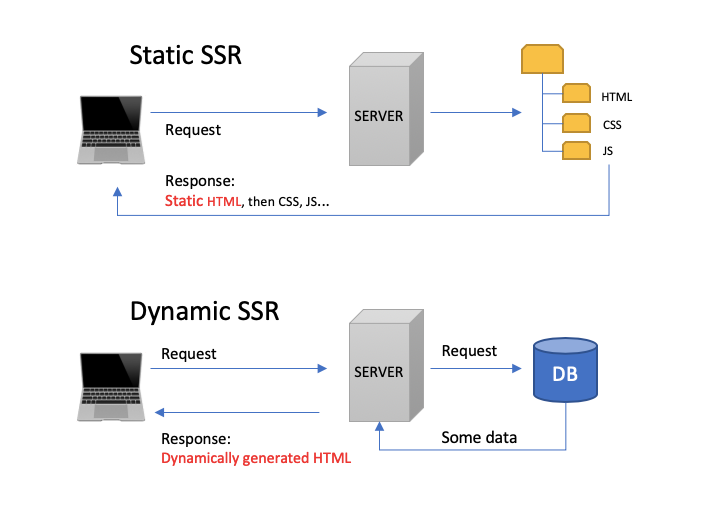
Server-side rendering (SSR) is a web application strategy where the server generates full HTML for each request so users — and search engines — see real content immediately, before client-side JavaScript takes over.
[017kb6]
[9x6h0l]
[v16q3s]
[k5wao7]
[il5rwd]
For innovation work, SSR applies whenever a product’s UI is delivered over the web and you care about first impression performance, SEO, and conversion — e.g., SaaS dashboards, consumer landing pages, marketplaces, and content-heavy applications.
[017kb6]
[9x6h0l]
[k5wao7]
[il5rwd]
It does not apply to native-only mobile apps or back-end APIs that don’t send HTML.
[ifsgl6]
[9x6h0l]
An innovation consultant cares because choosing SSR vs alternatives (client-side rendering, static generation, or hybrid approaches) materially affects acquisition (organic search), activation (perceived speed), infrastructure cost, and the technical complexity of the stack that founders must build and scale.
[9x6h0l]
[k5wao7]
[il5rwd]
Disambiguation
Primary sense — the innovation-consulting sense
Definition.In innovation contexts, server-side rendering is the practice of generating a page’s HTML on the server at request time and sending that fully rendered document to the browser, typically followed by client-side hydration for interactivity.
[017kb6]
[a2of6r]
[9x6h0l]
[m243uq]
[k5wao7]
- Request-time HTML generation, not an empty shell. SSR means “the server builds the full HTML for a page on each request and sends it ready-to-read, so users and crawlers get content without waiting for client-side JavaScript.” [017kb6] Unlike client-side rendering (CSR), the browser does not start with a near-empty shell and then “builds the page itself” via JavaScript. [017kb6] [a6ut3t] [7m3af9]
- Initial render on server, interactivity via hydration. Modern SSR architectures render UI into HTML on the server (often React/Vue/Svelte components), then “JavaScript ‘hydrates’ it to make it interactive.” [017kb6] [a2of6r] [m243uq] Architecturally, this is request-time rendering of UI into HTML on the server, followed by client-side hydration. [a2of6r] [m243uq]
- Focused on initial load performance and SEO. SSR is widely described as a technique “to improve initial load performance and search engine indexing,” shifting computation from the browser to the server while delivering full content in the initial response. [9x6h0l] [k5wao7] [il5rwd] [fc47nr] Search engines can crawl headings, links, and metadata “in the initial HTML response” without waiting on JavaScript. [il5rwd] [fc47nr]
- Not static site generation, not pure CSR. SSR is distinct from static site generation (SSG), which prebuilds HTML at build time instead of generating it per request, and from CSR where “the client…uses JavaScript to generate HTML content.” [a6ut3t] [7m3af9] SSR is “dynamic rendering” — HTML generated “on each request,” especially in frameworks like Next.js. [a2of6r] [a6ut3t]
Other senses
1. SSR as a performance/SEO tactic in frontend optimization
Definition.In frontend performance and SEO circles, SSR is a tactic within a broader optimization toolkit, chosen specifically to make content “available right away” to users and search engines.
[k5wao7]
[il5rwd]
[fc47nr]
- Performance-focused guidance frames SSR as a way to “deliver fully-rendered content to the browser, improving initial load performance…while maintaining the interactivity of a React application.” [k5wao7] From an innovation lens, this sense treats SSR as a lever in conversion rate optimization and growth engineering, not just an architectural choice. [k5wao7]
- SEO-oriented material describes “Server Side Rendering (SSR) in React for SEO” as generating HTML on the server so “search engines can then crawl and index the page without waiting on client-side JavaScript.” [fc47nr] This aligns with startup concerns about organic growth, especially on content and marketplace products. [il5rwd] [fc47nr]
Etymology and Origin
Server-side rendering is largely a descriptive technical phrase rather than a coined brand term; it combines “server-side” (work done on the server, not the client) with “rendering” (turning application state into HTML or UI).
[7m3af9]
Early web platforms inherently rendered HTML on the server (classic multi-page apps) before modern JavaScript frameworks popularized CSR and thus made SSR a distinct label again.
[a6ut3t]
[7m3af9]
- Contemporary definitions stress that SSR is the pattern of “producing the initial application response on the server so the browser receives ready-to-display HTML rather than assembling the first view entirely on the client,” reflecting its re-emergence as a named strategy in the single-page application era. [ifsgl6] [9x6h0l] [a6ut3t] [7m3af9]
Given this, SSR is best treated as a re-labeled and refined version of traditional server-generated HTML, reintroduced into innovation and startup vocabulary as JavaScript-heavy SPAs made client-side rendering the default baseline, and as founders, product teams, and SEO practitioners needed terminology to compare architectural options.
[a6ut3t]
[7m3af9]
[il5rwd]
[fc47nr]
Adjacent Vocabulary
- Synonyms
- Antonyms
- Static site generation (SSG) – HTML is prebuilt at build time and served as-is, rather than being rendered per request on the server. [a6ut3t]
- Adjacent terms
- Client Side Rendering – The alternative rendering strategy where the browser’s JavaScript builds the UI. [017kb6] [a6ut3t] [7m3af9]
- Static Site Generation – Build-time rendering; important in tradeoffs with SSR for startups. [a6ut3t]
- Frontend Architecture – The broader design space in which SSR is one strategy among several. [a2of6r] [k5wao7]
- Web Performance Optimization – The field that uses SSR as a tool to improve speed and UX. [k5wao7] [il5rwd] [fc47nr]
- Technical SEO – Practice area where SSR is often recommended to ensure crawlable content. [il5rwd] [fc47nr]
Usage in Practice
- A clear studio-style glossary aimed at product teams notes: “Server-side rendering (SSR) is when a web server builds the full HTML for a page on each request and sends it ready-to-read, so users and crawlers get content without waiting for client-side JavaScript.” [017kb6] This usage highlights SSR as a product-level concern (users and crawlers), not just a developer detail. [017kb6]
- An architect-oriented guide explains: “Server side rendering (SSR) generates HTML on the server and sends it as the initial response, so the browser can paint real content before the client bundle finishes booting…Architecturally, server side rendering is request-time rendering of UI into HTML on the server, followed by client-side hydration.” [a2of6r] This shows SSR doing work in decisions about system design and user experience. [a2of6r]
- A modern web development article aimed at practitioners says: “Server-Side Rendering (SSR) is a powerful technique in modern web development that improves SEO, performance, and user experience by rendering content on the server before sending it to the browser.” [il5rwd] This frames SSR explicitly as a lever for business outcomes (SEO, UX) rather than only as a coding pattern. [il5rwd]
- An SEO-focused React guide states: “Server Side Rendering (SSR) in React for SEO means generating a page's HTML on the server first…Search engines can then crawl and index the page without waiting on client-side JavaScript.” [fc47nr] Here, SSR is deployed as a response to growth and discovery concerns. [fc47nr]
- A content-infrastructure glossary aimed at headless CMS users describes SSR as “a rendering strategy where the server executes application code to generate a complete HTML document in response to each user request…to improve initial load performance and search engine indexing.” [9x6h0l] This demonstrates SSR appearing in decisions about how startups integrate content infrastructure with their frontend stack. [9x6h0l]
- A frontend accelerator resource positions SSR in the context of SPA tradeoffs: “Server-Side Rendering (SSR) generates HTML for each page on the server at request time. This approach delivers fully-rendered content to the browser, improving initial load performance and SEO while maintaining the interactivity of a React application.” [k5wao7] This reflects real-world product and architecture choices for React-based startups. [k5wao7]
Common Misuses
- Equating SSR with “any page that feels fast.” Teams sometimes call any fast page “server-side rendered,” even when they rely on heavy client-side rendering with optimized bundling. A more accurate term here is client-side rendering with performance optimization, since the browser is still building most of the DOM. [017kb6] [k5wao7] [a6ut3t]
- Using SSR to describe static sites. Founders or marketers may label statically generated sites as “SSR” because HTML comes from the server. The precise term should be static site generation (SSG) or pre-rendering, which renders HTML at build time, not at request time. [a2of6r] [9x6h0l] [m243uq] [a6ut3t]
- Treating SSR as a pure SEO “toggle” independent of architecture. Some marketing narratives imply you can “turn on SSR” without impacting stack complexity or deployment. In reality, this is a frontend architecture and infrastructure decision, and for “just SEO” concerns, more targeted dynamic rendering or partial SSR might be more appropriate. [a2of6r] [k5wao7] [il5rwd] [fc47nr]
- Calling any server-side logic “SSR.” Back-end teams may refer to server-side business logic (APIs, JSON responses) as “server-side rendering.” The correct terminology here is server-side processing or API responses, since SSR specifically involves producing ready-to-display HTML for the browser. [ifsgl6] [9x6h0l] [7m3af9]