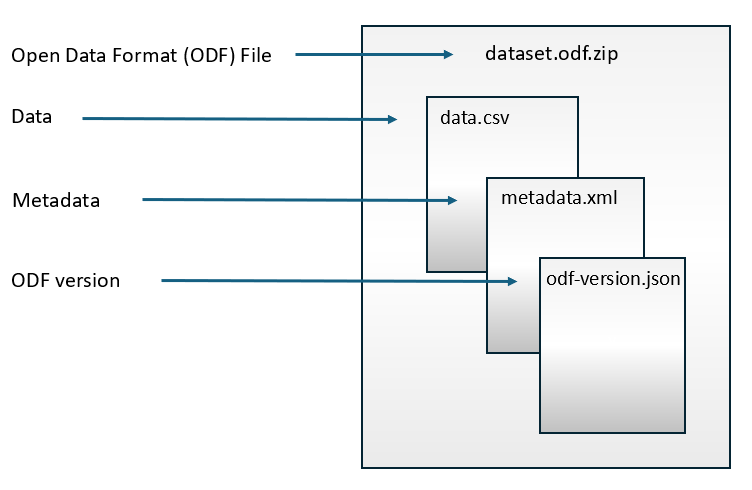
Open Data Formats
Defining and Describing Open Data Formats
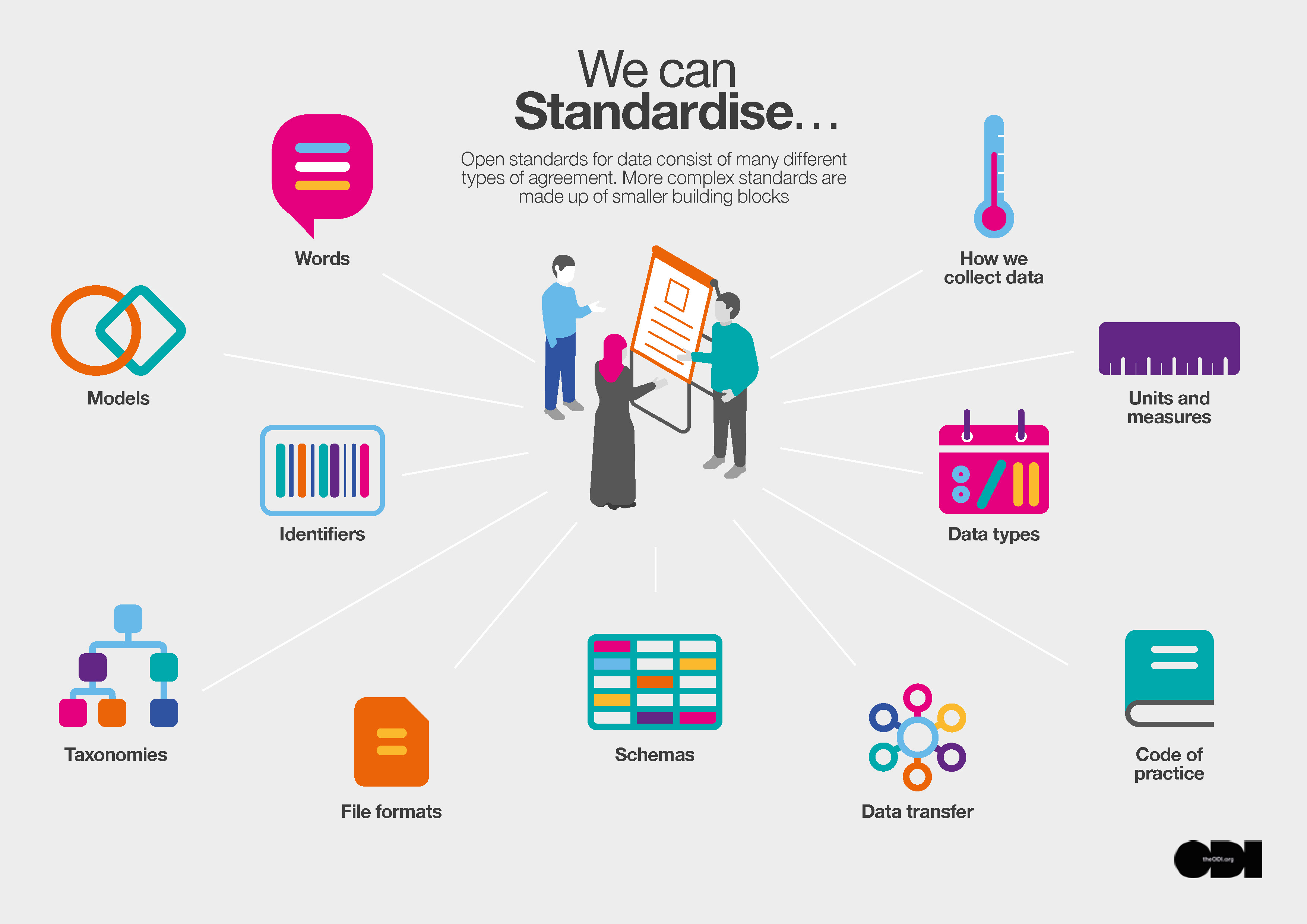
Open data formats are data and file formats whose specifications are openly published and freely implementable, allowing any tool or vendor to read and write the data without restriction, which makes them a strategic lever against lock‑in in modern data products and platforms.
[v8anfy]
[uxll43]
[il49kj]
In practice, the term applies when the structure of the data (file format or table metadata format) is defined by an open, documented standard—CSV, JSON, Apache Parquet, Apache Arrow, Apache Iceberg, Delta Lake, etc.—rather than by a proprietary, undocumented or patent‑encumbered spec.
[v8anfy]
[uxll43]
[zecj2u]
It does not require the data itself to be “open data” in the public‑licensing sense; teams routinely use open data formats for highly confidential or regulated datasets.
[uxll43]
[il49kj]
Innovation consultants care because choosing open data formats early shapes future interoperability, portability, analytics velocity, and negotiation power with vendors—directly influencing architecture, switching costs, and valuation narratives around “no lock‑in” and “composable” data stacks.
[v8anfy]
[uxll43]
[jsp0r8]
Conversely, over‑reliance on proprietary formats can make re‑platforming or adopting new AI/ML tooling expensive and slow.
[v8anfy]
[uxll43]
Disambiguation
Primary sense — the innovation-consulting sense
Open data formats (primary sense): an organization’s deliberate use of open file and table formats—with publicly available specifications and multi‑vendor support—as the backbone of its data storage, analytics, and AI stack to maximize interoperability and minimize vendor lock‑in.
[v8anfy]
[uxll43]
[il49kj]
[zecj2u]
- Scope and common usage
- In capital‑markets engineering, open data formats are highlighted for interoperability, avoiding vendor lock‑in, and allowing analytics teams “to use a wider range of tools on the same data,” which is exactly the value proposition many modern data startups and platforms sell. [v8anfy]
- What this sense is NOT
- It is not “multi‑cloud” by itself; multi‑cloud or hybrid portability depends on both open data formats and how tightly other layers (query engine, orchestration, UIs) are coupled to a specific vendor. A startup can be “multi‑cloud” but still locked into a proprietary database format, or conversely run an open‑format lakehouse on a single cloud and still retain strong exit options. [v8anfy] [56qea9] [zecj2u]
Other senses
1. Open file formats in digital preservation / libraries
Definition: Use of open, non‑proprietary file formats (e.g., TXT, PDF/A, TIFF, CSV, XML, JSON) to ensure long‑term preservation and accessibility of digital assets in archives and research libraries.
[np53i9]
[uxll43]
[3rzzif]
- Also used in linked open data / semantic web to describe datasets exposed using open formats and vocabularies; relevant mainly for open‑data and government‑data innovations, not for generic startup tooling. [3rzzif]
Etymology and Origin
- The phrase “open file format” appears in technical and preservation communities early in the 2000s, distinguishing documented, non‑proprietary formats from vendor‑controlled ones; library and research‑data glossaries now define open file formats as those “published and freely available for anyone to use.” [uxll43] [il49kj]
- The modern data‑platform notion of open table formats emerged from the big‑data / data‑lake ecosystem in the late 2010s, as engines like Apache Hive demonstrated an open metadata abstraction over file formats, followed by Apache Iceberg, Delta Lake, and Apache Hudi as widely used open table formats for lakehouse architectures. [zecj2u] [8fo4jj]
- The explicit framing of “open data formats” as a strategy to avoid vendor lock‑in and enable multi‑engine analytics is articulated in industry blogs from data‑engineering practitioners, especially in capital markets and lakehouse contexts, where teams highlight that open formats allow different tools and teams (e.g., quant research, surveillance, regulators) to work directly on the same data. [v8anfy] [zecj2u] [8fo4jj]
Adjacent Vocabulary
- Synonyms
- Antonyms
- Vendor‑specific data formats – Engine‑ or SaaS‑specific internal representations that are not documented for third‑party implementation and thus tie users to that vendor.
- Adjacent terms
- Data interoperability – Open data formats are a primary mechanism to achieve it across tools and vendors. [v8anfy] [uxll43] [zecj2u]
- Vendor lock in – Open data formats are a standard mitigation strategy in architecture and procurement decisions. [v8anfy] [uxll43] [jsp0r8]
- Data Lakes – Modern lakehouses rely heavily on open file and table formats atop object storage. [zecj2u] [8fo4jj]
- Schema evolution – A capability often enabled at scale by open table formats on top of open file formats. [zecj2u] [8fo4jj]
- ACID transactions – Brought to data lakes via open table formats like Iceberg and Delta Lake. [zecj2u] [8fo4jj]
- Digital preservation – Institutional use case where open file formats matter for multi‑decade accessibility. [uxll43] [3rzzif] [jsp0r8]
Usage in Practice
- Data‑engineering practitioners in capital markets write: “Open data formats enable interoperability, avoid vendor lock‑in, and allow analytics teams across an organisation to use a wider range of tools on the same data,” summarizing the core business argument for startups building data platforms. [v8anfy]
- The same source notes that by building an analytics system “underpinned by open data,” multiple teams can use the same datasets for their own purposes (e.g., trade surveillance and quant research) and even give regulators direct access to files, instead of bespoke exports. [v8anfy]
- The U.S. National Library of Medicine’s data glossary states: “Open File Formats are file formats that are published and freely available for anyone to use… contrasted with proprietary, protected file formats,” a framing often reused by research‑data teams evaluating tools and institutional platforms. [il49kj]
- A research‑data management guide emphasizes: “We strongly recommend using non‑proprietary (open) file formats because it’s important for preserving readability and long-term access for you and anyone else,” which innovation consultants translate into requirements when advising on archival features or compliance. [uxll43]
- In a technical overview, MinIO describes an open table format as “a standardized metadata layer that sits on top of data files in object storage… that transforms a collection of Parquet or ORC files into something you can query and manage like a database table,” highlighting the role of open formats in composable lakehouse architectures. [zecj2u]
- A lakehouse talk explains that a table format is “an open metadata layer over the file format,” providing schema, partitioning, snapshots, and version semantics and enabling engines like Spark, Trino, and Hive to interoperate on the same tables via compatible reader/writer APIs. [8fo4jj]
Common Misuses
- Confusing “open data formats” with “open data” (licensing / public access)
- Misuse: Treating any dataset stored in an open format as automatically shareable or license‑free.
- Equating “runs on Parquet” with “no vendor lock‑in”
- Misuse: Assuming that because a vendor stores data in Parquet or ORC, the system is fully portable; proprietary metadata layers, query semantics, or governance models can still create lock‑in.
- Using “open data format” as pure marketing gloss for partially documented or patent‑encumbered formats
- Misuse: Vendors describing their internal schema or binary blobs as “open formats” while not publishing full specifications or allowing independent implementations.
- Assuming any text‑based format is “open”
- Misuse: Labeling human‑readable text exports as open data formats even when the surrounding schema, code lists, or dependencies are vendor‑specific and undocumented.