


Observability
Defining and Describing Observability (in cloud applications)
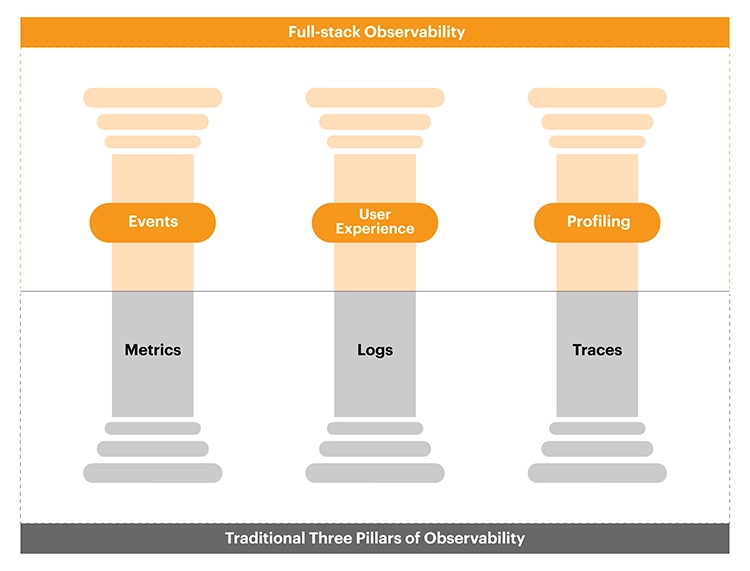
Observability in cloud applications is the engineered ability to understand a system’s internal state from its external outputs (telemetry) so that teams can answer new, unanticipated questions about production behavior without shipping new code.
[t5x4ex]
[mplmp7]
[dh4rog]
[u59hjs]
In practice, this applies to modern, distributed, cloud-native systems where complexity and change make traditional, dashboard-centric monitoring insufficient.
[4k2h5n]
[9oyc37]
Observability matters when founders and product teams need to debug issues, manage reliability, and make architecture and roadmap decisions under uncertainty, especially in microservices and event-driven designs.
[jo4mw7]
[4k2h5n]
[9oyc37]
It does not primarily apply to simple, single-node apps where a few health checks and logs suffice; in those cases “monitoring” alone may be adequate.
[jo4mw7]
[537sso]
Innovation consultants care because observability directly affects iteration speed, incident cost, and strategic choices about stack, tooling, and organizational design—core levers in startup competitiveness.
[4k2h5n]
[9oyc37]
Disambiguation
Primary sense — the innovation-consulting sense
Observability (cloud/software): the property and practice of designing telemetry (logs, metrics, traces, and related signals) so that engineers can infer a system’s internal state and answer arbitrary questions about its behavior from the outside.
[t5x4ex]
[mplmp7]
[kz3nss]
[4k2h5n]
[dh4rog]
[3b6ncg]
[u59hjs]
- It is implemented through telemetry signals—typically logs (discrete events), metrics (numeric measurements over time), and traces (request journeys across services)—plus the tooling and practices to collect, correlate, and analyze them at scale. [jo4mw7] [kz3nss] [4k2h5n] [g8g8p4] [dh4rog] [cecow6] [3b6ncg]
Other senses
1. Observability in control theory
Observability (control theory): a mathematical property of dynamical systems indicating whether internal state variables can be inferred from external outputs over time.
[gpg7fh]
- The modern software usage explicitly borrows the term from control theory, where observability was introduced by Rudolf E. Kálmán in his work “On the General Theory of Control Systems” around 1960. [gpg7fh]
- Control-theoretic observability underpins reasoning about whether a controller can reliably estimate and manage system state from available measurements, which conceptually parallels cloud observability’s concern with inferring internal conditions from telemetry. [gpg7fh]
- While the formal math (state-space models, observability matrices) is rarely used directly in startup observability practice, recognizing this origin helps distinguish rigorous state inference from ad hoc logging. [gpg7fh]
- Also used in fields like network operations, AI systems, and industrial control to mean the ability to understand complex system behavior from outputs; these domain-specific usages are conceptually related but usually not central in innovation consulting for cloud application startups. [g8g8p4] [g7jn9b]
Etymology and Origin
- In formal engineering, “observability” originates in control theory, where Kálmán introduced observability and controllability as core concepts in his work on general control systems around 1960. [gpg7fh]
- Contemporary software observability explicitly acknowledges control theory as the source; practitioners associated with modern observability tooling have stated that they “borrowed” the word from control theory to describe the ability to reason about complex systems from telemetry. [gpg7fh]
- The term migrated into DevOps and Cloud-Native vocabulary as Distributed Systems, Microservices, and SRE practices exposed the limits of simple monitoring and pushed teams toward richer, question-driven telemetry, leading to widespread usage across blogs, guides, and tooling ecosystems focused on metrics, logs, and traces. [t5x4ex] [mplmp7] [jo4mw7] [kz3nss] [4k2h5n] [537sso] [9oyc37] [g8g8p4] [dh4rog] [3b6ncg] [u59hjs]
Adjacent Vocabulary
- Synonyms
- Observability engineering: refers to the specialized discipline of designing, building, and operating observability tooling and telemetry pipelines; essentially the practice layer around the core property of observability. [g8g8p4]
- Antonyms
- Adjacent terms
- Site Reliability Engineering — SRE teams rely heavily on observability to meet error budgets and investigate incidents. [4k2h5n] [9oyc37] [g8g8p4]
- Cloud Infrastructure — managed services, autoscaling, and multi-region deployments increase the need for robust observability. [4k2h5n] [9oyc37] [g8g8p4]
- Monitoring — a related but narrower practice focused on known metrics and alerting. [jo4mw7] [537sso] [9oyc37]
- OpenTelemetry — an ecosystem standard that defines and transports observability signals (logs, metrics, traces, and more). [jo4mw7] [5q44wu] [dh4rog] [3b6ncg]
Usage in Practice
- “Observability is the property of a system that lets you understand its internal state from the outside, using only the telemetry it emits,” followed by the practical test that a system is observable if you can answer a brand‑new question about its behavior without shipping new code to instrument it. [t5x4ex]
- Architecture notes explain that observability is “a set of tools and practices used to have information about what is really going on in the system, from different standpoints: resource usage, errors, components interaction, and logs,” anchored in metrics, logs, and traces as core signals. [jo4mw7]
- A comprehensive guide states that “Observability is the practice of instrumenting software and infrastructure so engineers can understand internal state from external outputs like logs, metrics, and traces,” emphasizing engineered capability rather than incidental logging. [537sso]
- System design advice describes observability as “a critical aspect of modern system design, especially in distributed environments,” defined as how well you can understand the internal states of a system by examining its external outputs. [4k2h5n]
- Observability architecture documentation highlights that an effective observability setup “gives engineering teams the ability to ask arbitrary questions about system behavior — without deploying new code to answer them,” tying observability directly to investigative flexibility. [9oyc37]
- Guides on modern Web Development note that observability “lets you figure out why — by collecting enough structured data (logs, metrics, traces) that you can ask new questions you didn’t anticipate when you wrote the code,” relating it to product iteration and debugging in evolving applications. [3b6ncg]
Common Misuses
- Marketing APM or point tools as “observability” when they only support a fixed set of pre-modeled views and alerts; in such cases application performance monitoring (APM) or diagnostics are more accurate, since the defining ability to ask arbitrary new questions is missing. [t5x4ex] [mplmp7] [9oyc37] [dh4rog]
- Treating “observability” purely as a tool purchase (e.g., “we bought observability”) rather than an engineered property and practice involving instrumentation, telemetry design, and analytic workflows; tooling or monitoring stack is the better descriptor for the narrow act of acquiring software. [jo4mw7] [537sso] [9oyc37] [g8g8p4] [3b6ncg]