


Mutually Exclusive & Collectively Exhaustive
Defining and Describing Mutually Exclusive & Collectively Exhaustive
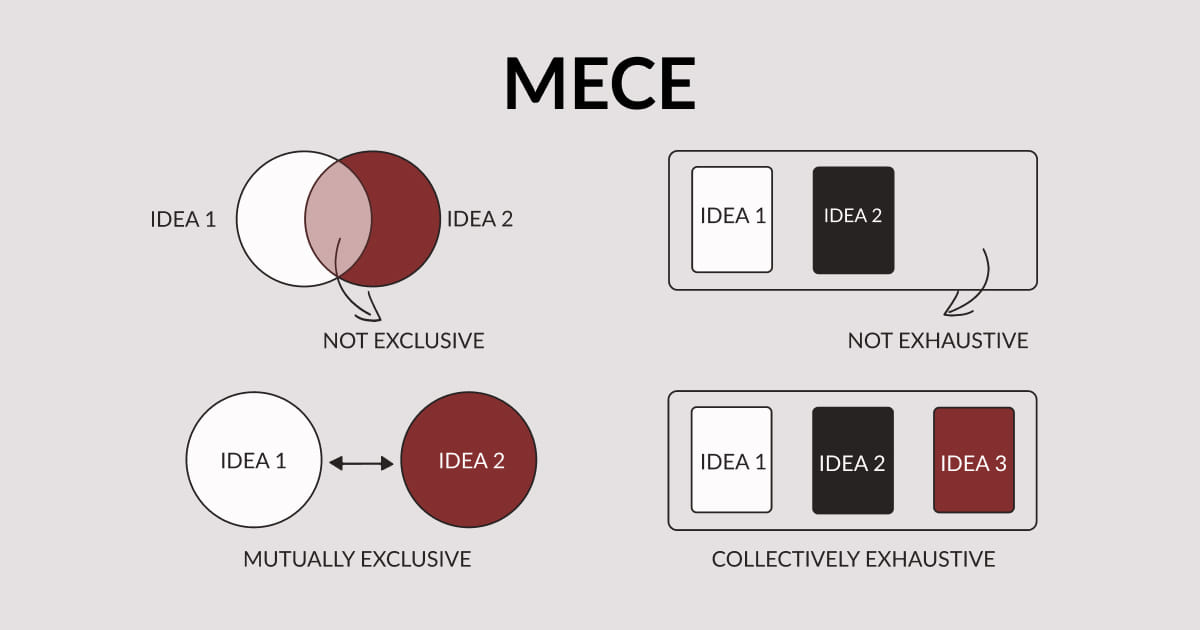
MECE is the discipline of making categories that do not overlap and leave nothing important out.
[91z4dw]
[is85xp]
[43xmep]
Mutually exclusive and collectively exhaustive, usually abbreviated MECE, is a grouping principle used to structure information into categories that are both non-overlapping and complete.
[91z4dw]
[is85xp]
[uo364n]
In business analysis and problem solving, it helps teams avoid double counting, missed issues, and ambiguous ownership by forcing a clean partition of the problem space.
[91z4dw]
[43xmep]
[wzfty7]
In probability, the same idea appears as events that cannot happen simultaneously and together cover all possible outcomes.
[pia06e]
[xs7ep7]
[gxwzs2]
Uses in Context
- Consulting firms use MECE to break complex problems into buckets that “cover everything but never overlaps.” [91z4dw]
- Strategy writers describe MECE as a way to make a set of options “Mutually Exclusive” with “no overlap” and “Collectively Exhaustive” so “nothing is missing.” [is85xp]
- Umbrex frames it as a way to structure information so “categories do not overlap” and “nothing important is left out.” [43xmep]
History of Use
Origins
MECE is a management-consulting term that became widely associated with McKinsey-style problem solving, where it is presented as a core principle for structuring analyses into non-overlapping and complete parts.
[91z4dw]
[uo364n]
The phrase itself is built from two older logical/probabilistic ideas: mutually exclusive events and collectively exhaustive sets, both of which long predate consulting usage in probability theory and mathematics.
[pia06e]
[xs7ep7]
[gxwzs2]
Contemporary explainers consistently define it as “Mutually Exclusive, Collectively Exhaustive,” indicating that the consulting usage is a named packaging of earlier formal concepts rather than a newly invented mathematical theorem.
[91z4dw]
[is85xp]
[uo364n]
Evolution
Best Real-World Examples
- McKinsey & Company — popularized MECE-style issue structuring in consulting practice and case interviews. [91z4dw] [uo364n]
- Khan Academy — teaches mutually exclusive and exhaustive events in probability through worked examples. [gxwzs2]
Case Studies
A classic consulting use case is diagnosing a profit decline by splitting the problem into Revenue and Cost drivers, a structure Umbrex explicitly gives as an example of MECE thinking.
[43xmep]
The point is not that those are the only possible branches, but that they are a clean first split that avoids overlap while covering the whole profit equation.
[43xmep]
In practice, this kind of tree helps teams assign work, prevent double counting, and see whether the problem has been decomposed completely enough to analyze.
[91z4dw]
[43xmep]
[wzfty7]
In case-interview preparation, MECE is used to keep candidates from listing ad hoc ideas and instead force a disciplined issue tree.
[91z4dw]
[is85xp]
[wzfty7]
PrepLounge and The Strategic Frame both frame the idea as a way to ensure that categories “cover all the probability space” or that “nothing is missing,” which in interview settings translates into a structured, exhaustive answer rather than a scattered brainstorm.
[pia06e]
[is85xp]
That usage shows how MECE became a general cognitive tool, not just a consulting buzzword.
[91z4dw]
[is85xp]
[wzfty7]
In probability education, MECE appears as the combination of two formal properties: events that do not overlap and sets that together span the full sample space.
[pia06e]
[xs7ep7]
[gxwzs2]
GeeksforGeeks states that collectively exhaustive events “cover all possible outcomes” and that “one of the events must occur,” while Khan Academy teaches the same idea through worked examples with dice and event sets.
[xs7ep7]
[gxwzs2]
This shows the concept’s deeper mathematical base and explains why the consulting version works so well: it borrows a precise logic of partition and completeness.
[pia06e]
[xs7ep7]
[uo364n]